
Two events concerning Roberto Cortázar caught the public's attention: the presentation of his book 344 Figuras y una en un espacio (344 Figures and One in Space) at the Museo de Arte Moderno in Mexico City, and the opening of his show at Galería Praxis. The book, which includes a text by Edward M. Gómez, was co-edited by Galería Praxis Arte Internacional and Américo Artes; this latter one is perhaps the most important publisher of art books in Mexico and one that has won a very relevant space in the visual memory of fine arts of the country.
Roberto Cortázar's work can clearly be debated between the perfection of the figure and the accidental support containing it. Always keeping in mind where he sets the orthodox elements of his work, Cortázar has decided to place his models in almost scene-like actions. The bodies, put to order with feigned naturalness, always appeal to the most classic attitudes of ancient painting, which he greatly admires.
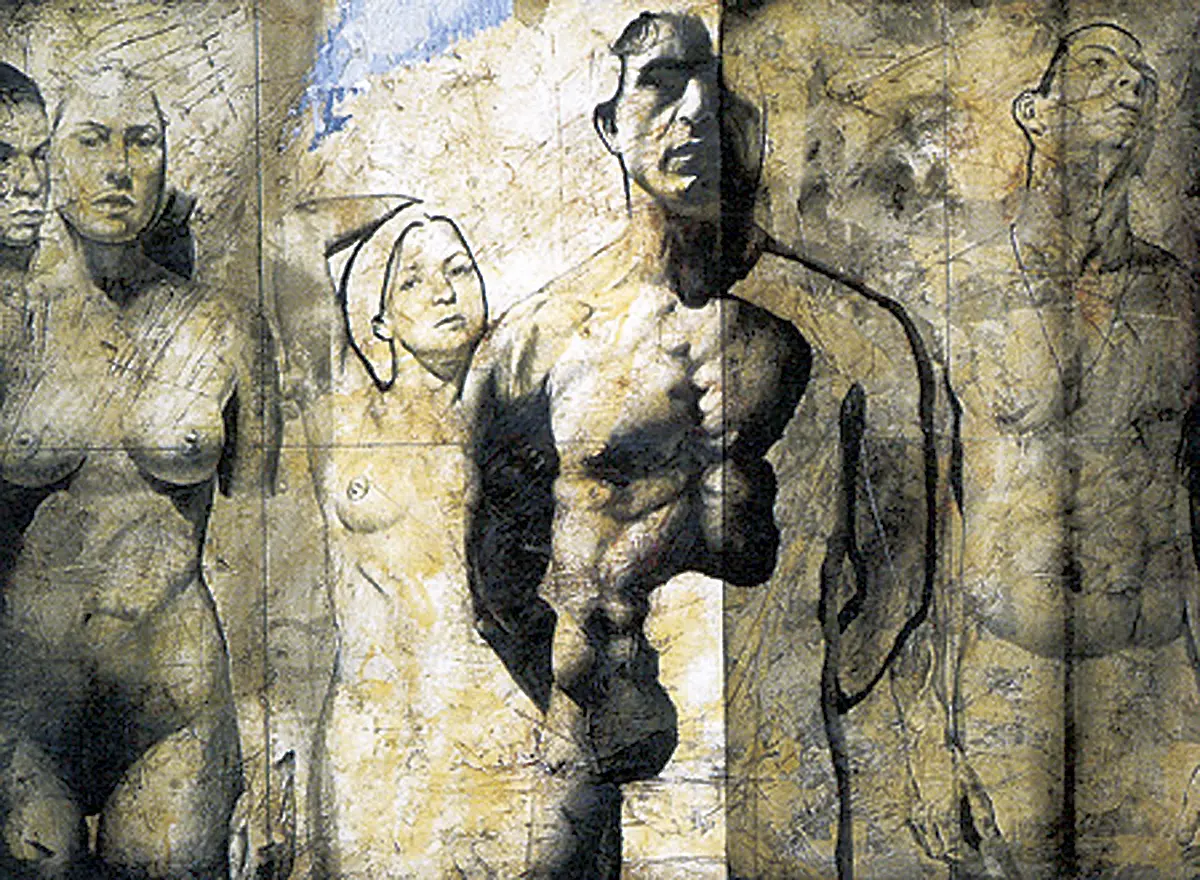
The contrast between the cleanliness of the figures and the purposely accidental nature of the wood on which they have been painted is one the most attractive elements of the show at Galería Matrix. On broken planks, with splinters sticking out on the sides, and wood fragments added to the frames, these bodies and faces whom nature has gifted with elegance are interrupted on the surface by controlled accidents that range from broad scratches to smears with ink and varnish.
There are no men with bulging bellies, nor women with flaccid breasts. All the bodies are harmonious and adhere to the most strict cannons of Western beauty. One of the most common characteristics of Cortázar's work is the youth or early maturity of those who inhabit his paintings. The exceptions are Tres figuras en una habitación (Opus 102) (Three Figures in a Room [Opus 102]) and Dos figuras en una habitación (Opus 100) (Two Figures in a Room [Opus 100]), both reproduced in the book, where we deduce are older women "because of their constitution, since their bodies cannot be seen. The rest of them are near youthful or of an indefinite age.
It is curious to note that most figures are depicted in rooms. Confinement, privacy, intimacy, cloistered sectors with stagnant air, and ochre light, always artificial, are fundamental elements in Cortázar's works. In an extra-limited celebration of that confinement, he has gone to the extreme of making his figures walk in circles, partly to academically represent movement, but also, considering the rest of his work, to signal that those who participate in his pieces are inevitably participating in a close space that the painter has delineated for them.
In the Obscene Scene series, one usually finds couples in action, but in others, such as in Opus 8, he shows a woman carrying a child. Does the obscenity of this scene lie in the ornaments of her low neckline? What is she holding in her hand? What does she see that we do not? The majority of the pieces of this repertoire show us faces coming close to each other, displaying some of the well-known codes of sensuality and seduction. But there are other pieces that, though they do not follow the codes of intemperance common in Cortázar, do transmit, with no doubt, moments of corporal interaction that indeed preclude an eroticism of greater intensity.
The need to annul the factor dominant-dominated of the sexual relation results in a fusion of gender identity, in faces that could be either female or male. Who is who in his works? Who does what? Sometimes one can even recognize him, his partner, or his mother-in-law (the well-known Martha Chapa, author of splendid cookbooks); but the models are not just that. His characters are somehow related to his life; and in his personal codes, every one of them plays a specific role in accordance with a real meaning with respect to the artist. Moreover, the characters that make part of the scene are in connivance with one another.
The wood used, like in Dos figuras habitan (Two Figures Inhabit), is rustic on purpose. Broken wood, separated parts, dismembered figures brought together by the emptiness of the support containing them. These pieces have been elaborated with sawdust (or shavings) of the wood that's been cut and then dusted. The rigid varnish applied to it makes it look clearly and convincingly integrated in the composition.
Robert M. Gómez's text titled Roberto Cortázar: Explorador de la conciencia humana, pintor del alma (Roberto Cortázar: Explorer of the Human Conscience, Painter of the Soul) clarifies this painter's singular way of "balancing out" his works: "There are occasions when he throws unfinished paintings out of the window of his 7th-floor studio, then he fetches them back and incorporates the surface stains and the scratches onto his works. In this manner, the delicately traced lines in Cortázar's human figures find a place in the irregular and unpredictable textures of a thick and sometimes beaten-up impasto."
For those who enjoy non-figurative art, Cortázar has an important import of his incursion into abstract art in what he's called the gráficas cerebrales (brain graphs). They are non-figurative pieces with well-defined strokes, and most importantly, solid internal structure that demonstrates his good composer's eye. Done on Albanene vellum paper, the pieces reproduced in the book 344 figuras y una en un espacio contain attractive graffito as well as glazes and mysterious zones stressed with dark tones that adequately contrast with the support's beige color.
Roberto Cortázar's work is undoubtedly immersed in figurative art that's now garnished by controlled accidents and tonalities that have abandoned the ample zones of skin color found in the works of former years. This period distinguishes itself from others by its irregular delimitation and, in some cases, its frank and openly visible assemblage.
This peculiar way of selecting a capricious shape, of setting his characters, manifests extra-pictorial reasons, the clues of which could probably be found in the phrase he himself revealed through the text of Edward M. Gómez: "I'm interested in the relations of power among people and how that power acquires a history." Once one of the most important enigmas of his paintings is revealed, we just have to wait to get to know the next period in his artistic production. Figurative art in an almost abstract surrounding cannot be a bad augur for his pictorial expression nor for his expression of power.
SANTIAGO ESPINOSA DE LOS MONTEROS