
During the month of July, Galería El Museo presented two individual shows of Colombian artists, Rodrigo Facundo and Catalina Mejía, who form part of a generation of artists who started in the 1980s. Facundo has been working with different media, but mostly with photography; while Mejía has always worked with painting, employing different approaches that sometimes resemble photography.
Rodrigo Facundo
Facundo's work has a constant retain, capture, and preserve. His initial photographs on clay, then covered with wax, and now printed on metal and wood, remind us of art's capacity to condense in one image very complex events that take place in time; events that are related to the stream of consciousness, the acts of memory, the passage of history, or the meaning of dreams.1 In 1991, referring to his show Instante y huella (Instant and Footprint), Facundo quoted one of Edward Hopper's phrases: "If we can save a fragment of our brutal reality from the erosion of time, that's already something." In this sense, choosing a photograph, an image has the power —as Barthes notes in Camera Lucida— to tell us: "This has been a real thing before our eyes," something that goes well with the intention to rescue various events from the inexorable passage of time, as memory often does away with remembrances.
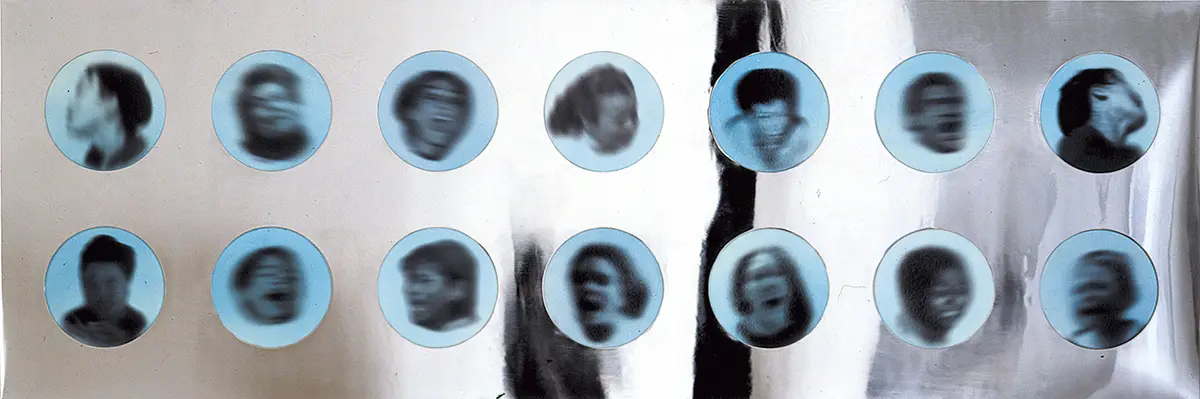
As Ivonne Pini puts it, "To delve into memory is Facundo's way to get closer to his country, his city, his surrounding; reconstructing reality not to generate mimetic visions, but to keep searching for answers to his essential questions."2 Facundo's last exhibition, Intermitencia (Intermittence), reveals a new facet of his preoccupation with collective memory. This show was made up of photographic fragments, details extracted from History books, relating some of the events that have characterized the 20th century. These photographic details of the small format are digitally printed on metal or wood, forming part of different series. One of them shows details of feet on different ground surfaces, of people who witnessed some event in a Warsaw Ghetto, or the feet of someone who was in Paris in May 1968; in Bosnia, or in Medellin. These square-shaped photographs of diverse tones and sizes, are placed on the wall in such a way that they resemble a sort of incomplete "puzzle". They appear as pieces of a violent history that remains hidden since those floors, sand, or pavement, and those feet, bare or shooed, do not reveal anything, they just let us know that they "have been there."
Another series has, mostly black-and-white round photographs, placed as a constellation on the wall. Here we can see hands wringing on a cloudy background, hands that greet us with joy, or maybe call on us from a time past and a place unknown. Another series shows images of a very cold, blue color "printed on a reddish metal sheet" where men appear throwing rocks. The shots are from different angles, reproducing something we have seen day after day in televised news or newspapers; the actions can take place any time, anywhere in the world. One of the most impressive works was a series of 14 photographs printed on a silver-colored metal, perfectly polished, where the heads of men and women appear screaming, perhaps in a state of pain. The action is intensified, stressing the dramatic aspect, by the sweep of the image that captures, freezes, and preserves the movement of the action, the agitation of the faces. The photographic details of the different series condense something essential captured by our observing eye; they become an incomplete image acting as a focal point that induces fixed observation, simultaneously expanding in our memory. These details remind us of something we have already seen in the past without having paid much attention to: gestures and actions that makeup memories that are always on the brink of oblivion.
With the small photographic images in Intermitencia one can "save a fragment of our brutal reality," where instances of the tragic history of the world are preserved. As Rodrigo Facundo himself has stated it: "It's about different occurrences registered in different moments and different places, moments —with a common action, event, element, or gesture— that have been captured as an image and grouped in the same context..." His interest in the image is "a search in time of the events that somehow form part of history, people who run, faces that make painful gestures, the elements that change matter with the passage of time. A semiology of graphic journalism, of the details that sometimes go undetected, looking for a paradigm, a model, a womb of the representation of the world."
Catalina Mejía
Catalina Mejía's show consisted of a collection of 15 paintings of a predominantly abstract nature, something that has been a constant in all her series. Formerly, her paintings also incorporated some figurative elements, objects of all sorts, hangers, hammers, tops, hats, and many other objects of everyday life. She also worked with animal figures: rabbits and camels occupied the pictorial surface or, abruptly so, the head of an ostrich would pop up through the center of the canvas. Objects and animals would be depicted, using a whole array of grays and with the realist precision that resembles photography. Throughout her development she has also flirted with irregular formats, she has recurred to assemblage of orthogonal canvases that, mounted one on top of the other, create a complex structure, in such a way that the regular border and the imminently flat surface of the painting is lost. Her intention was to create superimposing images that became a unifying whole with the use of stains, acting as a sole atmosphere.
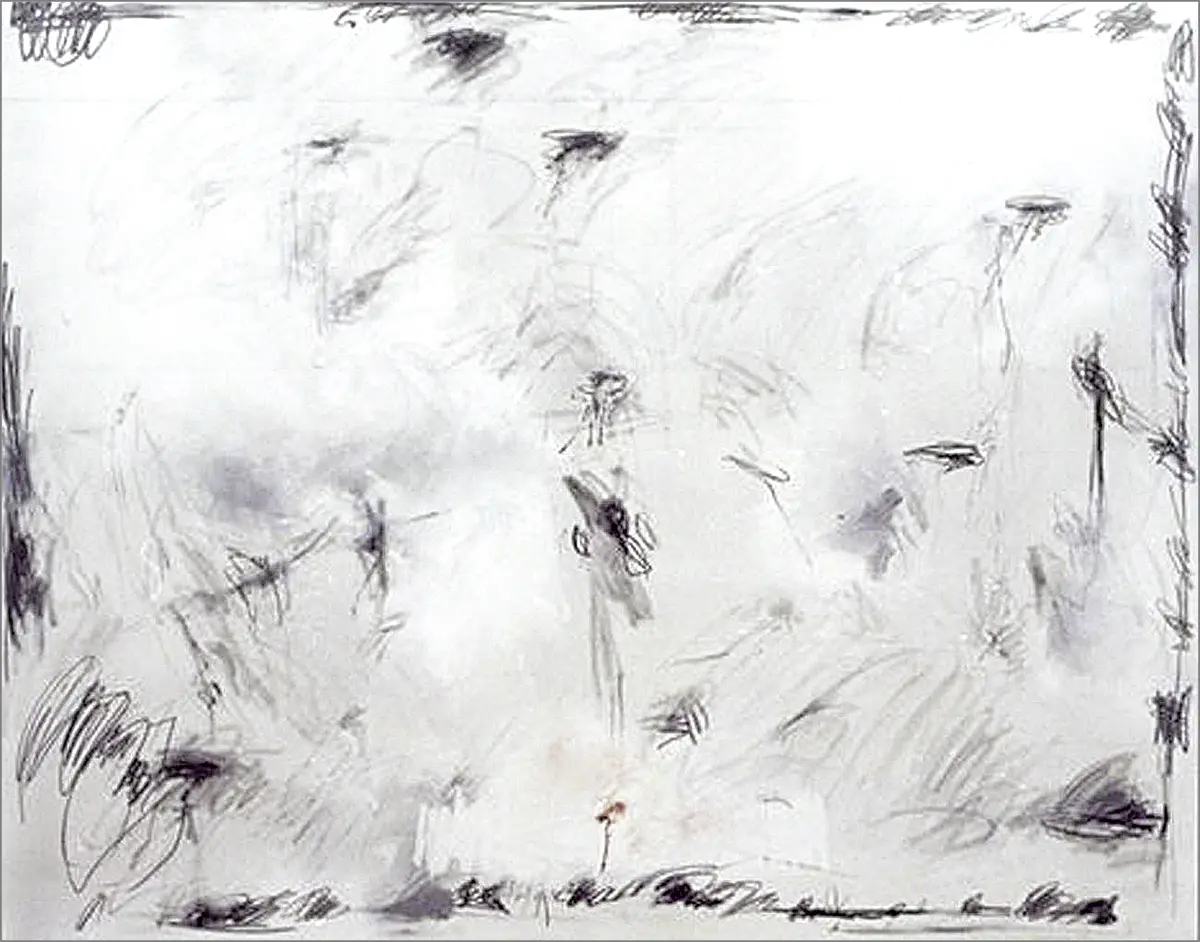
The presence of the photographic aspects has been a defining factor in her work. Her mother and father were photographers, and from her very young years, she got used to looking at the world as presented by sections of light and shadow, where the most diverse tonalities of gray exist. A black-and-white world where surfaces have a particular texture and details are defined beyond the possibilities of the human eye. That way of seeing captured by means of a mechanical process has given her a peculiar character, defined itself by the utilization of grays, often leaning on the cold tonality and on other occasions becoming lightly warm.
In this last series, any reference to the objectual world has been eliminated and her paintings go back to their rectangular format. On her canvas persist stains, strokes, and graphisms that reveal the identity of the painting, the flat surface where pictorial events, transparencies, denser, clothed sections take place; yet always preserving the stumped "rich-in-hues" "creme-like" texture, that Catalina Mejía achieves with the implementation of pigments. Moreover, in this case, her strokes and graphisms also evoke the history of painting. When one sees her canvases one cannot fail to think of the white, dense surfaces of Motherwell, in the spontaneous graphisms of post-war abstract art that's indebted to Surrealism, something Mejía gathered by observing children's paintings.
One is never under the impression of experiencing something already done, or something already said; on the contrary, the surfaces imply reflection; they reveal the many things that have been projected on them. The spectator is certain of having before his eyes a surface on top of which different processes have been superimposed, and Mejía's trajectory is readily visible, making it obvious that previous experience converges on the canvas, which, at times, is almost monochromatic; in other instances crossed by the use of a color like red, and yet rich in hues, ranging from white to black. In this manner, Catalina Mejía is able to reconcile "in a show of abstract nature" painting and photography, the pictorial gestures with the light tones captured by a photographic machine, revealing, in the absence of the object, the presence of a trained eye, experience, a prolonged and persistent reflection.
NOTES
1. The theme of dreams was addressed in a show titled Patafísica (Pataphysics), where clean and mysterious objects are used to condense the magic of a dream. As an example, a dove house covered by white feathers achieves a special synthesis through a poetic act that reminds us of Juan Eduardo Cirlot's 80 dreams. One of them is described in the following words: "Hands reached my heart, but another gaze remained on the horizon."
2. Ivonne Pini, "Rodrigo Facundo," ArtNexus, No. 29, Bogota, 1998.
MARTA RODRÍGUEZ