
The monumental installation, El laberinto de la Soledad (The Labyrinth of Solitude), by Soledad Salamé (Chile, 1954) reminds us of Joseph Beuys' declaration stating that an installation-sculpture emerges out of "the necessity to create other concepts concerning the power of thought, the power of the will, and the power of sensibility." Soledad Salamé, with a visual and conceptual language, which is the result of many years of work in different media such as engraving, sculpture, painting, installation, environmental art "and also her preoccupation with ecology and, without being militant, her obsessive preoccupation with the destruction of the environment" has risked everything when she incorporated all her accumulated experience into just one proposal. Historian and art critic Milan Ivelic, now the museum's director, wrote in the catalogue that "the work that she now presents in our museum is a monumental and interdisciplinary installation that prolongs her research in the ample and ever-more debated field of ecology; one that keeps the majority of the people in the planet... worried because of the destruction of the natural resources." Later he adds that it also assumes another facet of the proposed artistic discourse, that in this installation "the artist intuitively grasps the senselessness of a society that keeps going and going, with its faulty and exponential production and consumerism, deeper into a labyrinth, knowing that the support system for this voracity—the environment—is not regenerating a production mode that allows for a balance between the resources and the demand for 'growth and development' that the economic interests in power always expect." By accompanying the main aspect of the installation, these statements turned into an interdisciplinary dimension: a team of architects, anthropologists, botanists, entomologists, and designers developed a project guided in its entirety by the artist's visual, formal, and conceptual requirements. Soledad Salamé has been treading the road of art since she was very young and she's been in the Venezuelan art scene "where she studied" since her very beginnings. Then she moved to the United States where she has lived for 27 years.
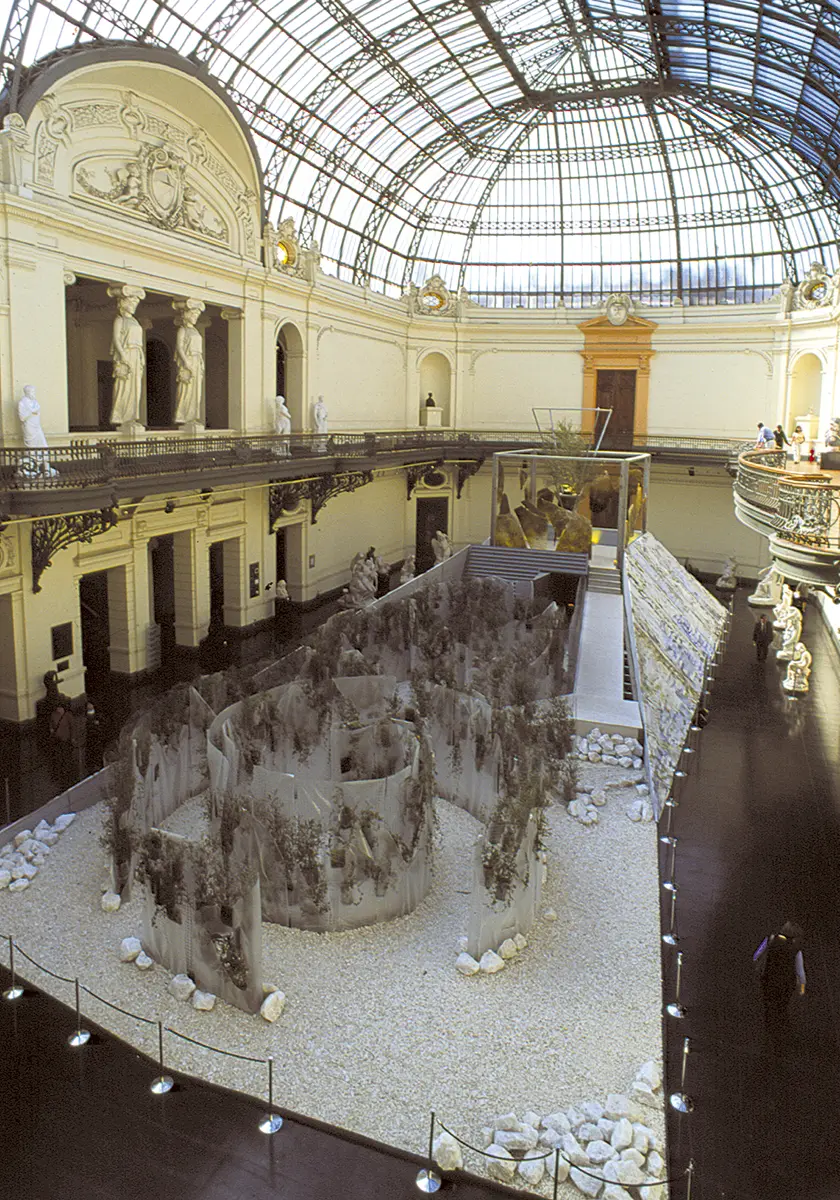
The theme of the exhibit was the metaphor of the destruction of the woodlands, the planet, and humankind itself. It was at the same time a pretext to recount her artistic life, the many experiences and cycles lived under the auspices of art. The conception of this complex installation is a road already trodden, where the aesthetic, artistic, and spiritual turn into a metaphor of reality.
El Laberinto de la Soledad, according to its own definition, was "an environmental and architectural labyrinth," a large-format installation where three fundamental elements of the planet's life—air, earth, water—come together in an artistic configuration to be part of the metaphor of the labyrinth (based on the Greek myth of the Minotaur.) Not a labyrinth of destruction, but a labyrinth of hope and faith in humankind. With her artistic proposal "which seems to be a synthesis of the history of art since many of the historical avant-gardes appear immersed in different contexts" Salamé, already in the hall of 21st-century art, calls our attention to the beauty of the planet. 600 square meters divided into three spaces, one for air, another for earth, and the other for water, all in the enormous central hall of the museum's magnificent building (formerly a botanical garden), offered a global vision of an ecosystem of the artistic language.
The earth section depicted its minerals transformed into quartz sculptoric volumes and its insects trapped, as fossils, in pieces of amber transparencies of tinted resins. Air, the metaphor of beauty, is wonderfully represented by real plants hanging from wire netting that formed transparent walls, generating an impressionist ambiance produced by shifts of light and color. Water, at the end of the labyrinth, was located in a mirror lake from whose surface emerged three extraordinary sculptures of transparent quartz, three great engravings as metaphysical images that served as its immanent background. The prisms circling the water mirror evoked millenary spaces where life must have begun. The labyrinth culminated in a square structure raised at the very end. On top of it, an inverted acrylic pyramid containing an autonomous microworld where all the species that save the ecosystem live. In a few words, the installation offered an interactive landscape where the spectator's participation was not only perceptual but also sensorial.
Throughout her artistic development, Salamé has gotten closer to the three-dimensional work, breaking all the conventions in order to propose it as a product of a multi-sensorial study. The results have had a lot to do with the natural, urban, and domestic context employed. In this respect, the thematic concepts she has always preferred are based on nature and on landscape, interior as well as exterior. That which projects onto the spectator to stimulate his perception and to place him in the position of protagonist; in other words, to afford him an active and dynamic role in the final resolution of the work. With El Laberinto de la Soledad, Salamé once again has demonstrated the complexity of her artistic vision and her interest in ecology, humanity, and nature. She employs an anthropological vision by involving many domains of life and art. Hers is a plural art proposal, which results in the sole conclusion of being purely artistic.
BÉLGICA RODRÍGUEZ