Beginning in the 1970s, art museums all over the world started to revise their museographic philosophies in order to slowly assimilate new and polemical artistic practices.
It could be said that, in general, contemporary art's new spaces came into being thanks to the unclassifiable new tendencies that progressively appeared in the practice of art. Thus the new turned into tradition.
Today, the dominant role played by the museum as an artist's only medium of acquiring legitimacy is frequently debated; contemporary artists sometimes appear to produce works specially designed to occupy museum spaces, and it is only in those spaces that their work acquires meaning.
A good example of this is the transformation of Venezuela's Galería de Arte Nacional when Meyer Vaisman mounted there his adolescence room, complete with a full array of objects from an elegant Caracas middle-class house located in a Jewish neighborhood.
Vaisman inscribed his room within the space of the museum, changing the exterior but faithfully maintaining the interior. In the end, the piece was destroyed and the objects were kept in the Conservation Department. When called for, the piece is rebuilt.
A show titled The House, at Miami's Museum of Contemporary Art (August through September), offered a surprising new twist. For this occasion, the museum became a home for a young artists' group calling themselves The House, whose works were thus absorbed by the space. The artists themselves, along with museum curator Bonnie Clearwater, curated the show.
The moving of works to the Museum is the central element here: a sophisticated alliance between artists and institutions. Both parties were ready for this casual encounter.
The surprising novelty here, in terms of museographic or curatorial practice, is the inversion of usual procedure; it is as if the museum itself had occupied the art collective named The House, in a new form of appropriation.
In fact, The House is the name of a physical space where a large number of student artists gather, live, and work. Their explorations focus on multimedia expressions, among many other things.
Installation, video, and photography are the dominant media, as they are part of the preoccupations that define our times. The 1960s, when Charlotte Moorman, John Cage, and Nam June Paik shocked the world with their inventions, are our prelude. But contents have changed drastically—for the better or worse, that's an open question—it's a matter of survival instinct. A noticeable difference: before, avant-garde artists tended to avoid narrative arguments, be it of a social, political, or biographical nature.
Walking through the show, one could think that media are less important now than conceptual visions—and therein lies what can be construed as "new," or a revision of the new. As in any art show, most of the artists are American or Hispanic. (The art world, obviously, has long proclaimed the dissolution of narrow identities, but whether cultural policies will continue to follow this direction after the attacks of September 11 is still uncertain. Will those policies support multiculturalism in this country?)
Bhakti Baxter, Natalia Benedetti, Patrick Michell, Martin Oppel, and Tao Rey are Hispanic artists who think and act in both English and Spanish; the rest of the group represented in the show are either of American or European background. They are Aja Albertson, Daniel Arham, Tim Curtis, Nick Delaveyde, Jason Hedges, Jay Hines, Ali Prosch, Tom Scicluma, Frank Wick, and Frances Trombly.
As soon as one enters the large museum space, one encounters Jay Hines' disquieting People Watching TV, where everyday objects have been painted in gray—as has the space that contains them—and the only chromatic variety is found in the video images (supposedly their own) the characters watch. What Hines perhaps is searching here for is more easily achieved in his photographs.
Jay Hines uses photography to restate composition and color concepts, registering garbage in black bags in the street, located in different places, and whose contents have been painted with a monochrome palette. Despite its seriousness and formality, this work doesn't lack irony and pathos. It is almost as rigorous as a constructivist piece, dominated by a certain type of composition and emphasizing the qualities of color photography.
Simultaneously, it transfers painterly needs to a different, gladly mechanic medium such as photography, allowing for the recycling of the real. Right in front of Hines' work, one comes upon Patrick Michell's painting, similarly characterized by its synthetic strategy. Michell, of Nicaraguan background, turns simple images taken from the mass media, such as logos or market codes, into neoconstructivist abstractions. At first sight, his paintings can be assimilated into the minimalism of past decades, as suggested by their title, Subliminal Pop. Clearly, it is not a simulation, but it could be a form of nostalgia for the painting of the future.
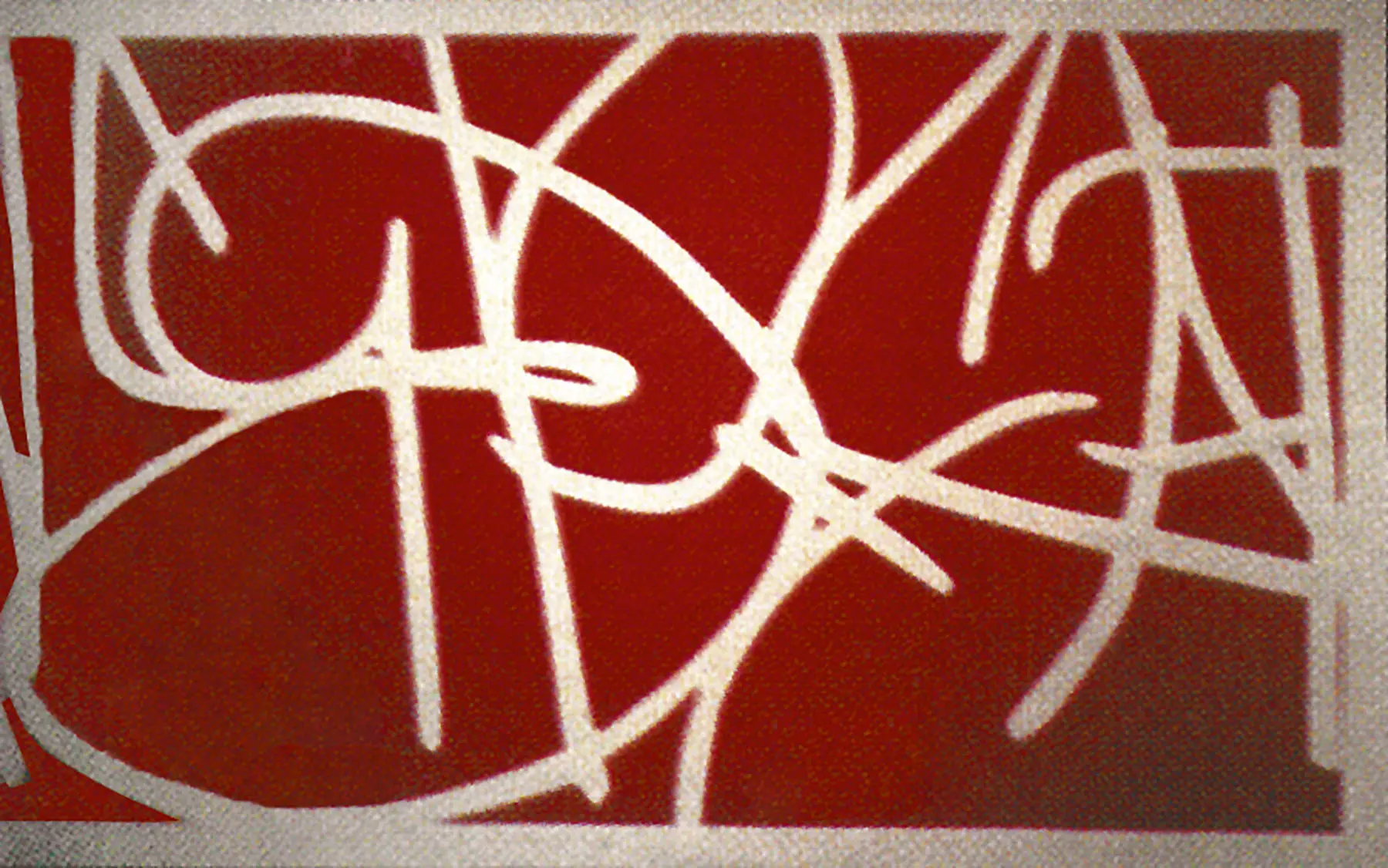
Tao Rey, originally from Argentina and one of the show's curators, offers an immediate alternative for the art of painting: the word "Communication," written initially in freehand, almost gesturally, is amplified until it loses its own communicative power and becomes some form of free calligraphy; the piece's elegant execution and concept almost overwhelms the visitor. This happens as the show reaches its end and one is beginning to rationally meditate about it.
Martin Oppel, also from Argentina, opens an option that rethinks the mystical and the natural over a sordidly minimalist space. His work is non-narrative and the subject is the Earth itself, dirt pressed into a support with a somewhat strange feel, as in Richard Arstchwager's unclassifiable 1970s works.
Sculpture gains a preeminent place with Tim Curtis' works. Curtis brings to the museum the atmosphere and the scale of rivers and mountains. His "X" reached the height of the walls and was smoothly built with four intersecting wooden canoes. Simply put, it is an eloquent invitation to metaphor.
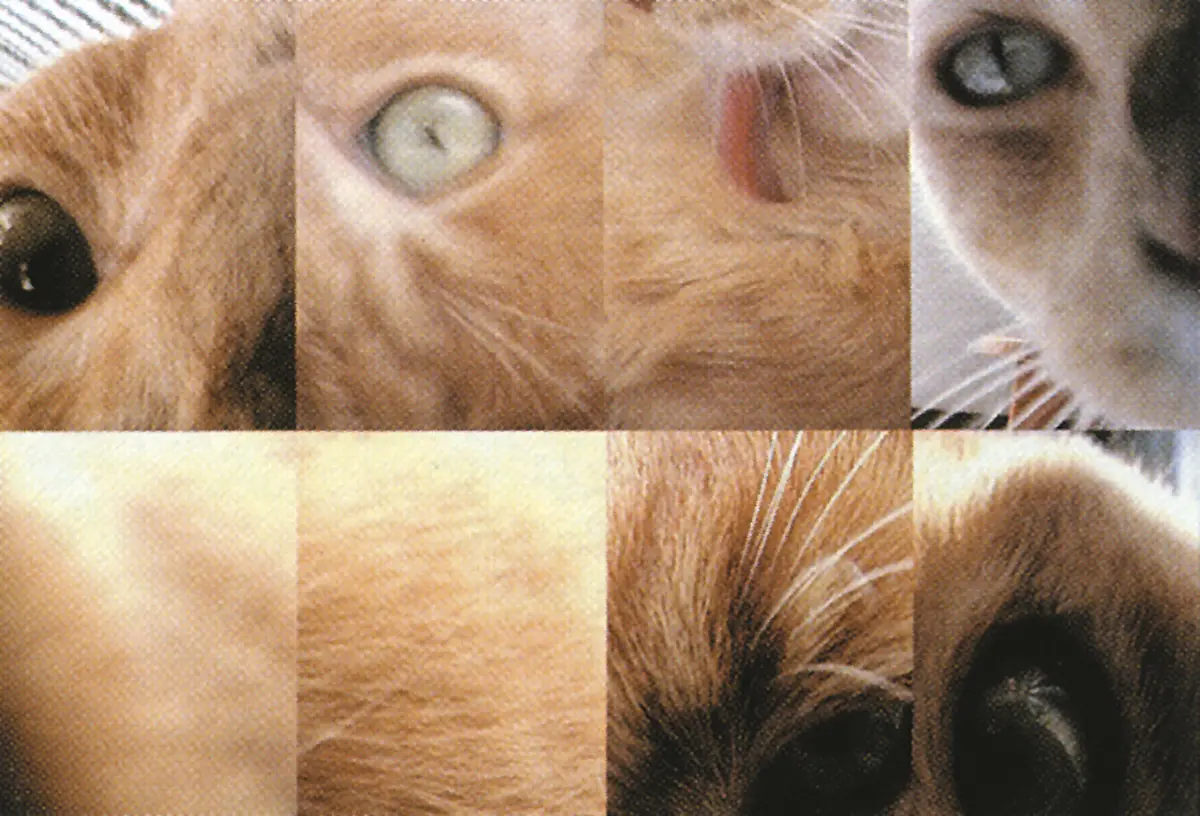
Quietly, one enters a space arranged specifically for video art projects. There, spectators await patiently their turn to watch a film. Venezuelan artist Natalia Benedetti projects a DVD onto the wall, with images describing the feelings of well-being of a well-cared-for cat, while the audio, through headphones, brings us the voice of a killer who rejoices in relating his crime. The void is open between innocence and evil.
To continue with the aesthetic of suffering and cruelty, Frank Wick surprises us with a readymade turned into man-made. A fashionable jacket is built with a myriad of Band-Aids; the clash of the recognizable material and the object it forms generates, as it always does, a surprised, stimulating response.
Suddenly, one discovers Tom Scicluna's installation; a line of magnetic tape, tied to a helium balloon, rises from a long agglomeration on the floor to reach the museum ceiling, recalling arte povera. Slight material and a small effort to capture so much space and so much humor.
Photography is not dominant in this show. However, it does play a role. Once again Jason Hedges makes use of his interest in food as a subject, seeking to represent life through sustenance. His piece here seemingly attempts to transform one detail from a salad into a kind of abstract image where "organic planes interact on the pictorial surface."
Photography also seems like a detail of some installation or performance held in another location.
Hedges' coherent work synthesizes the most rigorous minimalism in the inescapable act of feeding. Perhaps art and food both are close to celebratory feasting, as Antoni Miralda proposed in the 1970s. But the strictures of minimalism in Hedges' work make him somewhat of an eccentric and a purist —hence the title of his works, Aesthetic Experience.
Hedges reviews nature and the aesthetics of food by submitting them to the unexpected though protected by the static qualities of domestic technology.
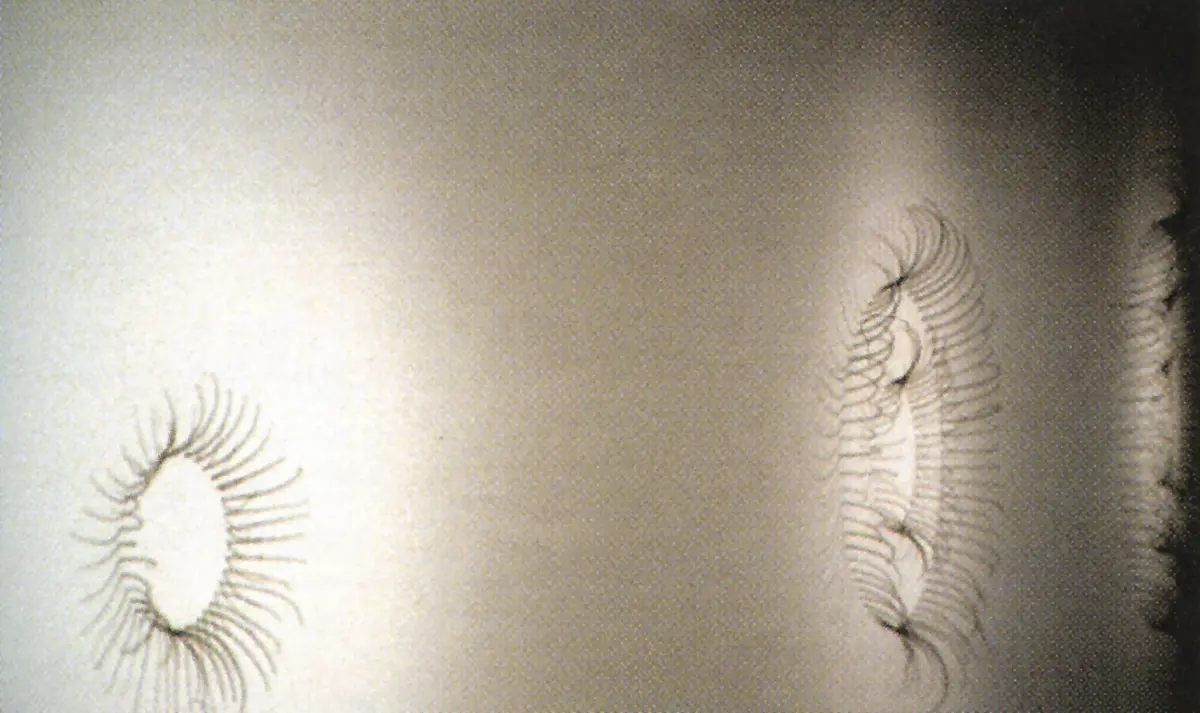
Bhakti Baxter, also from Argentina, tends to create installations with natural elements, such as small tree branches or strains of twine woven into geometric structures. The result is completely holistic.
As one readies for a surprise or some unexpected event, one sees darkened halls prepared for video projection; in one of them one finds Daniel Arsham's work, perhaps the show's most complex piece and the most elusive to memory. Within this large panorama, our perception is subjected to a forced visual experience. Nick Delaveleye unfolds a large panoramic view of the city seen from a train; the skyline is compressed into a fine line, almost monochrome, containing all the visual information.
Monumental pieces can also be found here with Franck Wicks' wall/art piece. A gigantic text in Braille seems to announce some sort of occult message; the title, Nobody Says Life Was Easy. It brings to mind the notion that, in the end, art is also a fantasy, like film is. One shouldn't trust everything one sees.
Other artists, like Aja Albertson, impress our memory with the titles of their works, as examples of accurate reasoning: My Lawyers Advised Me Not to Comment on Any Such Issues.
EUGENIO ESPINOZA