
Woman celebrated or objectified? A loving evocation or the listing of female body fragments as if for some unspeakable catalog? The former, of course; with this artist, it is always the former. Alejandro Kuropatwa is a distinguished photographer, part and parcel of a shining Buenos Aires now struggling to survive. Bold and unexpected appearing and disappearing acts, the beautiful photographs from the Mujer (Woman) series exhibited at the Galería Ruth Benzacar confirm his visual instincts. His is a fascinated, penetrating gaze.
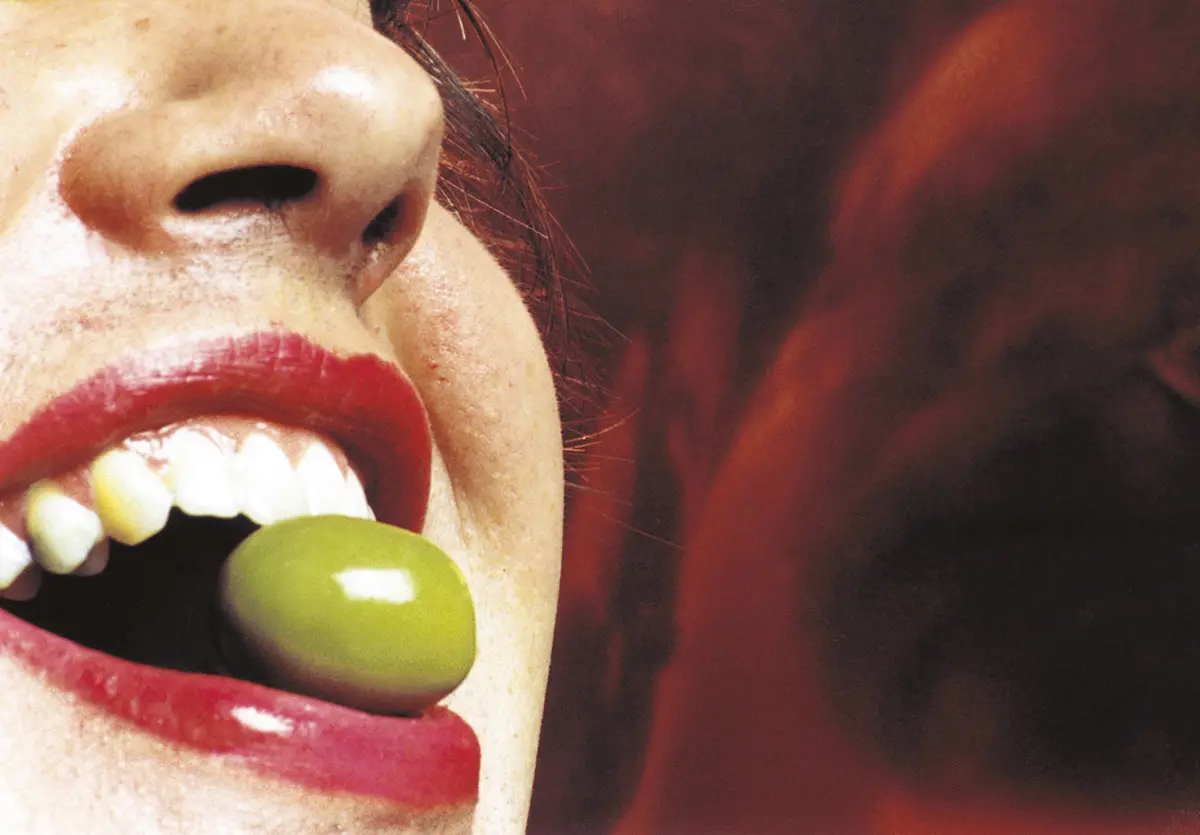
Kuropatwa’s insolent, pleasurable, disquieting photography works both in color and in black and white to register a powerful feminine landscape in transit toward a highlighted sensuality. This series appears as a dazzled “and dazzling” remembrance of women, full of artifices without being artificial. Against current trends, which favor the manipulation and distortion of images through digital means, Kuropatwa’s photographs are direct but not necessarily objective. His shots combine voluptuous images and create extravagant atmospheres, linked to his own identity and cultural background. Those enticing lips, those breathing breasts, those seductive smiles, those provocative legs, those flashing eyes… Do they have the power to enchant… or the power to reject? Watch, but not touch? What do the images show? What are they hiding?
This is not the first time the artist’s camera explores the universe of the feminine. In Familia (Family, 1997), he presented portraits of the prototypes —preferably female— of a certain social dysfunction parading through the big circus of open-signal TV programming. He was interested in the impudent times’ instant celebrities, their uses, and habits. His lens captured exaggerated expressions, and wandering gazes. He completed a portrait gallery centered around seven women belonging to the local upper-middle class; to a degree, the pictures in that series, titled Marie Antoinette (1998), partook of the same spirit of protagonism and voyeurism one finds in the gossip glossies. With unusual frankness, Kuropatwa approached the gestures and poses of those women he considered beautiful, bold, sophisticated, and unprejudiced. They became ageless beings presented with a profound humanity — although others looked at them with extreme cruelty.
Even before, with his joyful series Cóctel (Cocktail, 1996), which celebrated the mystery of his own survival, the media interrogated him endlessly and repeated his story. On that occasion, he photographed the colorful collection of pills keeping him alive, transformed into a kind of poetry by the artist’s love and skill. Without striving for sentimentalism, that series became a political gesture that spoke of Kuropatwa’s AIDS condition. Television reporters came, and he gave his message: “The reason why I went public with my story is because I know living is worthwhile, and I want every AIDS patient to have a future like I do now.” Only then his name became a familiar sound, although he’s shown his work in Buenos Aires since 1976 when he was 20.
The Mujer portraits seem to embrace an atmosphere punctuated by the hope for a future, already very present in Cóctel, even before the devoted “if not melancholic, crude, and explicit” images in Marie Antoinette. The new series’ technical excellence and its subtle humor point to an optimistic outlook and to a sense of exultation, both of which bespeak intense emotional experience (the author’s?). The images draft an itinerary through the mysteries of those bodies that are not always youthful but clearly healthy and full of desire. Such desire gives the subjects a renewed vitality, allowing the work to preserve the balance between the artist’s conceptual discourse and a surprising intimacy.
VICTORIA VERLICHAK