
Projects Gallery, the New Jersey City Museum exhibit space dedicated to young and mid-career artists, offers a new show of Chilean artist Catalina Parra’s work, titled It’s Indisputable. Prepared by associated curator Rocío Aranda-Alvarado, the show gathers five of Parra’s collage series realized between 1992 and 2000 in New York, where she lives and works.
Each of the series comprises 10 collages, all of them in the same format (71 x 56.5 cm) and all of them created from the same base: one ad page from The New York Times, in black and white, adhered to a white sheet of construction paper. Parra uses the ad’s own title, printed in large boldface type, for each of the ten pieces of a series. Parra’s repetitive use of the same newspaper page reaffirms a work process based on the use of advertising strategies. The collage is created later by taping, gluing or sewing ripped fragments of magazine print, newspapers, e-mails, and personal photographs. The combination of sublimated images and topography is in Parra what it was for American artist Barbara Kruger: the deconstruction and use of a written and visual message’s seductive power, as well as its ability to persuade the public. However, Catalina Parra is indebted to modernist tradition, and she’s been influenced by literature. Following the cubist and dadaist tradition of collage, Parra revitalizes the genre’s transgressive, disturbing character. Her interest transcends, though, the mere experimental aspect in the use of different techniques already explored by the avant-garde; Parra’s collages signal the influence of advertising in our daily lives and the speed with which one message overtakes another, as in building façades covered by successive levels of graffiti and bills.
The serialization and the persistence of written messages in advertising are ironically subverted by Parra in order to introduce a new, much more political message of her own. In the then collages comprising the series If You Can’t See (1992), Parra divides the repeated surface of the newspaper page into two sections. The top section presents only the Times headline, while the bottom section is occupied by a collage of magazine fragments. Images of war, malnourished children, and extreme poverty mix with colorful fragments of tropical fruit, flowers, or vegetables, images all we associate with the Third World. This is a combination of the advertising of exoticism with striking realities, a contrast reinforced by the strata and the levels created by means of seams, masking tape, and affixed images. Similarly, but with greater subtlety, It’s Indisputable (1992) looks at the problem of racism in the United States. In this series, Parra juxtaposes, connects, or dislocates newspaper and magazine fragments from both advertising and the mass media; these are unconnected images depicting acts of violence, some of which can be identified—such as the beating of Rodney King by the L.A.P.D.—intermixing with suggestive pieces of commercial advertising. Fragmented faces and parts of lack bodies appear in the series’ collages with a subliminal sensuality that reminds us, in its colors, of ads targeted to minority consumers in the US.
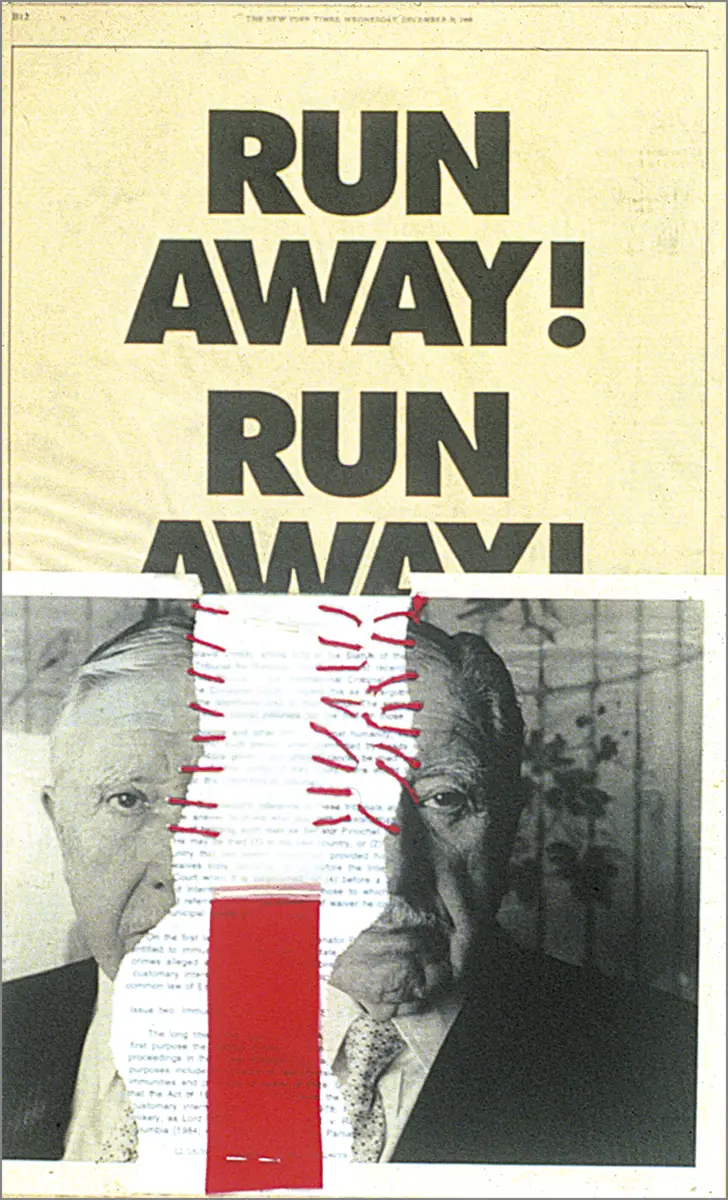
No Moaning. No Complaining. No Rehab. Just Laughs (1999) and Run Away (1999), offer a personal commentary on political events in recent Chilean history, events sometimes drowned in the mass media. Both series explore the Pinochet case, specifically the judicial process the former dictator was subjected to in the United Kingdom between 1998 and 2000. No Moaning. No Complaining. No Rehab. Just Laughs repeats a black and white photograph taken from a newspaper and affixed to the usual New York Times page. In the photograph, Pinochet appears embracing Bolivian general Hugo Bánzer, later President of his country. Small patches of colored paper break the image of the two generals, and the photograph is "ripped" and opened to new meanings, as if behind the news item’s surface there appeared something hidden: rips on skin, or, in the case of the red-colored seams, subtle threads of blood connecting the actions of both dictators. In her series Run Away every collage is different. The title suggests the notion of escaping and refers directly to Pinochet’s trial. Parra combines newspaper fragments and e-mails, pieces of color, fragments of the Chilean flag, and photos taken by the artists of Wewelsburg Castle in Germany, where elite SS and Imperial Guard troops received training in Nazi times. Parra uses red glue and seams to provocatively attach these elements to one another. The juxtaposition constitutes a commentary on Pinochet’s arrest and the response to this event in the press and in the internet newsgroup Referente, to which the artist belongs. In Run Away # 8, Pinochet’s face has been irregularly ripped and put together back again by sewing it and adding a red stain. In the background, we see the fragment of a text in English about the judicial process against the former dictator.
The last series, Photographic Memories (1998), emphasizes the relationship between the public and the private, which appears subdued in other series by the sheer force of political commentary. The title is taken from a section of The New York Times in which archival images from the paper’s collection were printed. Parra creates thus her visual archive. Using the original captions, Parra substituted the paper’s images with her own incongruous vistas, landscapes, and anonymous private spaces. Taken during a trip to Chile, these photographs are Parra’s radically personal register of somewhat banal locations, devoid of referentiality for any other observer. Some of these images were captured from a moving vehicle as if the very act of capturing them was associated with the fleetingness and distance with which they were seen. In each collage, two photographs with the same image are glued to the top section of the page, while the headline occupies the central portion. The bottom section contains the usual collage of magazine fragments joined by seams and adhesive. These fragments take the shape of see-sawing patterns and show body fragments as well. The joints, a type of seam in red, reaffirm a constant in Parra’s work: that of traditionally feminine handcrafts, where every cut will be reattached not by arbitrariness or even playfulness, but by a conscious linkage of the elements of the collage.
DERMIS PÉREZ LEÓN