Art is my business, Darío Escobar's recent show, was the end of an important cycle in this Guatemalan artist's work. Without the lapidary intentions of all anthological expositions, this show was more like a carefully presented review done by both Escobar and the curator Jacob Karpio. It suggests a journey through the artist's entire research and conceptualization of baroque art. And it culminates with works where the sublimation of his process consists of the alteration of formal aspects and the perennial idea of the mask.
Art, immersed in a system of codes established a priori, has always functioned in the obese world of social, ideological, and aesthetic constructs. In this respect, Darío Escobar has become a sort of contemporary anthropologist. The objects he "rescues" are the emblems of a specific time period. They do not direct us to anything concrete, but they speak of their own objectual specificity; where formal "beauty" offers the first and, to a certain extent, the fairest interpretation.
Escobar is selective, and his selectivity, which operates in the ample iconography of today's symbolic universe, is not arbitrary. A Vaso de McDonald's (A Cup From McDonald's), the Cajas de Corn Flakes (A Box of Corn Flakes), or the Skates are the contemporary idols utilized and canonized. There is no other function in them but to offer visual pleasure. Ideological disturbances felt by some spectators are caused by the rupture from hostile canons offered by social awareness. Common places (and these objects are a perfect example of this) are a civilization's best-achieved manifestations, its defining traits. That is why the skates (the artist's favorite form) —the most recent victims of the obligatory process Escobar imposes on his chosen ones— not only show the sculptoric condition of the first ones but are also the consummation of the new sense he attributes to the readymade. The new forms are in accord with the logic of the transformer, charged by the obstinacy of today's mass media and societies; but lacking the multifunctional notion needed, they transform (with the same numeric and insatiable eagerness of Pessoa) into themselves and others, embodying the whims of art.
The baroque is seen then -as Borges would have it- in the actual overuse of possibilities that are for the most part in the object's capability to speak and to its aesthetic legitimacy, which —amid the fragility and the waning of individual memory— has been imposed as consensus and fetish by the work and grace of mass media; or perhaps in the continuing quotes of 17-century painting, here on sleeping bags or camping tents; or the virgin that produces 1,24 galones/ minuto (1.24 Gallons/Minute), creating the irony that would be the envy of the most sophisticated markets of Chinese products and of all the Western secular population. The artist is also a great painter, without any fear of perishing in his effort.
From the public space of everyday life (the most authentic museum, a pristine place of cultural production and demand) to the sublime privacy of the gallery, it all reveals itself as one of the central aspects of the artist's proposal. The barely readable text, Ar is my business, is the normative axiom naming the exhibit — on white paper on the very white wall of the gallery and accompanied by the popular slogan, NO MONEY/NO HONEY— and attesting to the spatial conversion. The impromptus of the words contrasted by the subtlety of the whiteness transforms the wall into the work itself. The space where the mechanisms of artistic circulation take place is now art, thanks to art itself; and in that negotiation of heterogeneous means and channels, the production and the legalization of the same are founded.
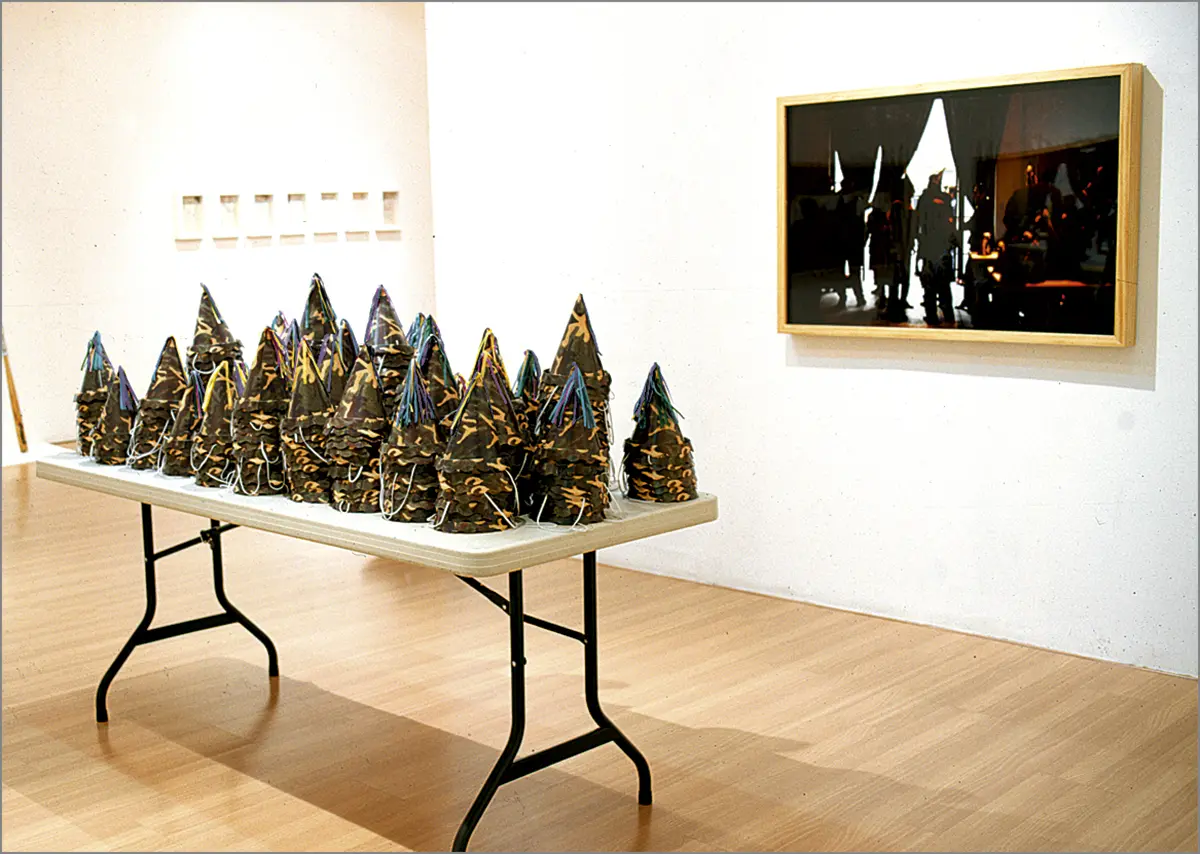
Art, according to Vygotsky, consists in concealing art. Darío Escobar's work is articulated in that almost literal game of masking. From Aristotle's Poetics to our day, the idea of mimesis, of sameness of metamorphosis, of becoming and consuming a disguised identity, has been the human condition. That is why camouflage is not just a modus operandi in this show, it actually serves as a regulator providing it with unity and sense. In this manner, we go from silver and gold, from adulteration and formal transformation of the pieces to the obscene and the obvious allusion to military dress (the usual way to use the term) in los angelitos (the little angels) that cross-dress on the wall, or to the Happy Birthday to You! hat, where camouflage becomes a leitmotif of the show as an homage to our own deceiving behavior and to passive complicity in the aestheticization and simulacrum of consumerism.
Rightly articulated, without the lavishness or the horror vacui assumed by just mentioning the baroque, Art is my business finished a cycle and opened new possibilities. The exhibit shows Escobar's critical distance with respect to his objects and their aesthetic potential. Devoid of their initial direction and inserted in another dynamic, with small and susceptible exchanges, they are the new trick of their representation.
"Something" is destined to be the business of all; for those who produce it, sell it, buy it, write it, or read it, art is theirs. The artist's missive letter is important even to us who unfortunately cannot find a less complex business. We see Escobar in a new enunciative period and in the hypothetical construction of a utopic language that was delegated to us by Duchamp, for whom art was also his business, at the beginning of the last century.
CLARA ELENA CONCEPCIÓN ASTIASARÁN