
The closing of the five spectacular exhibitions of Latin American art here in Madrid a few months ago, left us—particularly those of us who are more involved— with the feeling that it was necessary to transcend and overcome an artistic-aesthetic-geographical category that, being overly manipulated and deconstructed, hardly legitimizes anything. But, just then, the Fundación Telefónica inaugurated the art season with one of the best exhibits ever presented in the institution in the last several years; but its general presentation, from the perspective of the debate about the (non-) identity of Latin American art, shows a clear regression.
As its messianic title implies, the exhibit El final del eclipse (The End of the Eclipse)* springs from the premise that Latin American art has always been there, with its own quality and value, never before appreciated because it has been "eclipsed" by prejudice as well as cultural, social, and economic interests of Western first-worldliness. But the issue looks false; the quality of the selected works is undeniable and directly proportional to the selection of artists—hardly a discovery in these latitudes: Liliana Porter, Luis Camnitzer, Cildo Meireles, Alfredo Jaar, Ernesto Neto, Adriana Varejao, and Rosangela Rennó, or Tunga. On the other hand, a great majority of the younger, lesser-known artists selected have participated in collective shows in Spain, or have presented their work on more than one occasion at fairs and cultural events of all kinds. Such is the case for Abraham Cruzvillegas, Pablo Reinoso, Yoshua Okón, Jorge Macchi, María Fernanda Cardoso, Martha María Pérez Bravo, Carlos Garaicoa, Pablo Vargas Lugo, and César Martínez, among others. One has to imagine, then, that if these are the artists that function in an international circuit well sanctioned by first-rate institutions, critics, and publications, it is precisely because the quality of their proposals—in addition to circumstantial good fortune—has turned them into "stars" that shine by their own right in the extensive territories and diverse geographies of contemporary art.
The result is, at the least, ambiguous. Although not all the pieces are paradigmatic for every artist's work, each one of them shows great aesthetic and conceptual quality, to prove the rigorous eye of the curator. However, the compilation is far from presenting an authentic reading of the direction where the works are coming from or going. This should not come as a surprise in an exhibit where all the artists participate with just one piece, and where the works are not related to each other by any unifying concept, except perhaps the place origin of the artist. This brings us back to the question: If, as it is stated—and rightly so—in the main text of the catalog, Latin America "does not exist," "how is it possible to continue putting into practice this political and cultural fiction fabricated in the West as a criteria for a selection and exhibition of such a diverse compilation of works? It is true that the overly beaten problem of identity is practically eradicated from the general presentation of the exhibit, but "the place of origin" is still being used as a normative criteria. The debate in the main text of the catalog maintains a didactic tone that practically eludes mentioning the multiplicity of theoretical writings on the subject, signed by Latin American authors and published in media produced and distributed in the United States, Latin America, and Europe.
In spite of this limiting framework, one can see the light shine in some of these pieces that frankly are quite good, such as the performance, video, and photography, Dúplex (Duplex), by Gustavo Artigas from Mexico, who makes a perverse turn away from this discussion. Artigas, assisted by a publicity agency in Madrid, contracted more than a dozen of his "doubles" who, after doing a conference about the benefits of being "multiple," roamed around the inauguration causing general surprise and confusion in the public as well as in the media, who went into great trouble to find the "original" Artigas.
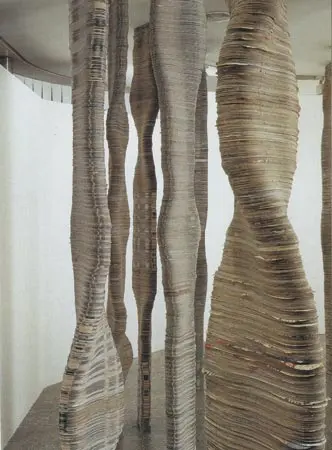
Another outstanding piece was Carlos Garaicoa's, Toda ciudad tiene derecho a llamarse Utopía (All Cities Have the Right to be Called Utopia), consisting of an installation of a city drawn with metallic thread on a wall; or José Damasceno's columns with footprints, Durante el camino vertical (During the Vertical Trail).
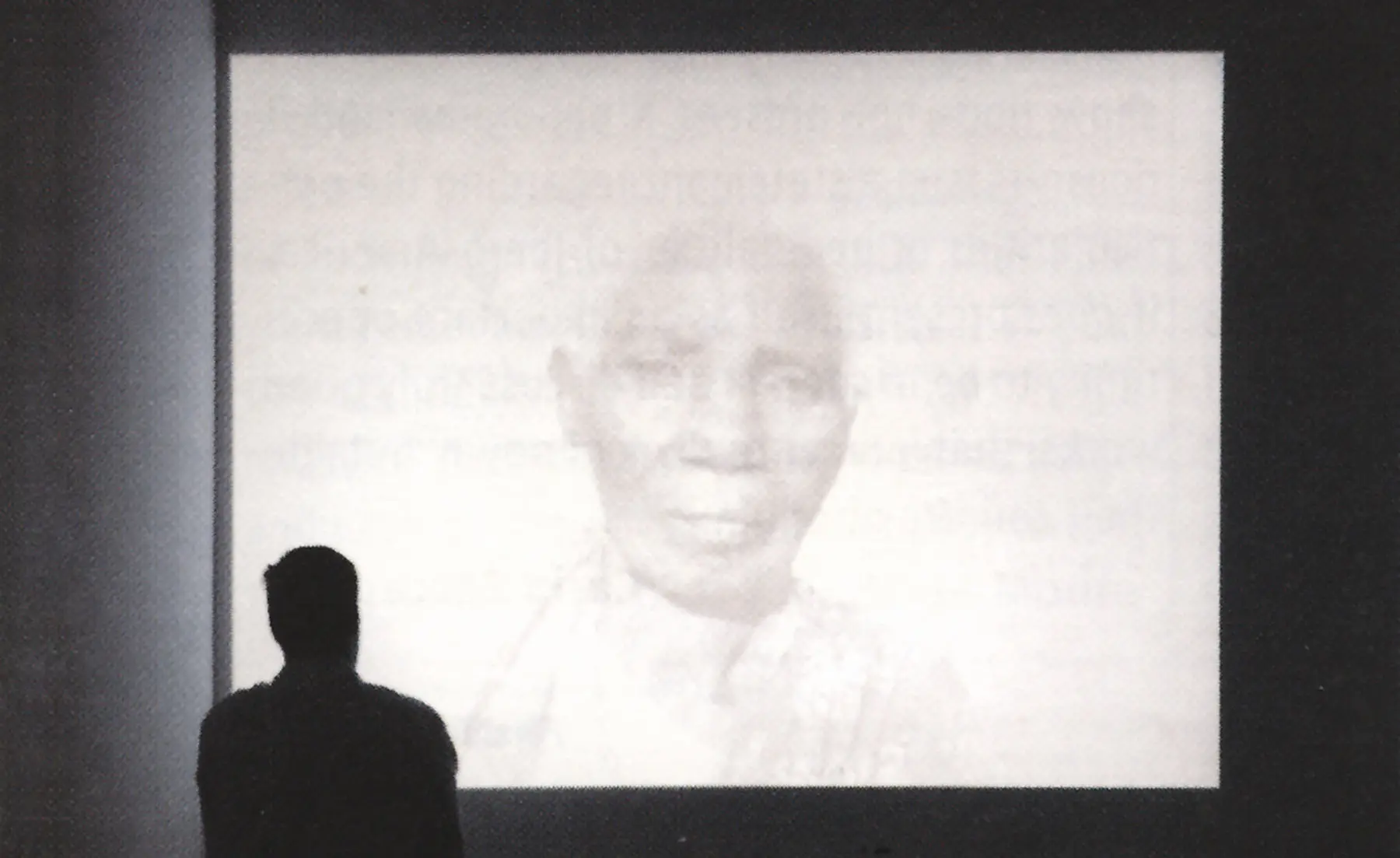
One of the most imposing pieces was the video Epílogo (Epilogue), by Alfred Jaar, consisting of a white screen with the appearance of what seems to be a ghost, a black woman, probably African, that stares fixedly at us and then disappears to give way to the white screen again. Meyer Vaisman presents his own skeleton, scanned and reconstructed with plastic resin. All these pieces seem to share the desire to vanish and the sense of impossibility, a resistance to "embody," which could be the key to understanding the limitations of the show as a whole. One of the best parts of the exhibit—where the presentation of certain forms of expression generally marginalized by the great installations turns really effective—was the selection of videos and web art. Notably, the piece Presenta (Presents), by Yoshua Okón. The artist has produced a five-minute video where the only things appearing are the logos of the supposed Mexican organizations, foundations, and institutions (voices included) that present, finance, or support the project itself. Also, Gisell Beiguelman's web projects —O livro depois do Libro (http://desvirtual.com/giselle)— and Brian Mackern's —CONTENT TYPE: //NO CONTENT: PRE-LOADERS (http://no-content.org)— deserve closer attention.

Another outstanding proposal is Jorge Macchi's video installation, Víctima serial (Serial Victim), where the artist, filming words mostly from street signs, constructs a unique threatening letter that makes reference to his previous work with crime notes of journalism.
In this manner, risking to sound as if America has been discovered again, one would have to reconsider the metaphor of the eclipse, that although it appears to shed light on the artists and the selected pieces, it harbors the defect of obscuring their context, their trajectory, their relations with an art-form defined more by time (their contemporaneity) rather than by space (their place of origin.) Perhaps it would be more appropriate to resort to the simile of the full moon. When it is up there, fixed in the night, it looks arrogant; but when it disappears, we can finally see the stars, in the same plane, in the same sky; and from below, all of them look unique, and at the same time identical.
*The exhibition will be shown at the Palacio de los Condes de Gabia in Granada through January 20, 2002, and, at the Museo de Arte Extremeño e Iberoamericano de Arte Contemporáneo (MEIAC) in Badajoz from February 20 through April 8.
ISSA MARÍA BENÍTEZ DUEÑAS