
One of the paintings in this exhibition of recent works by Chilean master Ernesto Barreda is titled La Casa del Sabio (The House that Knows) and it certainly describes the haunted atmosphere that pervades all of his works. Every house, patio, room, and vista that he presents speaks of the past in images replete with memories and fraught with suspicion. Each has witnessed life’s passages and now stands deserted and forgotten, a mere remnant of what once must have been a rich and privileged existence. For the viewer, it is a voyeuristic intrusion into someone’s life that is as provocative as it is mysterious, and only the house knows what came to pass.
Ernesto Barreda has never been content to merely speculate about life without subjecting it to intellectual and psychological scrutiny. His paintings are vehicles for more than formalist explorations. They are grounded in literature, art history, quasi-personal narratives, and surreal visions of the past into the present. A natural environment poised to ensnare its occupants or their ghosts surrounds the house of solitude that has long been the subject of his work. While there is always evidence of human presence, seldom does anyone appear, and if they do, as in Cuando la tarde languidece renacen las sombras (2000), they are lost in impossible relationships and darkening shadows. Interior and exterior spaces are architectural confusions and the landscape is ominous and threatening.
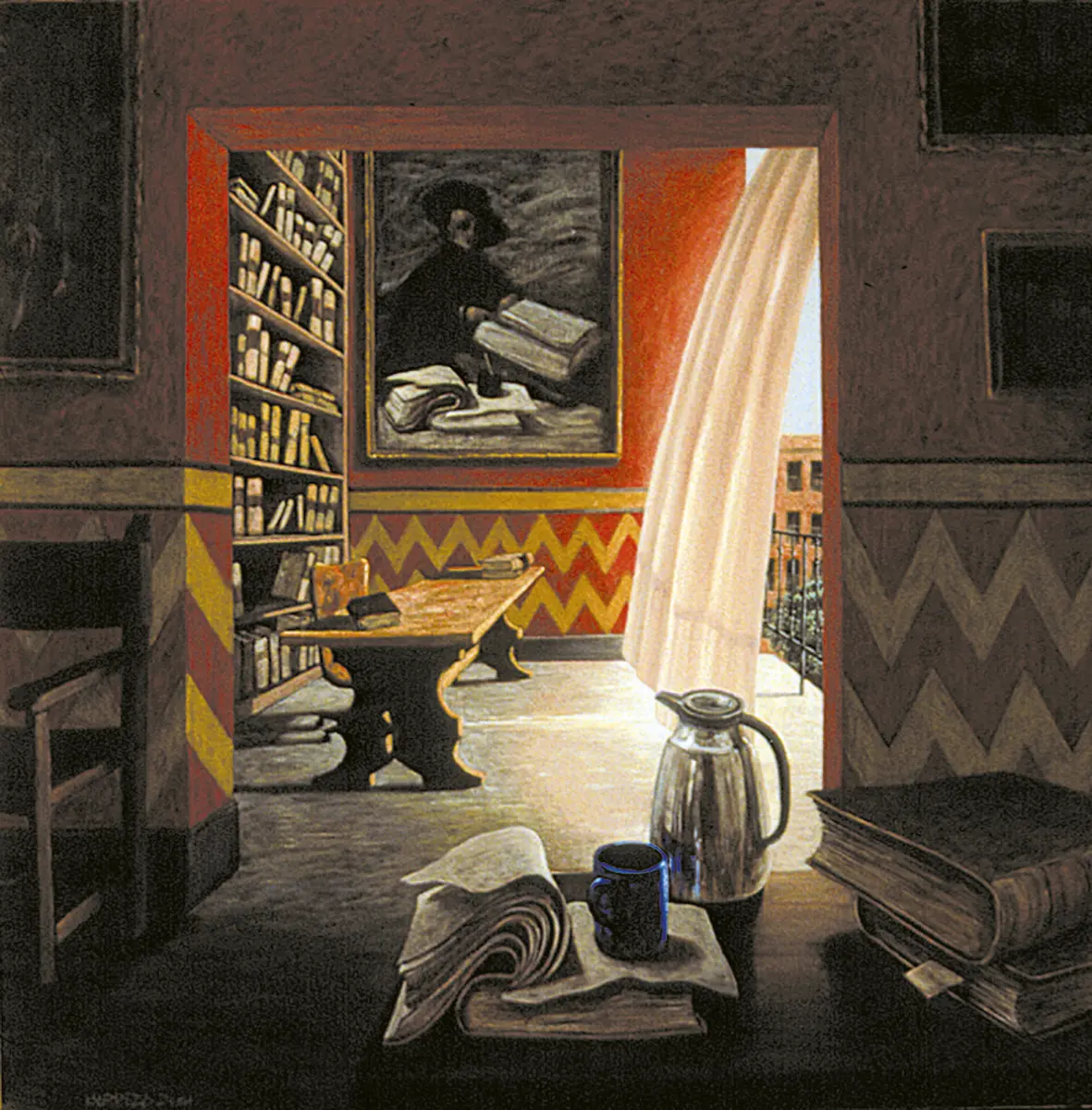
The occupants of his lonely houses did not desert the rooms and patios in an orderly fashion. There is evidence of haste and abandonment. Drawers are open and boxes ready in the lamp-lit room in La Mudanza (2000). A jacket is hung over a chair and the tropical gardens in the background are poised to enter through a wide-open wall, as if the entire scene is in the process of quickly reverting back to nature. Books are strewn about a library and lamps are lit for an absent reader in Los Libros del Primo (2001), a work that also makes reference to other favorite subjects of the artist, the paintings of Velázquez and the Spanish masters of still life, brought to modern surroundings. In other works, monkeys stroll comfortably through lavishly curtained salons to take charge of their new habitat. A section of La casa vacía (2001), a once-elegant house with graceful arches and a solitary sofa, is so vacant a horse grazes within its remains and shadows encroach like harbingers of doom hovering with anticipation of something strange to come.
Ernesto Barreda has once again demonstrated his mastery of the art of magical realism to present a repertoire of metaphorical devices to express issues of cultural identity, nostalgia, and loss. The atmosphere that pervades each work is always charged with mystery and impossibility, and a touch of sadness for what was once and will never be again.
CAROL DAMIAN