One of the most damaging pathologies of current Cuban art, as a sector of critics, has repeatedly pointed out, is the undermining of the artistic sign’s conceptual and hermeneutic dimensions in order to flirt with fashionable proposals where the universal voice of art is denaturalized. If on the one hand, the youngest Cuban art partakes of those artistic procedures highlighted by postmodernism, and the carnival of heterodoxy values the efficacy of travestying imaginaries, on the other hand, a group of poetics (which they are, despite everything) does not transcend purely domestic preoccupations, lost in a landscape of social phenomenology. The impoverished presupposition that finds transcendence in the archaeology of the ephemeral, of the contextual, keeps opening up symptomatic banalities and dull rhetorical architectures, which will no doubt find their proper place in the normal course of things.
However, De este lado del puente (From This Side of the Bridge), Cuban artist Esterio Segura’s recently inaugurated show at Galería La Casona, clearly dodges “like a perfidious lover” the totalization of a discourse wholly or partially subjected to the dizzying commonplaces of political, ideological, or religious contestation. This is due, perhaps, to its incorporation of the opposite side theme; perhaps it is because the show brags about the true meaning of art. De este lado del puente is, in any case, a cultural text where the content’s sharpness, the legitimacy of semiotic contradiction, the skill in managing social commitments, and the sign’s autonomy and deliriousness, push the eloquent discourse beyond the limitations (as obvious are they are predictable) of an insularity besieged by marketing.
Independently of the clearly perverse and manipulative spirit of the Buddha sculptures, where the resemantization of kitsch, the parodical intent, and the mixing of parables alluding to “twisted” historical and sociocultural processes pay homage to baroque stridency and the epiphany of signs (something Cuban art has accustomed us to), Segura’s canvasses and large-format installations follow serpentine reflexive paths that bring his poetics even more to the fore. After the “accusing deconstruction” in the face of the “accidental” intertexts that emerged from the arbitrary multiple exposures undertaken by the dominant discourse, comes now questioning where tone knows much about introspection, traveling to the interior of Being, the humanity of paradoxes and ambivalences, and the painful price of (in)communication.
Titles such as De este lado del puente, La disyuntiva de cruzar (The Disjunctive of Crossing), El final nunca está en el horizonte (The End is Never on the Horizon) would seem simple linguistic indexes for thematic orientation, but in reality, they turn out to be metaphors for contemporary life that work as a kind of essay in ontology. Esterio Segura’s current work dissents (widely) from the tourism slogan "One closer to the other" that fuels postmodern cultural polyglossia. His pieces, even as they aspire to the redeeming dialog of utopia, let us see through to the un-joining of voices in the mass-mediatic village. An astute and enraged critic suggested that the dialectical antinomy of this promise was a genuine finding of the popular saying that goes: "The closer... the farther away."
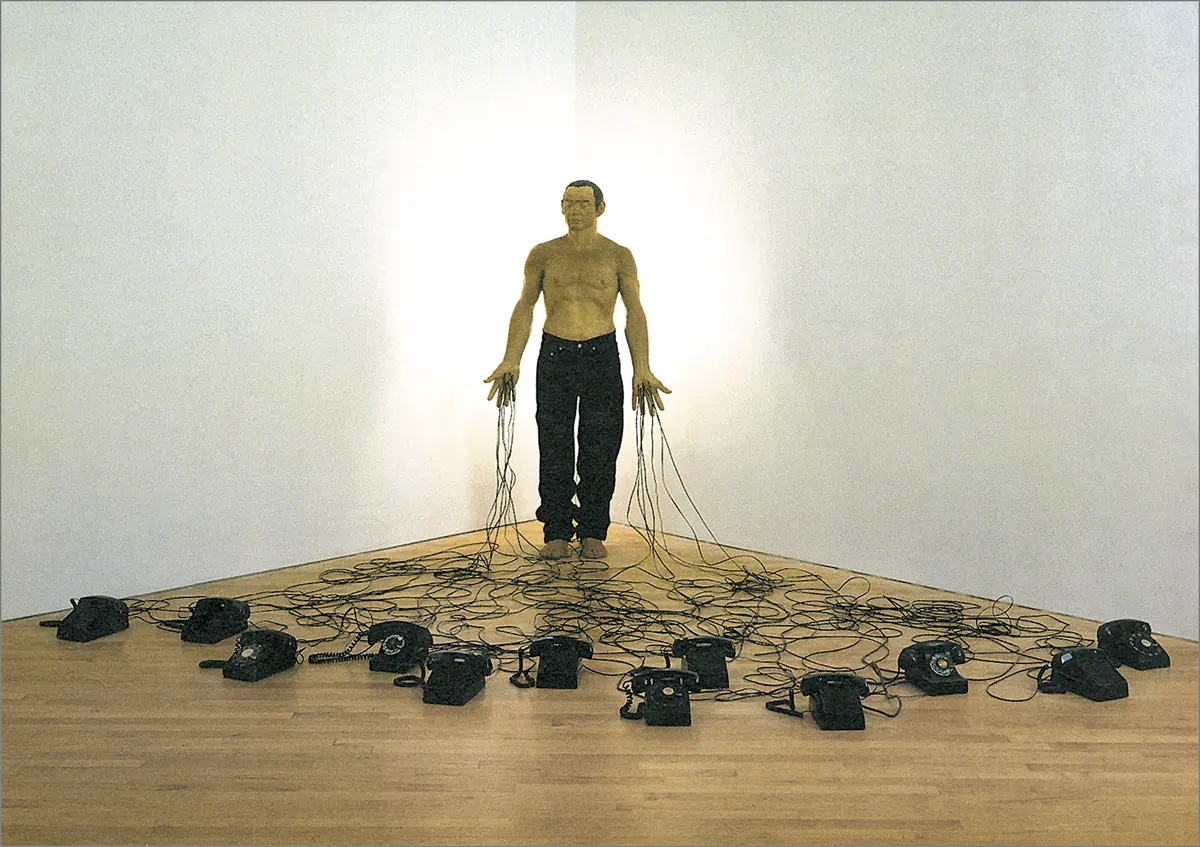
Straddling the boundary between two millennia whose physiognomy and relief are defined by the apotheosis of the media and their cold obscenity, the artist experiences that strange feeling of MORE regrettably producing a disconcerting LESS. In the regime of computers, the web, the internet, the kingdom of the virtual, and the obligatory sublimations of the ego, the voice of humanity is cheapened, as is the will to dialogue and listen to others. This Age of communication has sown its own sclerosis: silence. One of the pieces in the show, under the title 0.53.7, is an eloquent gesture about the tragic dilemma of communicating with another who inhabits a different geography. This installation, of a performative character, represents (if you allow me the term) a man to whose hands twelve telephones are connected. The telephones ring simultaneously. The piece’s stony front precludes dialog, but even more surprising is the public’s refusal to listen to the other’s voice. The fear of what is not seen is such, prisoners as we are of the terrible objectivity of life, that at no point during the show did anyone pick up the phone, not even by mistake, to listen to a message, perhaps an urgent message.
In any case, it bears emphasizing that the show does not want to become a Manichean essay on the important phenomenon of communication; in fact, it refuses to be such an essay. Its conceptual density moves it well beyond the frame of any single analytical context, which means it tends to disorient critics. Esterio Segura articulates a fervent polysemic document where the Idea and its multiple turns-of-the-screw dislodge from its comforts the just-visiting spectator as well as the sharpest of critics. As the critic Denis Matos writes in the catalog, “the proposal as such does not allow for the discourse to become the object of a reductionist hermeneutics, it expands its range within a major order of meanings that revolve around the status of today’s humans in contemporary society.”1 Thus Esterio Segura’s poetics, beyond any unidirectional, monolithic discursive preoccupation where a governing statement organizes the text’s meaning, informs us in different degrees and intensities of the existential conflicts facing the individual, and of the individual’s relationship with social structures. The referential lubricity, the invitation to multiple situations and dilemmas of the contemporary, and the wide profile of Segura’s discourse give prominence to his poetics among so many concessions to circumstance. De este lado del puente blazes the trail. We only need now the next ring and the will to listen...
NOTE
1. De este lado del puente. Exhibition Catalog.
ANDRÉS ISAAC SANTANA AND NURIKA CRUZ