
Humberto Castro belongs to the 1980s generation of Cuban artists. His existential language is based on the use of the stylized human figure; the treatment and context of which transmits an array of messages ranging from the political denunciation to the purely poetic.
Humberto Castro: The Paris Years, is his first individual exhibition in a US museum. The collection presents a retrospective vision of Castro’s work, which includes a selection of the artistic production completed during his stay in the City of Light (1989-1999), as well as a painting done in Cuba and various recent pieces done in Miami.
Mis ideas determinan tus limitaciones (My Ideas Determine Your Limitations) (1988), exemplifies his work done on the island and introduces various elements that with the passage of time have become an essential part of his visual proposal. It is a piece of great dimensions, painted in a monochromatic mode with shades of whites, grays, and blacks. Two winged, androgynous figures enclose a beheaded figure encrusted on a pedestal with a bronze plaque bearing the name of the piece. In this early work one can appreciate the artist’s interest in drawing and design, techniques he has finally mastered with great perfection.
During their first years in Paris, Castro completed two series based on the Minotaur and the zodiac signs. The pieces chosen for the exhibition show how all the characteristics already mentioned consolidate as the artist explores the effects of time on human existence. The Parisian elegance and glamour are tacitly shown in the figures of the early 1990s. Strong tones are combined with fluidity of line, creating sensual and even erotic images. For instance, in La luna más alta (The Highest Moon) (1990), the fire-red hues make the main figure, a nude woman lying in a provocative pose, look more aggressive.
After a transitory period, when he produced earth-colored works with more universal symbols, like the moon and the spiral (Equinox, 1991), Castro developed a series based on the Minotaur. Some of these pieces were presented in the show titled Minotauro en su laberinto (Minotaur in its Labyrinth) in 1995 at the Galería Ambrosino in Miami. The museum presents a new selection that emphasizes the delicacy and the poetics of this series; one of the richest and most sensual of Castro’s oeuvre. Here, the main character is shown as a stylized figure with horns and legs. The warm tones range from pale beige to intense blood-red, creating a strong tension between empty space and the line. Tension is also evident in the pose of the figures embracing themselves — due perhaps to physical or emotional pain, or maybe to the anguish felt as many of them see themselves confronting the labyrinth (Laberinto en escaleras [Labyrinth on the Staircase], 1994, and Minotauro [Minotaur], 1994).
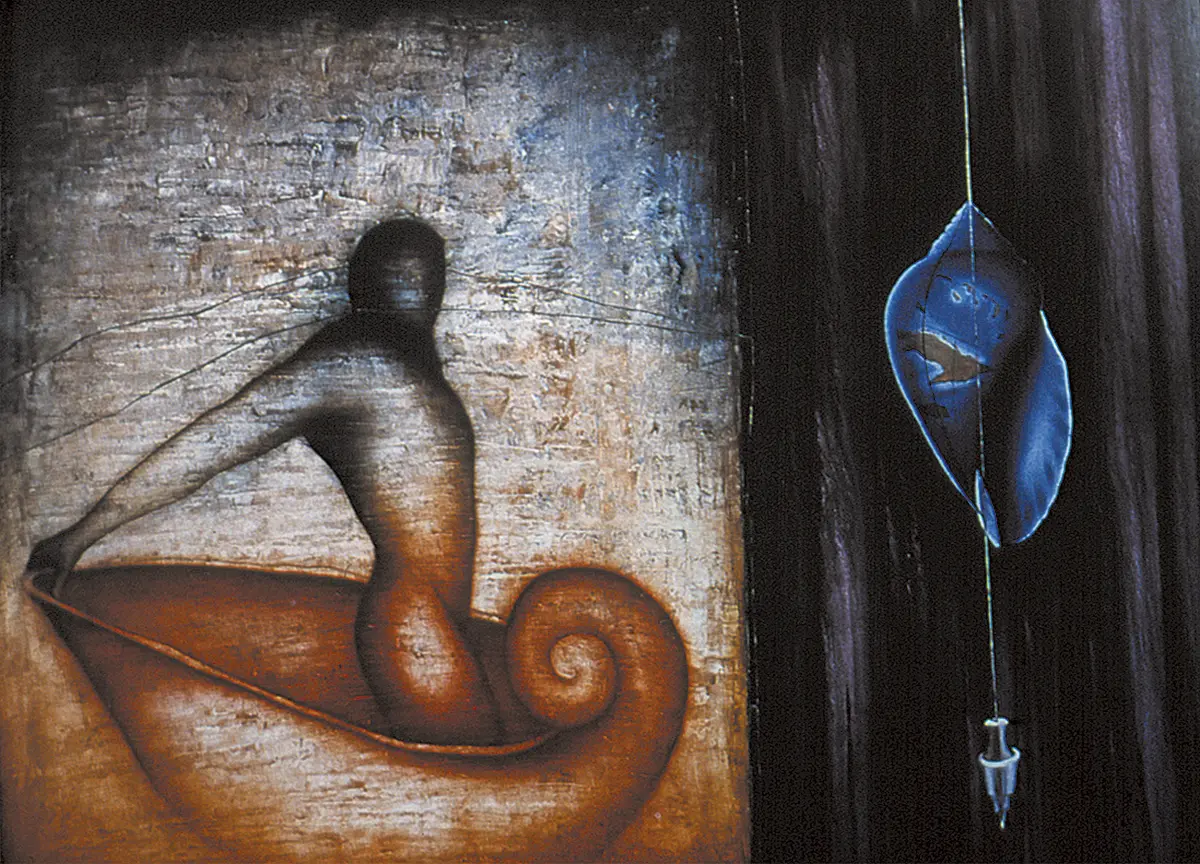
In 1995, as the massive exodus of Cuban balseros went on, Castro developed a new theme. New organic forms appear in his canvases, specifically the snail, a symbol of the home and of the traveler who carries his home on its shoulders (Bleu [Blue], 1998). Cuba’s map, as well as the balsero, also appears in some of the pieces (Fuga nocturna [Night Escape], 1995). They are symbols that avoid being anecdotal due to Castro’s contextual treatment of them in each individual painting.
From the marine theme forward — and surely influenced by the pneumatic inner tubes used by the balseros — Castro develops several paintings where figures appear enclosed in circular spaces. The composition and the treatment of color in these paintings are particularly attractive. In Entre dos aguas (Between Two Waters), 1998, the two figures tangled up in the middle of the inner tube reinforce the dynamics of the scene. The blue and iron oxide hues referencing the marine, appear in works of a more existentialist nature, like Traición e inocencia (Betrayal and Innocence), 1998, where two walking figures hold hands, the first guiding the second, without realizing that the latter one conceals a knife behind his back.
The selection ends with recent studies of color and the human figure, which are related to more universal themes like passion, fertilization, and human existence. Enormous canvases — treated with varnishes that could stand out themselves as abstract works — serve as backgrounds to the figures that walk on a tightrope or float adrift on an aquatic background. It is obvious, that Castro has reached maturity in his pictorial works. These pieces, like Invasión (Invasion), 2001, and Cuerda Floja (Tight Rope), 2001, show total technical as well as thematic mastery.
Perhaps this is the reason why he explores the realms of sculpture and installation. The exhibit presents various works in bronze: Minotauro, 2001, a torso that makes reference to the work done in Paris; Maredón, 2001, a character sitting on a chair with his hands tied and strangled by an oar; and El muro de los lamentos (The Wailing Wall), 2001, a character with an incrusted oar placed in front of a wall painted with skulls. These tridimensional pieces are of great force, but they lack the sensuality of the pictorial works. No doubt, the theme of exile is too strong to be represented in a form other than the hard image Humberto Castro depicts in his enormous bronzes.
FRANCINE BIRBRAGHER