
Birds fly high, symmetrically and identically shaped, varying only in size: a clue to the proximity of the eye that views them. Square-framed within a baby-blue sky, a computer-generated image of a black flock of birds is composed of the same figure repeated several times in different sizes. When viewed horizontally the flock moves from right to left towards the edge of the frame, yet, when seen from the top or the bottom, there seems to be no movement but a silent, motionless suspension. This is the first work one sees before visiting Iran do Espírito Santo’s (Mococa, São Paulo, 1963) solo exhibition at Galeria Fortes Vilaça, entitled Nada mais natural (Nothing more natural). It is the invitation to the exhibition.
Movement and stillness are just one of many meticulously devised dualities that are manifest in Iran’s work, both conceptually and technically. In this image, reproduced through the exhibition’s announcement, the figure of a bird is simplified to a sign whose repetition composes a pattern that one immediately associates with something known. In Iran’s work, most objects and paintings are characterized by a formal economy, which is not concerned with 1960s minimalism, or geometric abstraction. Rooted in design, most of his works represent common objects, images, and notions in contexts alien to their original existence. This form of objective displacement studies the beauty of the image/form at the same time that it makes the spectator question its original (functional, natural) role and current historical or cultural status.
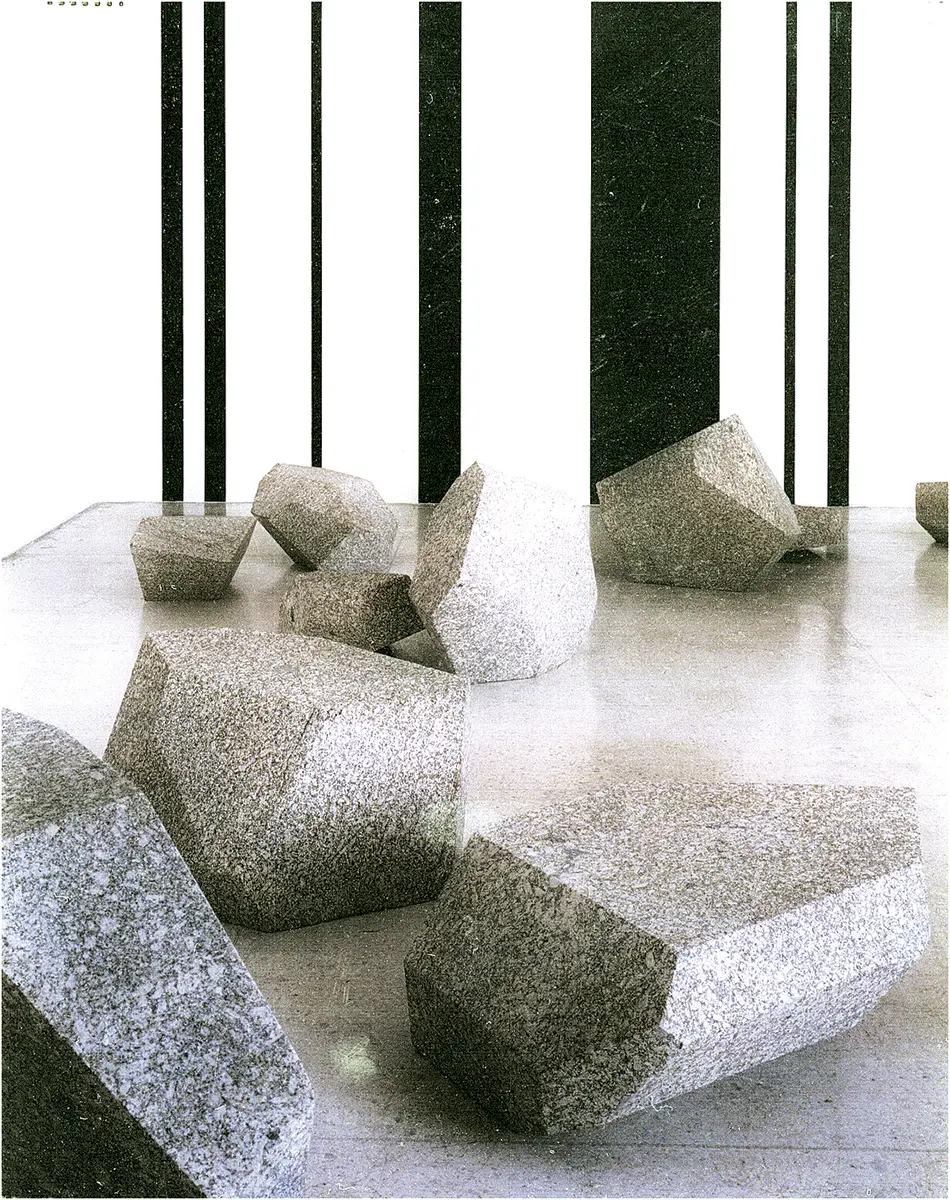
Iran’s interest in graphic and object design is closely linked to a broader concern with the use of space. Throughout his career he has incorporated the architecture of a particular space in site-specific installations or used it generically as an underlying theme and/or object for other works. In Floresta Paralela (Parallel Forest), 2000-2001 a series of thick black stripes painted with tempera on the main wall of the gallery bring to mind a gigantic bar code enlarged to architectural dimensions. Repeated minute scratches carried out with a cutting blade along the black vertical stripes, revealing the white wall beneath the layers of paint, imitate the vein-like lines of wood, a pattern that Iran has employed in numerous formats and exhibitions since the early ‘90s.
The remarkable characteristic of this work lies in its seemingly industrial quality, which even on close inspection conceals the laborious craftsmanship behind its precise execution. If in this case Iran spent days on end painting and scratching the wall to achieve such mechanical accuracy, in other works his manual ability is excluded from the ‘industrial’ process of creation altogether. Contrary to the wall paintings, the emphasis lies solely on concept and design. Such is the case with the other four works displayed in the exhibition. Opposite Floresta Paralela, resting firmly on the floor were two groups of nine and one group of six irregular blocks of gray granite measuring approximately 60 x 30 x 40 cm that were geometrically cut and polished according to their natural formation. Correções (Corrections) from 2001 are “corrections over nature’s own cuts,” the artist explains. A geometric representation of the found object, this work is almost didactic in its evident relationship with the object’s original raw state. Yet, it is chance—or an intuitively perceived “natural geometry”—that guides the direction of each straight, controlled cut. Correções are at once found objects interfered upon to become irregular polyhedrons, and land art sculptures that have been extracted from their environmental habitat and ironically placed inside the art gallery, as natural specimens.
Order, control, and reason versus chaos, instinct, and chance are divergent forces mutually present in each one of these works and what grants them the formal-conceptual tension so characteristic of Iran’s production. In this exhibition, the relationship between the natural and artificial worlds — the duality between nature and culture - increases in complexity to the point where the boundaries that distinguish each category become blurred. In Untitled (Relief, I, II, III, IV, V) from 2001, Iran took an artifact rather than nature in its pure state as the starting point for another geometric analogy. Inspired by stone fragments of revetment seen in building façades of the 1950s, Iran designed five aluminum reliefs where metal replaced the ancient material used in construction. The shadows created by converging planes were enhanced by the clean-cut quality of the objects, which were hung side by side on the wall to the right of the entrance. As occurs also with Correções and the black bands of Floresta Paralela, the repetitive aspect of serial work reinforces the interconnections between nature and artifice while geometry acts as the pivotal force of ambivalence between metaphor and reality.
On the top floor of the gallery a green woolen carpet measuring 300 x 200 cm rested quietly on the floor. Breaking the monochromatic black-gray-white quality of the ground floor works, the carpet seemed, at first sight, a little understated and out of place in comparison with the block stern bulkiness of the rest of the exhibition. Geometry is also at play here, but the carpet has texture, elicits touch, and reminds one immediately of the artificial, instantaneous world that man has neatly manufactured for a cleaner and more comfortable urban existence. Nostalgia, (1999) is the subtlest work precisely because it is so commonplace, both as an object and as an ideological concept. Paradoxically, Nostalgia adds natural warmth to a reasoned environment in which modern culture has come to replace nature; where a synthetic bed of grass brings back memories of a lost arcadia: a nostalgia for a past condition, where history and nature were synonymous.
Strategically placed at what could be the end or the beginning of the exhibition, isolated against a bare white wall next to the gallery entrance hung Untitled (keyhole) from 1999, a small convex keyhole made of stainless steel. The smooth polish of the keyhole reflects the image of the onlooker within his/her larger surroundings, subverting the voyeuristic symbolism of this object. Rather than peeping into a secret interior, the spectator sees him/herself amid groups of works that question the relationship between an environment controlled by reason (geometry), inspired by nature, and determined by modern culture. Confronted with such dualities, one can no longer remain a passive visitor to the exhibition. Untitled (keyhole) is a subtle interactive device that in itself reflects more than an optical causality: it epitomizes in form and content Iran’s artistic concerns.
VERÓNICA CORDEIRO