The pieces comprising Brazilian artist Jac Leirner at Brent Sikkema Gallery are realized through the combination of three elements: a "level"; acrylic plaques in different colors; and stickers or institutional papers of a varied nature. The organization of such elements can be described as follows: stickers and papers are framed by the transparent acrylic pieces, which, in turn, are affixed to the walls by the level (similar to a carpenter's), which works as support and can be seen through the acrylic.
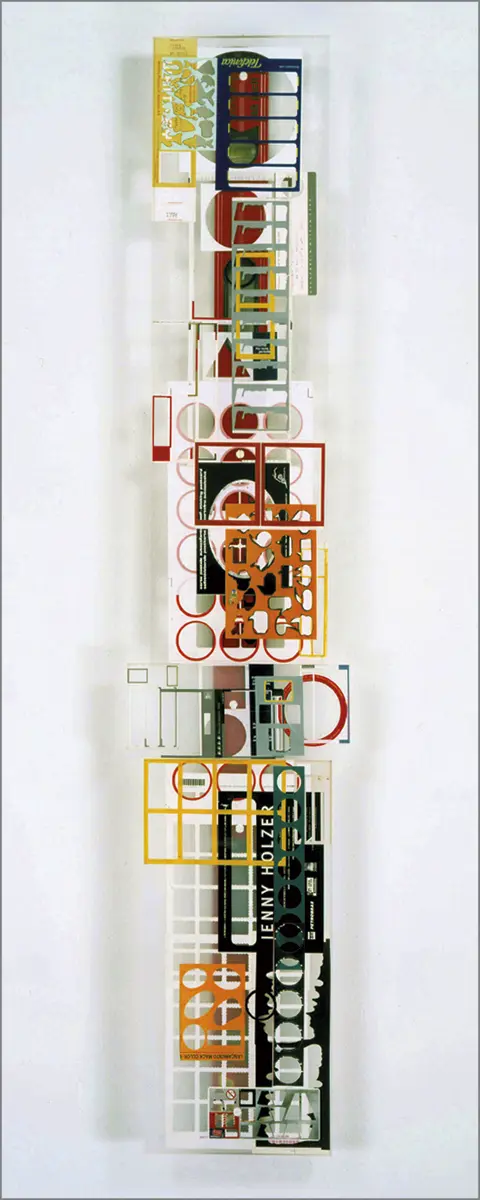
These works are, then, a complex elaboration of support for the collections of things Leirner has gathered through the decades: traveling labels for luggage; invitations; entry tickets to museums, conferences, and art fairs; assorted institutional papers; and also, in the case of this show, stickers and ads for rock bands, small promotional flyers for famous artists, etc. These images, grouped and classified here according to their color or content, are "little things" affixed to certain objects, which we tend not to notice, not to look at closely; that, or they belong in that category of papers kept inadvertently in a pocket or a wallet for weeks, until one day we find them and put them in the trash —since, despite the added value they gain through graphic design (as in the fact of sporting an institutional logo), their only function is to facilitate, for others and for a limited time, the controlled circulation of people and objects. Leirner, however, has decided to stop at these minutiae and archive them with a fetishist's care, signaling, but the very act of conservation, the fact that these little stamps are really something more than that: they are fragments of memory, identity marks, symbols of status and belonging; they are also the residue of those bureaucratic controls through which both us and our things are forced to pass. [Such attention to the issue of the value of objects has always been present in Leirner's work, already in her now classic pieces done with devaluated currency notes (Os Cem (Roda), 1986) or cigarette packs (Pulmao, 1987) which arranged thematically the artist's participation in the international visual arts market; also in works where Leirner gathered bags from museum shops, postcards from the art world, airplane blankets, correspondence between herself and some museum, etc.]
But, as I said at the beginning, what is central to this show seems less the meaning or even the order of Leirner's collections —as was the case before—, than the configuration of the support or the frame for those elements. This, to me at least, represents an important change of direction in Leirner's oeuvre. Up to now, the formal aspect of each piece emerged from the accumulation and obsessive presentation of elements, be they envelopes or shopping bags, in the space or plane of a gallery's wall. There was a relationship, perhaps organic or necessary (even a kind of purism), between the piece's total form and the form-function of each one of the units that comprised the work: the will to exhibit the collection determined organizing choices that tended toward the simple and the modular, and which ended up producing, as if in a parody of excesses, something similar to sculpture or painting. To synthesize, what I'm calling "things" are, in previous instances, the conceptual and formal matter of Leirner's work. In the current show, the emphasis has shifted from those collected items to a passion for frames, for the design of supporting structures in itself. Here, stamped papers, stickers, and tickets are not the piece's matter but, let's put it this way, it is "figure." The acrylic pieces supporting and framing them are what is "organized," composing elongated horizontal or vertical constructions that appear leaning against walls as paintings with a trimmed frame, or reclining perpendicularly like Brazilian artist Willys de Castro's "active objects". These acrylic structures show, in turn, their own support, which is those "levels" now turned from mere instruments to hang a piece of art, into an essential part of the piece's visible body —as in Nivel, which Blinky Palermo made in the 1970's.
INÉS KATZENSTEIN