A group of works created in the last decade by Colombian artist José Alejandro Restrepo (1959), titled TransHistorias (TransHistories), comprised the show at the Biblioteca Luis Angel Arango in Bogota during the months of June and August 2001. It was an exhibition curated by José Ignacio Roca with the spirit of carrying out a show of the production of an artist in the middle of his career in order to give the public a panoramic vision of his path. This is the first time that a retrospective of several video installations by the same artist has been carried out in Colombia. There were eight video installations, one installation, a video recording of one of his most recent works of theater, photographs, and an important series of engravings. José Alejandro Restrepo's work is very extensive; without exhaustively counting his pieces, there are approximately eighteen video installations, in addition to the performances, compositions, and montages for theater. This circumstance implies choosing some of them related to a concept, in this case, that of the history and myth of his work.
For this show, I would like to underscore three aspects of José Alejandro Restrepo's work that, in my mind, make it crucial, and which always help to clarify the role that contemporary art can have in society. I would first like to point out the awareness that this artist has of the use of the image. A book by Neil Leach which analyzes the phenomenon of the image in the contemporary world and sums up its problems highlights the double condition of this today: its undeniable seduction and the excess in its consumption. The contemporary individual, says Leach, is exposed to a constant sensorial distraction that leaves him in a state of fascination, a state of suspended awareness. But it is not Baudelaire's flâneur, beautifully described so many times as that character who strolls along the streets with his sharp and vibrant senses, but with his spirit subtly suffering from the awareness of the void of the splendor that surrounds him, thus becoming the modem hero. The case of contemporary man is different; he is a man who navigates in a world of permanent shock, of surprise within surprise, but disgusted and bored. Unable to respond to so many demands, he protects himself with certain anesthesia. The function of the artist in general, then, and particularly of the artist who works with photography and video, is contradictory, not to mention useless unless he is aware of the effects of this hyperconsumption.1
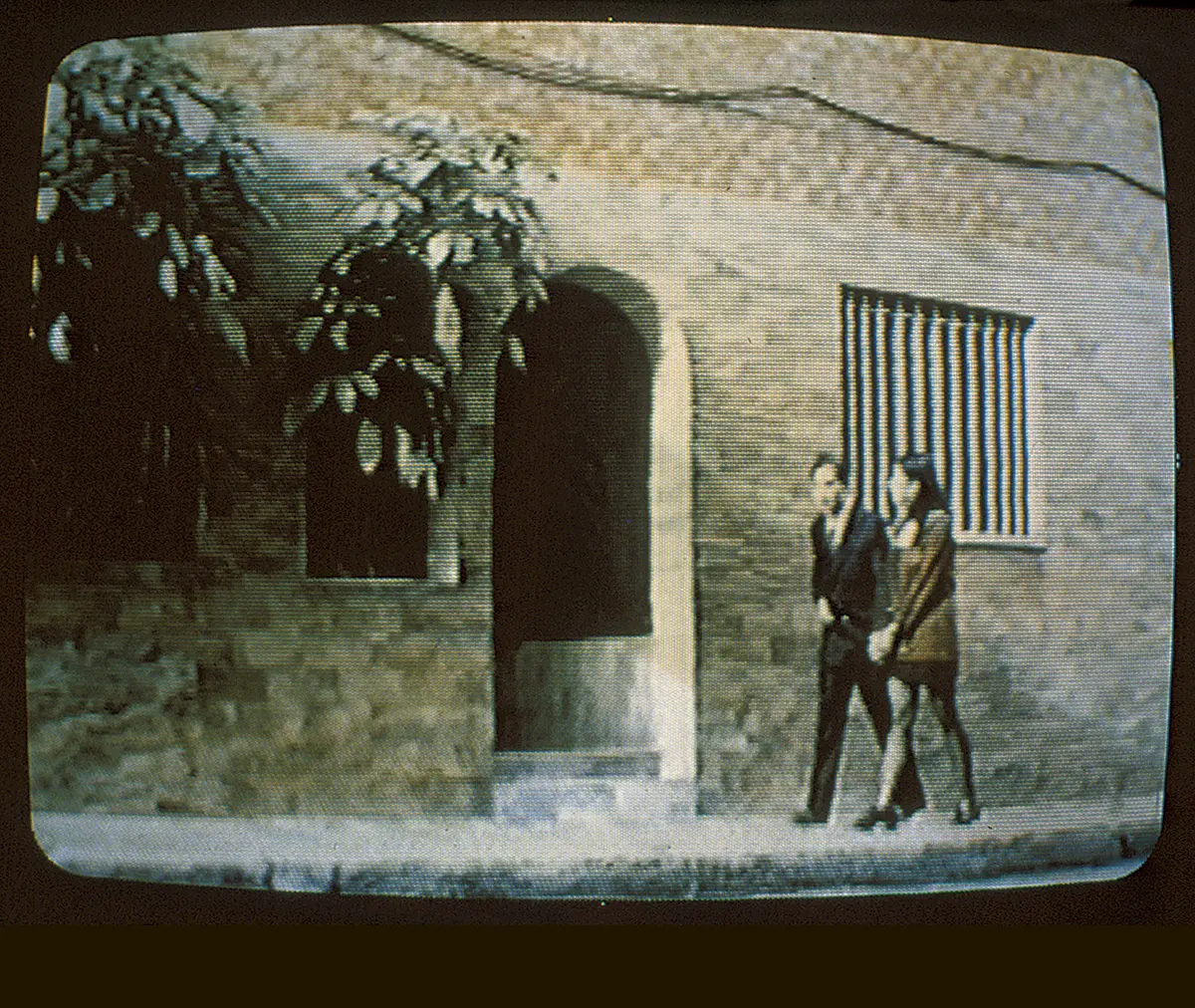
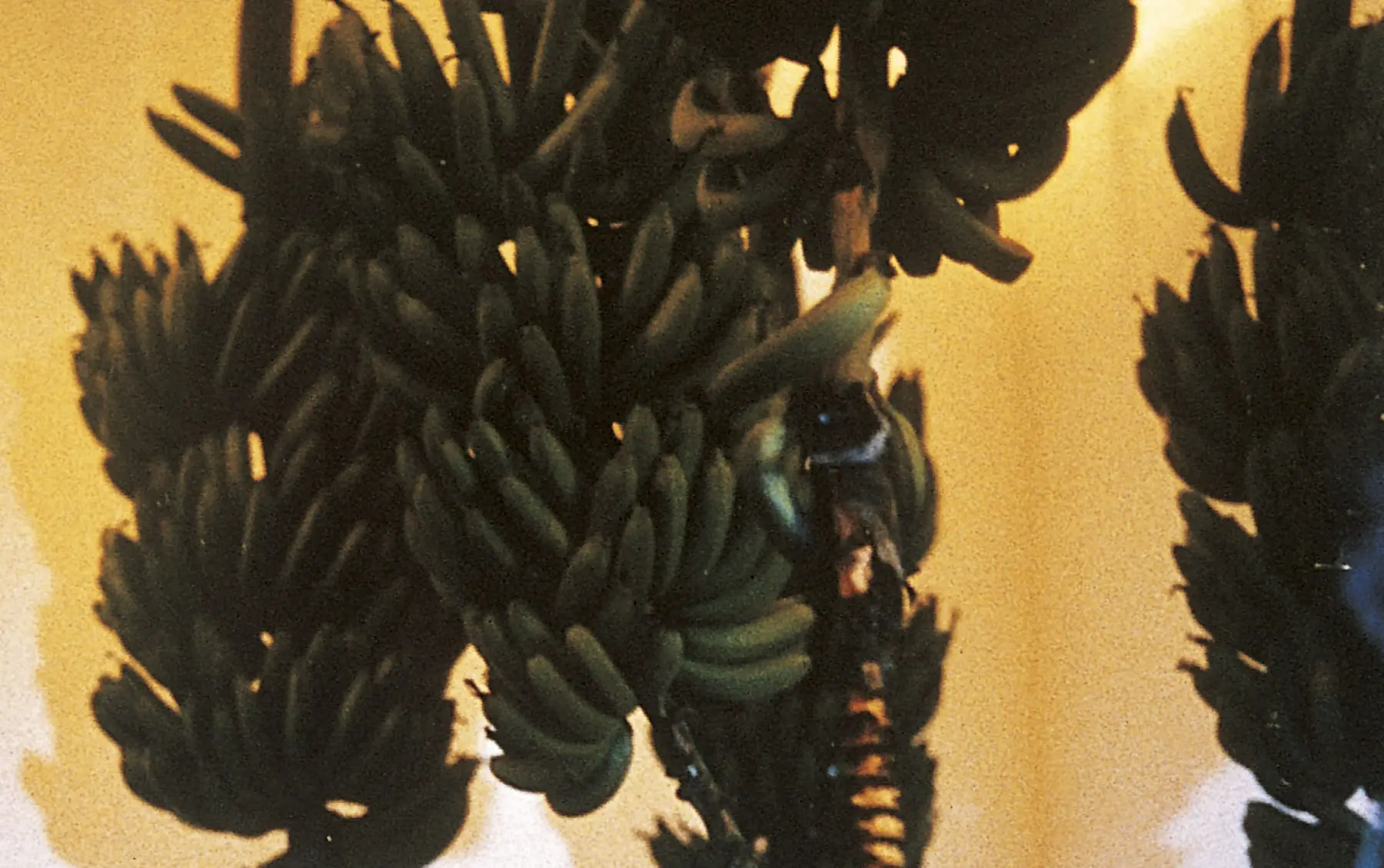
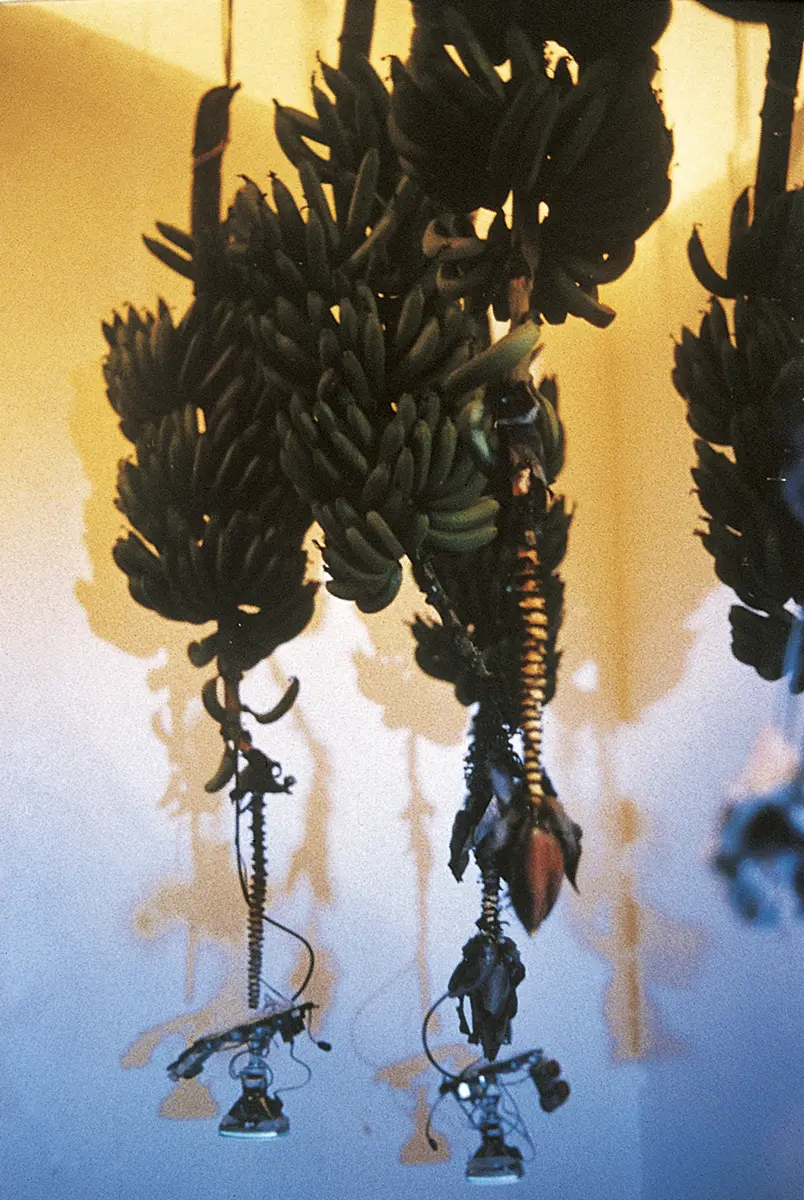
José Alejandro Restrepo, aware of the circumstances, analyzes almost taxonomically the possibilities of the image. Generally, this analysis begins, in my opinion, with the choosing of a theme that allows him to manifest the fact that he does not sufficiently believe in the splendor of the society that surrounds us, but rather that all splendor implicitly bears the suspicion of ruins and void.2 At the heart of his installations and images, there is always an ironic staging, never in black and white, of the hard or soft systems of power. And sometimes the mins and the void are more human than the splendor itself. This is the case of Musa paradisiaca (Heavenly muse). The image is based on a historical axis, that of the banana tree in Latin America, an axis crossed by the twenty-first century romantic definition of the fruit of desire, and by the violence of the twentieth century, engendered by the multimillion-dollar business of some plantations that have never shared their prosperity with the workers or laborers tied to them, thus generating geography of violence accumulated over the last eighty years. Bunches of bananas—hanging from which are small television monitors with fragments of news bulletins from the Uraba region and the heavenly images of a nude couple in the middle of the exuberance of nature—are an open system, because they displace the line of history to other places, for example, to desire, to myth, to war, and, finally, to the body of the viewer, since the bunches of bananas are a magnificent living fact that breathes and also deteriorates before the viewer.
This work formulates a disorienting situation in a world of multiple meanings, which brings a consequence an attitude of the contemporary thinker, as James Clifford says, of "being in the culture while the culture is being looked at."3 The contemporary artist, following this same author, would then have a perpetually displaced method of thought, with a focus that begins with the particular, as in this case, the bunches of bananas, violence, and the Uraba regions, but with a breadth of a comparative movement that leads him to superimpose attitudes of different periods, like myth or mass media, something close to contemporary ethnography which is characterized by confronting the permanent superimposition of different moments.
The images of Restrepo's works thus have the function of moving from the line of power toward other ideological spaces and niches inhabited in other ways that are often forgotten. In its way, the image fulfills its traditional functions, for example, it files information that cannot be forgotten; this is why his videos recover the country's history. Also, the image comments on the historical fact, it particularizes it, stages it anew. But the image also fulfills the function of displacing that fact to other segments when it is disturbed; for example, with sound, when the image is compared to others, when it is confronted by the human body in the theater when it is linked with greater intensity to the spectators' senses, and when it is tied to desires.
At this point, we should point out the word TransHistorias, which gives the show its name. It is a key tool of thought in the work of Gilles Deleuze and Felix Guattari, and it refers here to moving ideologically in a line defined by official discourses. However, on that itinerary we find that the circumstances, the essences that cross them, are more important than the line itself, that is than the power itself. And these circumstances, small events, partial objects, would demand to be diverted from the previously fixed itinerary and to dare to remain for a while within them, to inhabit them, and to make them visible. That is, to undermine a unique system of power. This ability for ideological movement is a possibility that lies in the very nature of art.
Myth in his work would also have to do with that awareness of the use of the image to which I am referring. It would not be a matter of falling into the anxiety of the search for the new, but rather of digging out the buried motivations and drives that myths often embody, and which always allow various interpretations that generally lead to the human, and almost never too abstract generalizations. In this show, the installation Anaconda has a reference that is more phallic than uterine, as at other times. The gigantic snake, transformed by the television light, was an apparition on the wall that was both powerful and fragile at the same time, but intensely disturbing. From the recording of the anaconda in the video to the massive projection in the installation, the snake became a huge partial object with its symbolic powers, sensorially enriched, contained, and presented once again to the spectator. The artist wrote the following words about the snake:
"Anaconda is a uterine symbol, devouring and destructive, but at the same time, it is a procreator. As a water snake, "sprung from the waters," it has the connotation of rotten, of a pathogenic residue. Sometimes it also symbolizes the negative, lethal aspect of male sexuality."4
The second aspect of Restrepo's images that I would like to point out is the power that they have to separate themselves from the excessive aestheticization of the human body, from the connections of man to nature and to others, which the mass media embodies and promotes. His works recover a prosaic content in the image; by this, I mean to say not idealized, run-of-the-mill, that allows us to recognize the desires that do not turn us into heroes, but rather, on the contrary, they make us similar to human nature. This is the case of the treatment that he gives to the characters that the official history turns into heroes. Orestes Síndice, the composer of the national hymn, is captured, so to speak, in Orestiada through his circumstances. This European opera singer died in the tropics, which has forces that sweep away any attempt at stylization. In this show, again, the historical formulation is displaced to different niches: today, his house is abandoned, in the middle of the downpours and the wind and cow-dung roof, as the video shows, the tropical heat with its downpours and the music and the sound that is a very important element because it allows the viewer to be able to compare the figure of the hero with other worlds, like that of the opera, but also with a human voice that coughs and which is superimposed on the first, and with the noises of nature. In this version, there is also a silent image of the human ear, perhaps in order to emphasize that this organ is a door for the image to be affected by other resonances, and also the historical account that opens up on multiple roads of interpretation.
Humboldt & Bonpland taxidermistas (Humboldt & Bonpland taxidermists) is an adaptation of the work of Venezuelan artist Ibsen Ramirez, where the geography analyzed by the two naturalists of the nineteenth century becomes interwoven with themselves, with their subjective lived experiences. Humboldt and Bonpland fall ill, desire one another, search for one another, and repel one another, with almost imperceptible gestures. They are common, everyday human beings. In this free adaptation of the original work, without making them atypical or folkloric, he is able to weave these two men with the complexity of nature that surrounds them. The video presents landscapes with rivers and mountains; that is, the possible paths of these two researchers in America. In front of the screen, the actors formulate their human drama and they sometimes appear in the image through animation effects within nature. The treatment of the theme where nature, both geographical and human, has the lead role, the mix of theater and video, animation, and the dialogues of the characters, all make the idea of scientific objectivity more ironic. The artist outlines the research that is called "scientific," but also art, not as a subject and an object, but rather as two organisms that interact and mutually transform one another. This work is eye-catching, a non-passive act whereby we look at that which looks at us, as Georges Didi-Huberman would say.5
The word "Trans" has to do with permanently passing from one side to another, and that is why we must cite (even though it is not in the show) the work Atrio y Nave Central (Atrium and central Nave), in which we pass to both sides of love, both incomprehensible due to the discourse, and only similar through myth. The prosaic side of the couples that meet in the motels in the street, and the sanctuary, which is the space of the meeting and also of the tensions of the problem of the nature of man and woman, which is only capable of showing the tensions, more than the discourse, the images, and the fragments of a myth like that of Diana and Actaeon.
The word "Trans" also has to do with proposing several sides of a definition. This is the case of the photographs of the Indian and the anthropologist kept in a museum case of the installation Ojo por diente (A tooth for an eye); one is defined by the official history as a cannibal and the other as a scientist, but whose portraits lead us to think about other possible definitions, like those of an anthropologist hidden behind a classifying vision and a living Indian, a human being who laughs with the visitor. As I see it, rooted within the comparison of these two images in a museum case is the extension of the fixed concept that is learned from the Indian and the white man. The image in Restrepo's work also serves to open segments in other directions, which destabilizes the power of a single interpretation, the power of a single look.
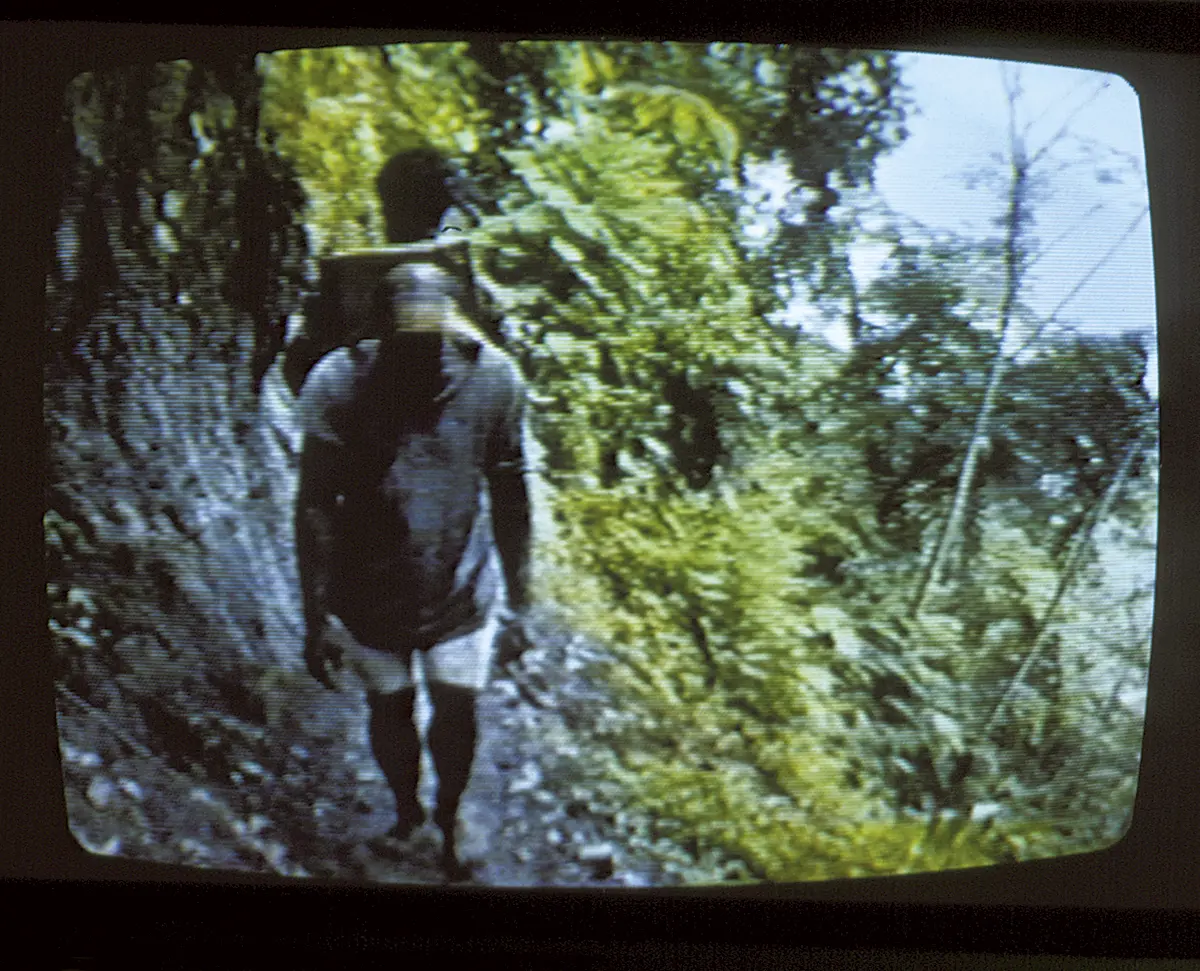
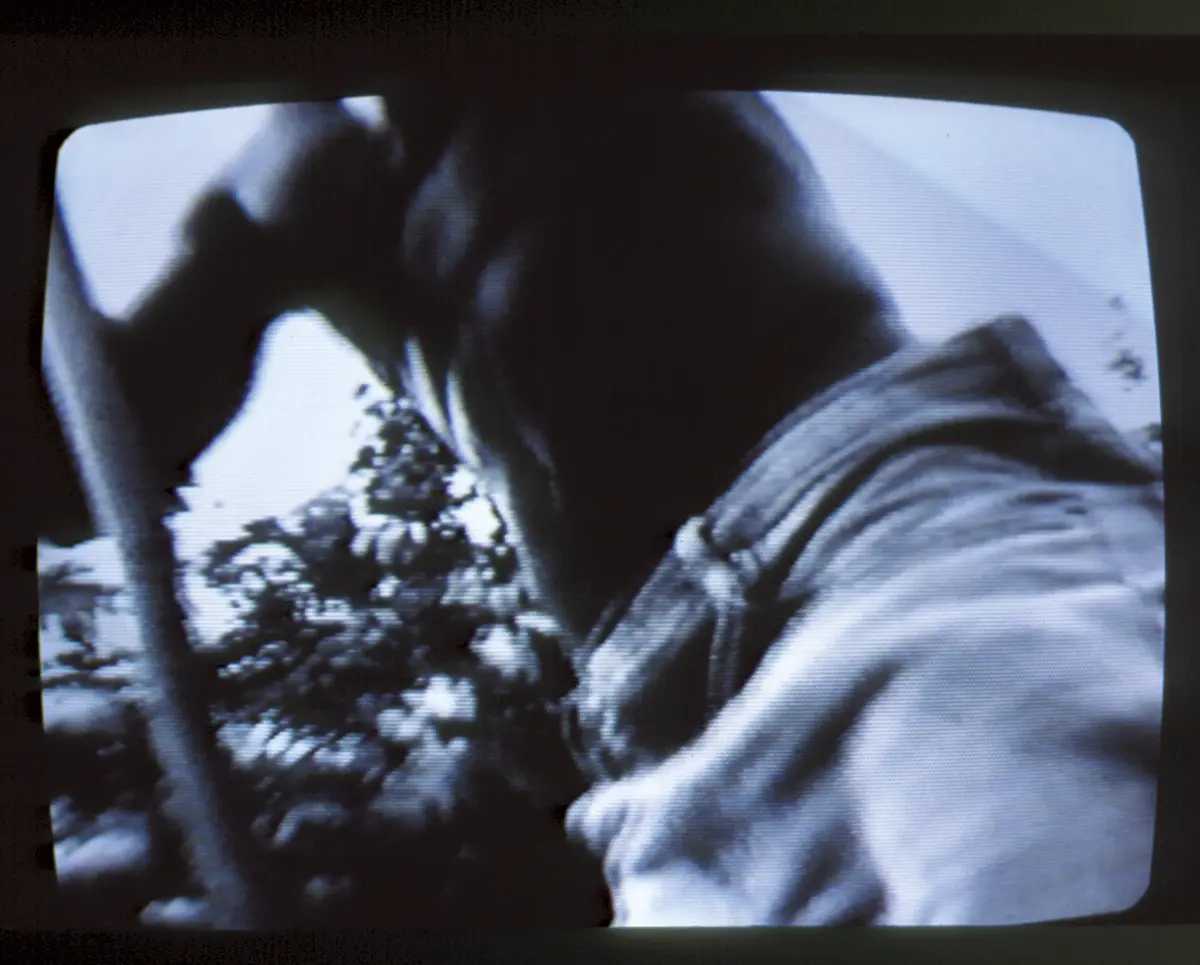
The third aspect of Restrepo's work that I wish to point out deals with Roland Barthes,6 and it consists of searching for a place that is not a huge generality, but rather a tight, intimate niche in order to penetrate it from within and to be able to describe or bring to light the acts and the feelings. More than general concepts, the circumstances are what is important, the almost microscopic gestures imposed by the general discourse of politics, education, religious beliefs, and the media. In that niche, the artist can protect himself from the uniformity of aestheticization in order to recover events from real life that are concealed by official accounts. Restrepo's works often begin with an investigation in places forgotten by the official culture of our country. The songs for burying the dead were recovered by the artist in lost areas of the savannas of Cordoba, where there lives an old singer who keeps the tradition of dairy songs; they are calls and screams, goodbyes to the dead. In the installation Canto de muerte (Death song), they are connected to the mythical image of Caronte, synthesized in the powerful arms of an oarsman. The intimate places to which Barthes refers, where the artist can investigate with greater propriety, are also small journeys that lie at the margin of habitual journeys, and they are therefore invisible. The two versions of the Passage through Quindio are short crossings, but historically significant on account of their paradox, like the video installation El Paso del Quindio II (Passage through Quindio II), in which Avelino, an old carrier like those of the nineteenth century, crosses the gorges of the mountain range with people on his shoulders. This specific segment is a problem of micropolitics in which there is a rejection of the notion of a single abstraction, call it society, power, organization, aestheticization, or art. Once more, it is a matter of making aware and valid for the hegemonic culture the gaze and the perceptions of other individuals, like Avelino, who within their circumstances dwell, work, circulate, and also exert their powers. In El paso del Quindio I, the camera also passes through nature in small series. The journey, the wax palm trees, the frailejón flowers: it is no longer the undifferentiated landscape that surrounds the wayfarer, but rather the plants, the mountains, and the palm trees are an interlocutor of the same stature as a man: restless, humid, living, and also pierced by their circumstances.
NOTES
1. Neil Leach, The Anaesthetics of Architecture (Cambridge, MA: MIT, 1999).
2. Georges Didi-Huberman, Ce que nous voyons, ce qui nous regarde (Paris: Editions de Minuit, 1992).
3. James Clifford, The Predicament of Culture: Twentieth-Century Ethnography, Literature, and Art (Cambridge, MA: Harvard UP, 1988).
4. José Alejandro Restrepo, 23rd São Paulo Biennial (1996).
5. Georges Didi-Huberman, Ce que nous voyons, ce qui nous regarde (Paris: Editions de Minuit, 1992).
6. Cited in Gilles Deleuze, Negotiations 1972-1990 (New York: Columbia UP, 1995). Barthes is quoted herein.
NATALIA GUTIÉRREZ
Professor at the National University of Bogota.