The work of Juan Soriano (Jalisco, Mexico, 1920) has gone through different periods and has been registered in many venues of modern Mexican art. His paintings, up to the 1950s, explore Mexican costumbrismo and classical mythology, with echoes of Picasso and the thematic elements of De Chirico, the Italian artist who followed the metaphysical movement, which made a great impact on many artists of his generation in the first half of the 20th century. Soriano’s contemporary painters —he is the youngest of them all— like María Izquierdo, Manuel Rodríguez Lozano, and Julio Castellanos were not followers of the muralist school that, receiving state support, became the dominant art of post-revolutionary Mexico.
Soriano’s early marginality made it possible for him to be curious and receptive to external influences. Well-informed and traveled, the artist lived in Europe for a long period of time, where he was exposed to the great masters of Renaissance painting. He was also exposed to the Avant-Garde, which —though diffused in informal gatherings since the 1920s— still remained relatively foreign in Mexican pictorial circles.
His eccentric position within Mexican art and his assimilation of an eclectic and cosmopolitan vision, thanks to his travels and an open mind, made him participate and, to a certain extent, become a protagonist in a movement known as la ruptura (the rupture), in which Rufino Tamayo, Carlos Mérida, Manuel Felguérez, Fernando García Ponce, among others, also participated. An urban movement par excellence, where the Mexican intellectual community, formerly provincial, was able to experience a shy modernity, so incomplete and subsidiary like everything else experienced in the country. La ruptura tried to do what the literary group “translators of T. S. Eliot, Ezra Pound, and the French modern poets” called Contemporáneos achieved, bringing the national manifestations along the lines of international currents; at a time when the broken-down officialdom was no longer able to impose a dictum of a sole aesthetics, which tried to equate Mexican identity with the indigenous, while ideology was the artistic work’s frame of reference. Vasconcelos’ Ministerio de la redención (Ministry of Redemption), as it was called by the writer Christopher Domínguez Michael, had come to an end at the same time that “the revolution betrayed” came into being concurrent with the stagnation of a triumphant and institutionalized revolution whose last reservoir was the florid rhetoric of politicians —the self-appointed and zealous guardians of tradition.
Possessed by poetic lyricism, Soriano elaborated his paintings and drawings incessantly, with a playful, joyous vision of the world, evident throughout his extensive production. His work combines the mythical and the every day, the Mexican and the universal. The fusion of myths is common in every culture, but each one of them has a uniqueness and a specific variant. In Soriano, we find a vital posture. More than just the sculpture and the artist, we find a man of profound creativity, constantly celebrating life, and recreating his work with a retrospective vision. He introduces new forms and returns to the old ones. This knitting and un-knitting tells us much about the author’s own inward gaze.
His vitality is capable of transforming what is trivial into something essential and the small into the monumental. This is more evident in his sculpture, where most of his efforts have been spent in recent years. This sculptoric inclination was already present in the terracotta ceramics and in some sculpted pieces of his early years, but it has gained much force with the pictorial work. Seen more closely, his paintings, especially the ones that leave academia and the Mexican school behind, already showed sculptoric characteristics. We only have to remember his hieratic portraits of Guadalupe Martín, for instance, with the rigid forms and the quality and hardness of the metal.
Soriano’s bestiary lives fantastic and real animals copulating. What is this attraction to animals? No doubt his universe, his particular world, lies there; but this world is revealing to all since no one is foreign to everyday life. It is in what is closer to us, the immediate, the apparently trivial, where poetry is, the gaze of revelations. Soriano’s mythical universe is an amalgam of cosmogonies of different cultures: fantastic animals, feminine forms, and fertility rites.
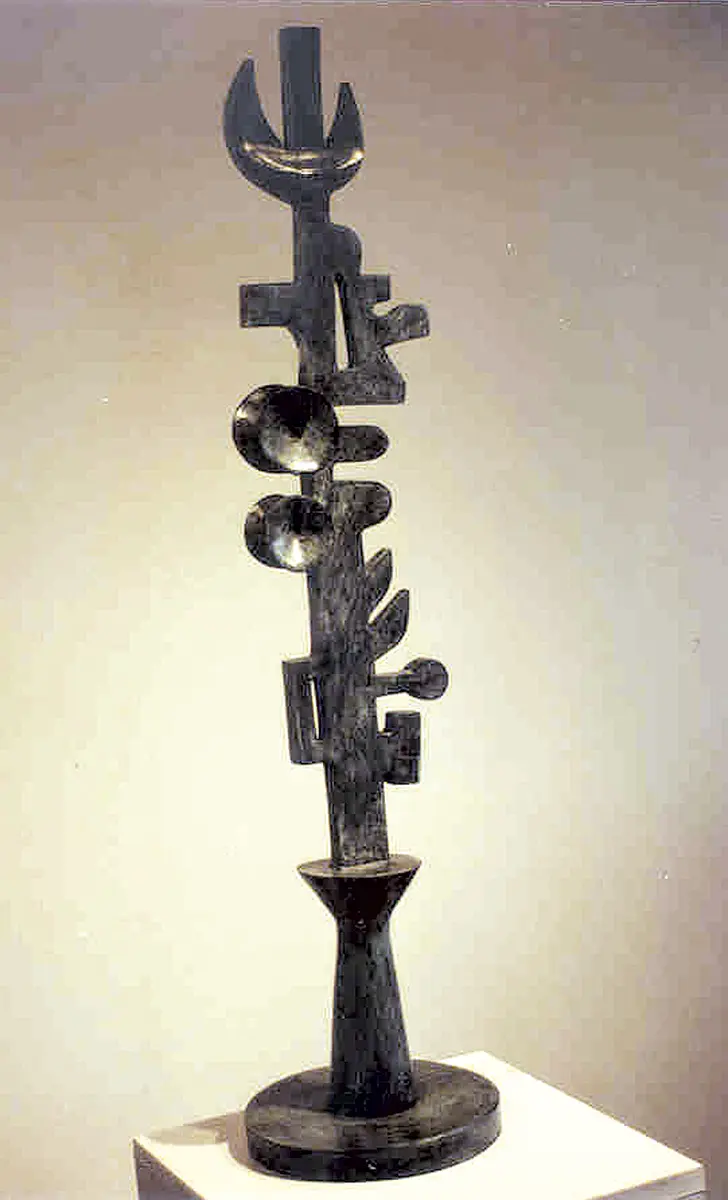
The mastery of technique, which has afforded Soriano a whole array of forms and skills while engaged in the language of sculpture, is evident in the exhibit at Galería Pablo Goebel. The use of hard textures —achieved in ceramics— gives his bronze figures an archaic and mystical quality, which reminds us of the 20th century’s great sculptoric influences, especially African and pre-Hispanic art, seen in Picasso and Henry Moore.
Of Soriano’s animals, the bull is the one with the most power and symbolism. The bull as a symbol of virility is also the Mediterranean bull, or the minotaur, or the object in Mithra’s cult, the one of pristine fecundity, an animal of great symbolic connotations. Doves, bulls, and roosters achieve great visual weight and solidity in Soriano’s hands; and this is not so much due to the material or style, but to the artist’s ability to bestow them with this quality. This is more evident in the larger sculptures. It is not surprising that this monumentality is the artist’s particular skill as a sculptor, and that these pieces are celebrated in public places where they form part of the surrounding architectural environment. Two well-known examples of these are: El toro (The Bull) of the Grijalva river in Tabasco, and La paloma (The Dove) at the Museo de Arte Contemporáneo de Monterrey.
ERNESTO SOSA