
Leda Catunada’s mixed media works at once amuse and challenge. Composed of large, multi-layered, loosely interwoven pieces of richly colored cloth, the Brazilian artist’s engaging works transform paintings into softly pliable, three-dimensional wall reliefs. Ten Covers (2000), radiantly depicts Catunada’s technique. Eleven curving, multi-layered pieces of fabric overlap, one above the next creating a ground of brilliantly hued, parallel waves of vibrant textures. Some of the wave-shaped pieces use terrycloth printed with orca whales or orange tropical fish against a cobalt sea, traced with brushstrokes of bright blue pigment. Others reveal pieces of lacy white oilcloth and are covered with a layer of clear plastic accented by green and yellow brushstrokes. Another wave presents orange lace covered by a layer of fine tangerine tulle. Color and texture separate each wave, creating an undulating surface of tropical tones, orange to blue, green to orange to blue.
In Seven Drops (2001), the wave-shaped forms interweave in such a way that tongue-shaped pieces of fabric appear to have been inserted through the adjacent wave. Black, white, magenta, orange, gray, tan, and red waves, some covered in plastic, are all highlighted with brushstrokes that add a dimensional quality to the surface flow. Cigarras Beach also from 2001, continues the interwoven layering of wave and tongue-shaped swathes but incorporates photography to resonant effect. Wave after wave of fabric projects the same idyllic beach scene photograph, printed on voile adhered to canvas, creating a softly luminous impression outlined in blue pigment. Alternating with the seaside views are waves of jet-black velvet, accented with scant smears of white paint. The smaller flaps of voile that hang over the waves of black, present portions of the beach photograph hidden from view, hence they act as windows opening onto the landscape behind the dark waves. Multiple layers and literal, photographic perspectives create varied sensations of space in this work, in effect challenging the viewer’s initial impressions. Like numerous other pieces in this show, the longer one studies the work, the more challenging it becomes.
Biting humor also permeates many of Catunada’s works. In Priests from 2001, the tongue-shaped cloth shape evident in her other works becomes the focal point of this frameless piece. Multiple, brilliant red velvet shapes filled with stuffing and outlined with regal purple pigment are sewn together in a voluptuous bunch that cascades down the wall. It is a palpable, piquant vision made more so by its title. The red velvet outlined in purple recalls the robes of clergymen. Hence the relief assumes a subversive tone, in which the sacred has been cut, stuffed, sewn, and displayed as a teasingly provocative object for our consumption.
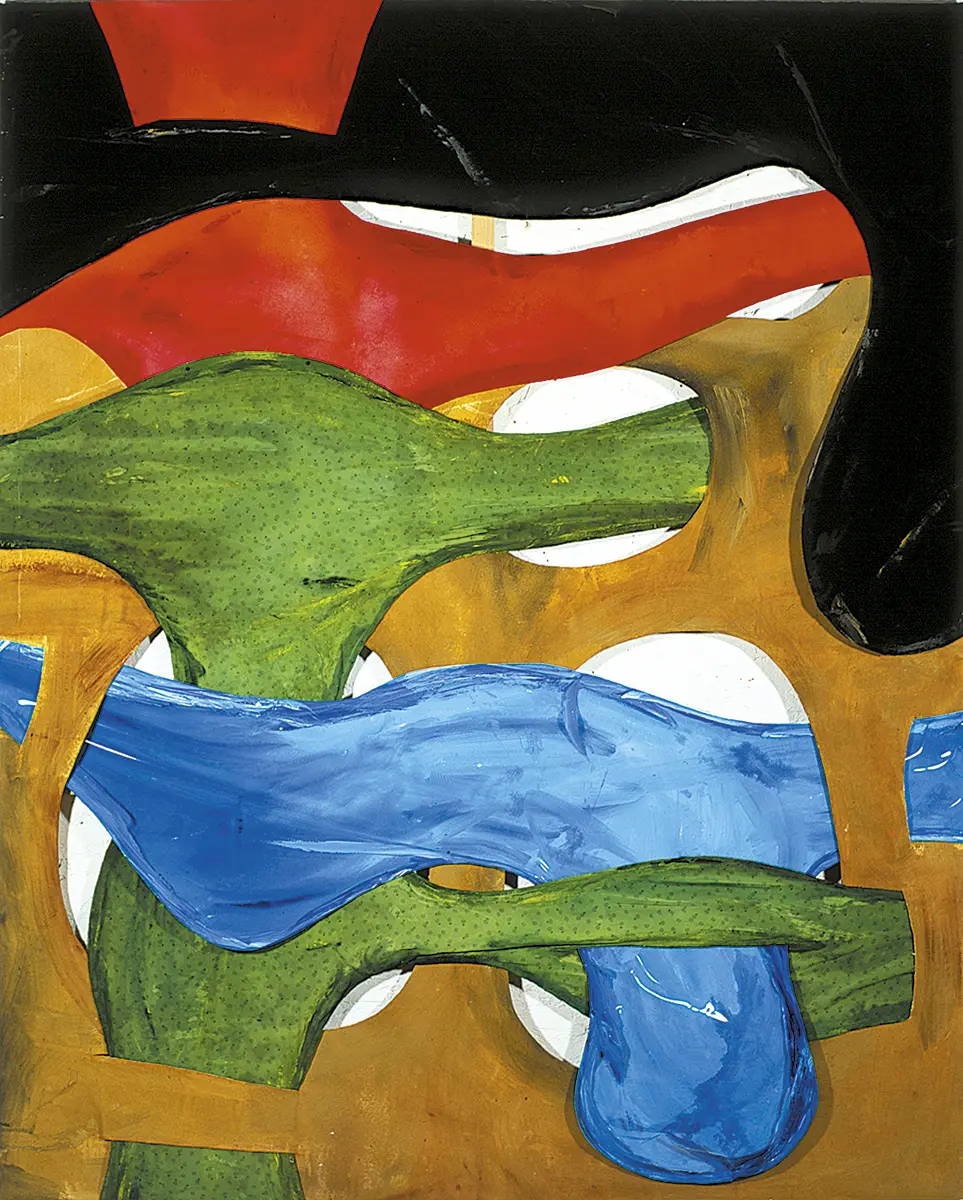
The most powerful work in the exhibition is Five Parts II (2000) because it literally dissects the stretched canvas into an interwoven collage of monumental, richly colored forms that remind one of Frank Stella’s wall reliefs from the late 1970s. Large, red, green, blue, and black canvas pieces shaped like enormous, fluid brushstrokes, wind in and out of gaping holes cut from the tan-colored ground. Open spaces around the interwoven forms reveal the wall behind the painting. This work, like most of the pieces in the show, relies upon the painted ground, however contorted, but celebrates the sculptural, three-dimensional qualities intrinsic to the piece. Ultimately, Catunada’s tactile expressions evocatively challenge the viewer’s definitions of painting and sculpture, by blurring the distinctions between the two.
MARY SCHNEIDER ENRÍQUEZ