Luisa Richter. Hojas de mi diario (Pages from my Diary), held at the Museo de la Estampa y del Diseño Carlos Cruz-Díez, shows that Richter uses graphic arts as a constant resource in her creative process. Once again, this artist demonstrates her skills in an oeuvre that has become richer with the years. This selection developed between 1961 and 1998, shows Richter's craftsmanship, creativity, and passion for the graphic arts. Here the print goes beyond its borders to become a hybrid of multiple possibilities. She combines different techniques: serigraphy intervened with watercolors, lithography intervened with pencil, gouache on print, collage, and etchings, to mention just some of the combinations afforded by these media.
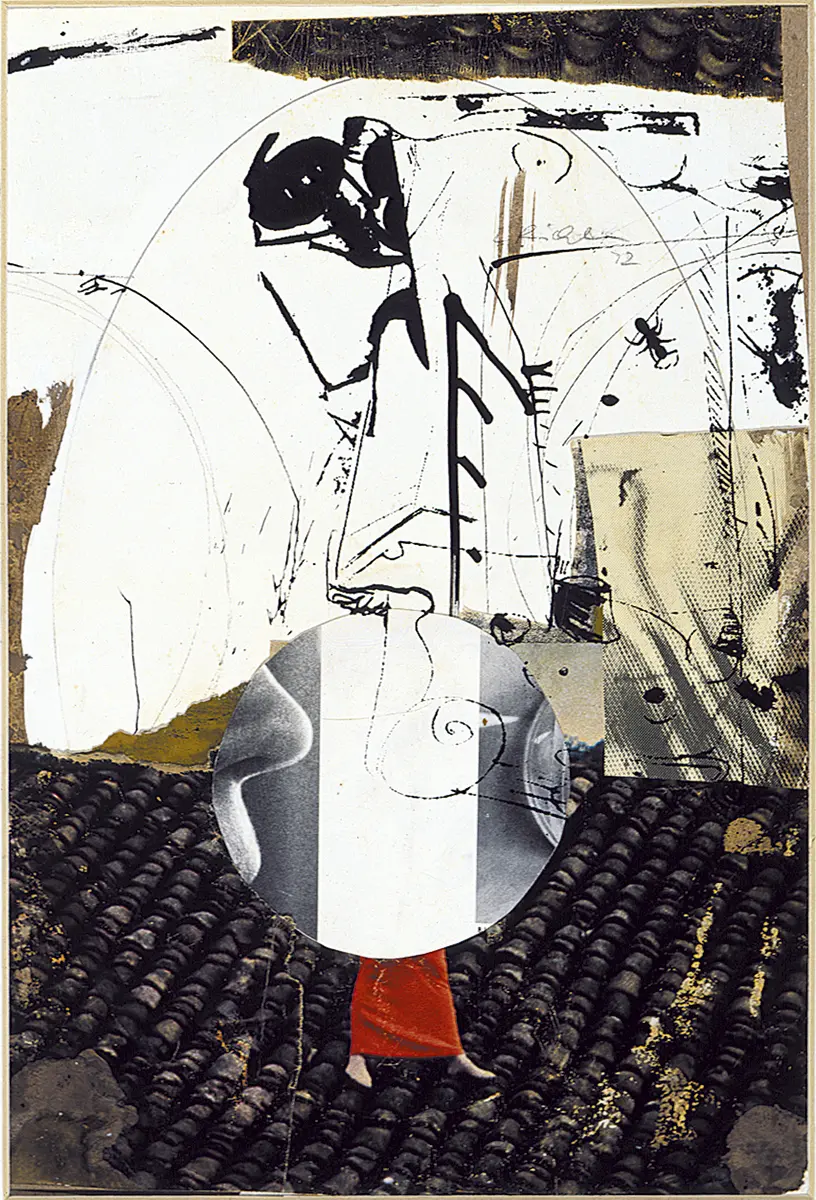
Richter's style is defined by visual exploration and different modes of composition. She breaks away from forms to later give them a chaotic ordering she got from collage and from informal language. The activation of space by incorporating maps, stains, numbers, and forms enhances the reading, for the contrasts between empty and filled space, print, and intervention, add on a whole new array of different textures. Richter, notwithstanding, keeps her own style, for, as any good artist does, she has set her own limitations. This is how format, technique, palette, and language itself are carefully selected to develop a personal alphabet. At this crossroads, the artist creates in order to search for something new, based on intuition, yearning, and experience. Her search has turned into a permanent passion. Some of the pieces show an overly-wrought baroque style, like the ones titled, Para Ovidio: El arte de amar (To Ovid: The Art of Love) (Hojas de mi diario, 1977 series; lithography and collage) or La sonámbula/El crepúsculo (Somnambulist/Crepuscule) (Hojas de mi diario, 1972-1973 series; collage on serigraphy). Other prints show the economy of elements used in purely abstract themes, conveying limited and unlimited pictorial space. Furrowed merely by simple and dismembered lines, reaching the extremes of almost absolute immateriality, we see a space activated by the eloquence of a few strokes; such is the case of Subyacen lineamientos (Guidelines Lie Underneath) (1993, burin) and Entrehilados (Interweavings) (1995, etching and burin). Here is where one has to understand the passage of time, which is constantly oscillating between excess and balance —in the creative process as well. In this proposal one can tell the dichotomy between speed and stillness, for the forms seem to have stopped and settled in the format the artist has designed for the occurrence, after their coming about, causing visual clashes that are masterly elaborated. Coincidence, randomness, and ambiguity appear to have intervened in the creative process. Conscious of the dadaist and surrealist proposal that the juxtaposition of images offers, Richter wants to demonstrate the coming-about of our speedy contemporaneity an amalgam of impressions, fleeting moments, and constant technological invasions as a reflection of a life forged by successive and unexpected changes. She defines it in these words: "An ordering of impressions: a wholeness of fragments..." We can imagine then a conglomerate of memories, visions, and sensations all seen as images of an eternal present.
The validity of the fragment lies in the fact that it represents a portion of a totality that, in our time, is always changing. That is why its discourse does not come to a conclusion as it does not end. Our contemporaneity is defined with precision, especially in the era of "globalization," when the feeling of "no place" has formed a culture, the result of travels, the aperture to new modes of thinking, and the result of a continuous coming-about. Susana Benko, the curator, has put it well in her own words when she says that "a unitary image would never encompass the infinite; rather, it shows it by means of its fragmented, illogical, and disorderly condition. If it were responding to rational, narrative syntax, it would not express the urge for the infinite, precisely the one that motivates creation as a constant yearning for transcendence".
GLADYS YUNES