
Los signos de los dioses (The Signs of the Gods), mixed technique on canvas, welcomes the visitor. It comprises seven horizontal large-format canvases, and it places the spectator immediately in a pictorial world of black lines intersecting one another, essential geometric figures, and color, plenty of colors.
In this entry to the show, our attention is called to the magical alteration of light and shadows in the format. On the one hand, the dark tone of the mostly playful and coy brushstrokes emphasizes chromatic contrasts; on the other, the caressing luminescence of the cream hues stumps the whole, as if in some kind of foamy dreamlike vision.
The show includes 34 paintings in various techniques: oil, acrylic, and pastel on canvas and wood; Miliani also seeks, in some cases, the particular effect of materials such as gold and copper dust, oxides, and ground marble. As for the dimensions of his pieces, they come in an variety of formats.
It is, in any event, a fresh proposal, distilled in its form and its content. The viewer notices a multiplicity of textures enriching the superposition of planes, and the occasional sfumato alleviating the figures' linear strictures. Miliani gives us order, but also chaos.
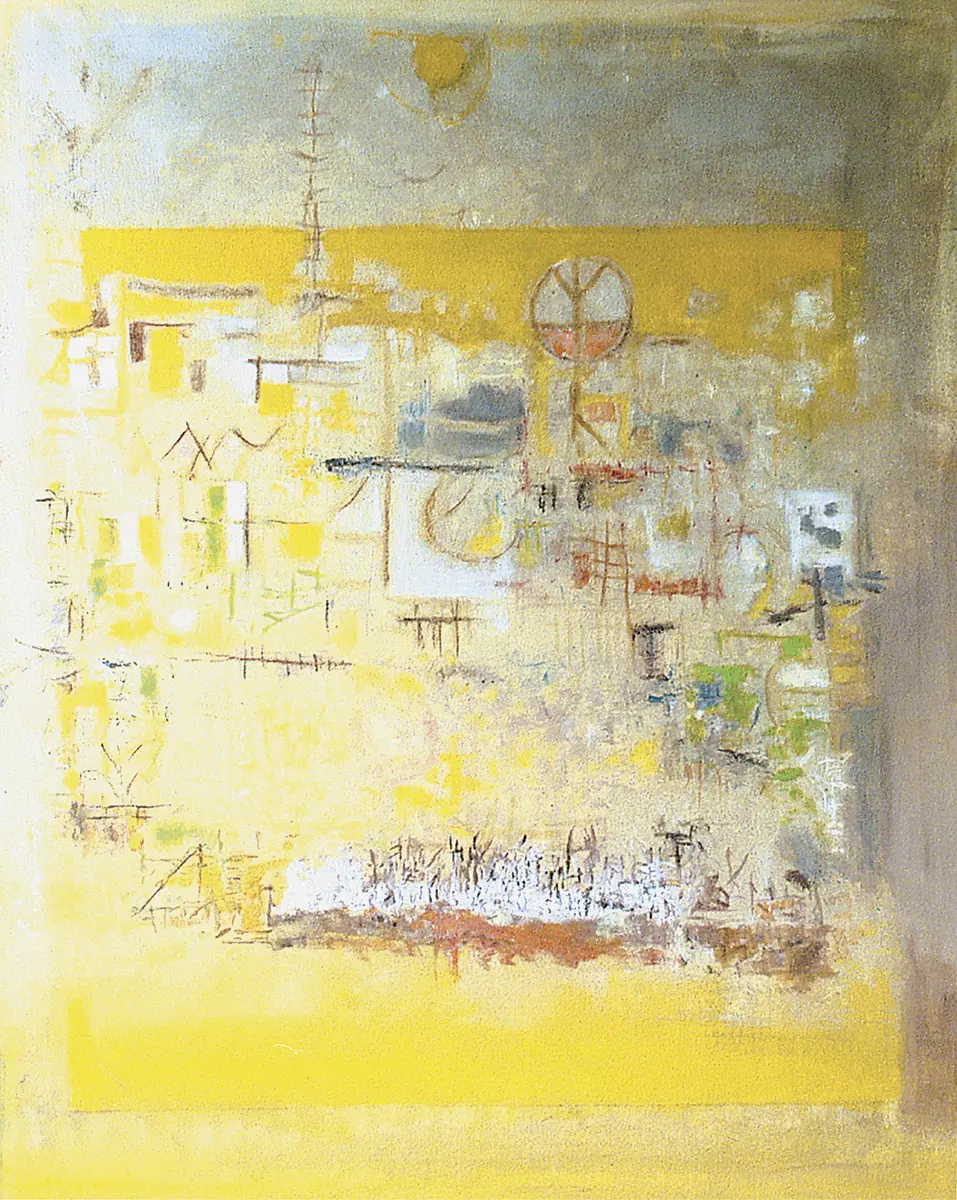
Paraguaná I. Cábala del viento (Paraguaná I. The Wind's Cabala) (acrylic on canvas) is a surprising piece, and could perhaps be appreciated independently of the rest of the show. The light emanating from Miliani's yellows envelops the visitor's eyes, while circles and squares recreated in red, orange, green, and ochre evoke, in a matter of seconds, the brightness of Paul Klee happy imaginings. The black line upon which other representations are built, the bulging, powerful black line of most of Miliani's pieces, is absent in Paraguaná I.
Miliani, 68, has had a distinguished career in Venezuelan art. He has said this show gathers his most recent work, realized since he started experimenting with small metallic sheets at his workshop in the city of Florence, Italy. "I've always thought that creating a picture is like writing a story or a poem."
The show's highest point is found in Puerta de la Umbría (The Shade's Door) I and II. Both shows open with ten wooden boards —two of them arranged as retablos— framing a series of fragmented imaginaries. The dark line returns to mark the borders of a scene in which ochre, combined with gold, silver, and copper dust, creates and recreates everything. The artist insists on calling them access doors to the cosmos.
But the show's chromatic nature is best described by the disposition of "Milianesque" colors. In Miliani's canvasses, there will always be room for lively oranges, warm reds, and yellows; there will always be a place for the birth of colder blues, sepias, grays, blacks, and browns. Any chromatic exploration is justified here; all of Miliani's explorations are wise, clean, and correct.
In terms of constructing figures, the most repeated is that of the stairs. This image helps the eye to ascend to Miliani's acrylic and pastel heavens, and to descend, bewildered, to his oil Hades. These objects take Miliani, step by step, to a profound knowledge of each and every one of the mysteries of color.
Most of Miliani's representations are arranged vertically. Vertical lines and fragments always end up touching the horizontal ones, even creating, in some cases, cross-like figures, and at the same time expressing a knowledge of spatial symmetries and balances within the work of art.
Ofrenda del rojo (The Red's Offering) (oil on canvas), El oráculo (The Oracle) (oil on canvas), Paraguaná II. Cábala del viento (Paraguaná II. The Wind's Cabala) (acrylic on canvas) where the attenuated yellows and the whitish cream hues return once again, and El cantar de los cantares (The Song of Songs) (oil and metal sheet on wood) also deserve mention. An impressive encounter of signs, lines, shades, environments, and forms.
PABLO VILLAMIZAR