
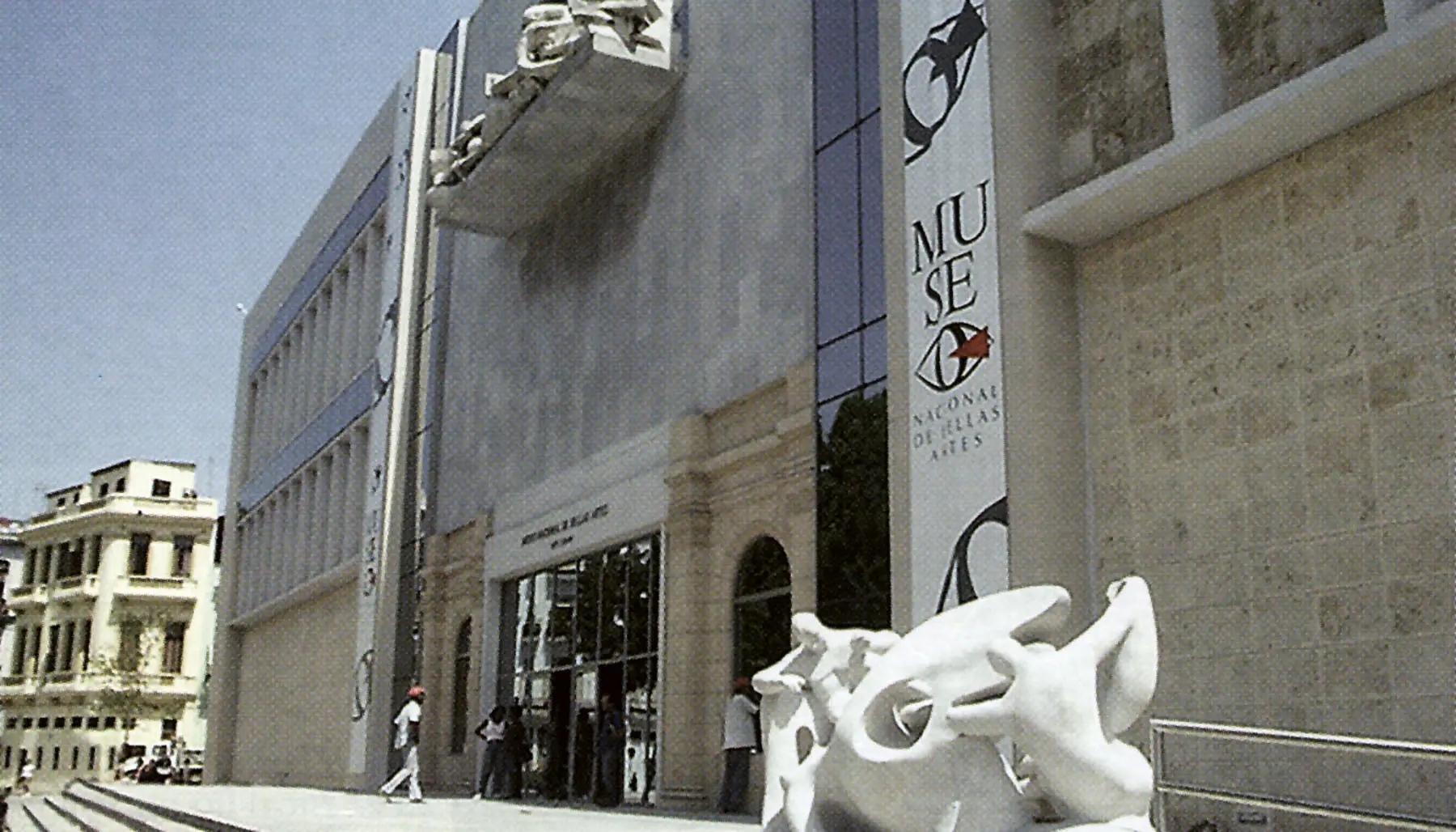
The National Museum of Fine Arts of Havana, which was closed since 1996, reopened its operations, after having been transformed and expanded, with a general project designed by architect José Linares Ferrera, who was also in charge of the museography.
The inadequate conditions of the exhibition, storage, safety, air-conditioning, and illumination led the State Council to make the decision to renovate it in a radical way. Construction began in 1999 and ended with the museum's opening on 18 July 2001, with introductory words by the Cuban President, Fidel Castro Ruz.
During the construction period, the valuable heritage fund that owns the museum, which displays 47,628 works, was moved to secure sites. Now, in addition to the old renovated center, the collection is shaped by two other restored buildings: the old Centro Asturiano and an ex-military barracks. The first two housed 2,000 works on display, while the third assumed the task of administration and research.
The building where the museum had always stood remained exclusively for the collection of Cuban art, which exhibits colonial art (eighteenth and nineteenth centuries), fin de siècle (late nineteenth and early twentieth centuries), modern art (starting with the Cuban avant-garde), and contemporary art (new generations, from the 1950s through the 1990s).
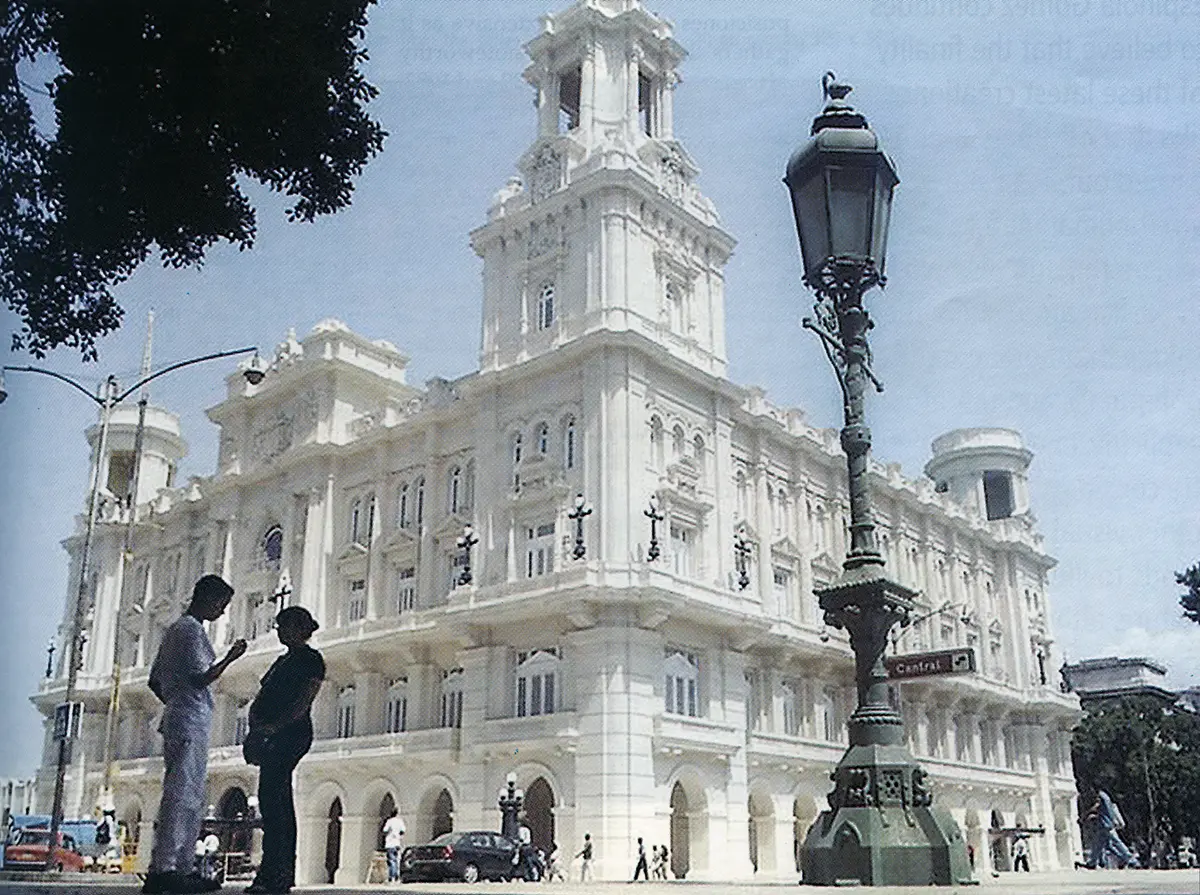
In the old Centro Asturiano, universal art was shown. It included a large collection of art from Antiquity (Egypt, Greece, and Rome) and European art galleries, with its seven basic schools (Spain, fifteenth and twentieth centuries), Germany (fifteenth to nineteenth centuries), Flanders (sixteenth and eighteenth centuries), Holland (fifteenth to seventeenth centuries), France (sixteenth to nineteenth centuries), Italy (fifteenth to twentieth centuries), and Great Britain (eighteenth and nineteenth centuries), as well as the collections of U.S. and Latin American painting. The new headquarters will offer other services, such as the Center of Documentation, with the best stock of art books in the country, an auditorium, an activities hall, and specialized stores. This is also where the warehouse and the conservation and restoration areas are located.
In the Office of Publications of the State Council's beautiful volume, El Museo Nacional de Bellas Artes. Historia de un proyecto (The National Museum of Fine Arts: history of a Project, Havana, 2001), architect José Linares explains how "we revalue and propose a new historical reading of the space that emerged after of the demolition of the walls, in 1863, in addition to opening other perspectives for coming years." The area of Havana, known today as the historic center "Heritage of Humanity, according to UNESCO" was surrounded by walls in order to protect the city from the attacks of privateers and pirates. When the walls disappeared, that area took on an exceptional appearance and coherence, Linares notes.
In urban terms, the project is assumed as a museum collection with three buildings, separated by no more than 250 meters, which allows for easy access to all. Linares adds that "the specific character of each architecture, makes it possible to identify the building with the content of its collections."
The original museum headquarters dates from 1954. It was conceived by architect Esteban Rodríguez Pichardo as a polyvalent museum, created within the codes of rationalism, which are valid for modern international architecture. Linares proposed to renovate the architectonic image and to attain its internal refunctionalization. For this, he revalued the building on an urban scale: among other changes, glazed semi-cylinders were leaned against the two longitudinal facades, with stairs to communicate between the three levels. The windows of the original project were emphasized in order to resolve better the lighting when optimally combining natural light with artificial light. A material and chromatic treatment of the facades was made, respecting the materials used in their construction (marble and stone), and the sculptural groups integrated into the building were highlighted. The ground floor was also remodeled, recovering the narrow relation that already existed in the building with the surrounding space, especially in the visual relations from the street to the patio. The spatial organization was also restructured, in connection with the eight thematic areas that translate into an equal number of museographical spaces or rooms. The central patio was also redesigned.
In the Centro Asturiano (1927), where the codes of Spanish eclecticism reached their peak, a mix of the baroque and the plateresque, the operation recovered its outer image, and all of the architectonic and decorative elements were restored, which marked it as a classic exponent of the aforementioned eclecticism. This included the revaluation of its perimetrial hallways, characteristic of the area as a space for pedestrian circulation. All of its inner architecture was respected, according to Linares, in order that the two spatial discourses might coexist, that of the building itself and that of the museum exhibitions.
The military barracks dates back to 1764 and it was the city's largest. Its building, with a trapezoidal floor plan, has been heavily transformed over time, but it preserves its best attributes: the area of the central patio with perimetral arcades, and the main baroque façade with mixed line decoration.
The existence of the Museum of Fine Arts, since its creation in 1913, in a building in central Havana, where there was a jai alai court, has been marked by a history of pilgrimages that culminated in the project by architect Pichardo, considered by Alejo Carpentier in 1957 as "one of the best museums of the continent." Nationalisms aside, although the agitated life of this institution, with so many ups and downs, seems to have ended its capital transformation in the hard economic conditions of the country, it speaks of a result that is more in tune, not only with the requirements of current Cuban society, which emphasizes even more the cultural boom but also with its future development which, regarding economic matters, looks toward the tourist industry.
*Photos by Oscar Camaraza.
ERENA HERNÁNDEZ
Art critic. Specialist from the Centro de Desarrollo de las Artes Visuales, Havana, Cuba.