Ever since she participated in the last edition of the Aragonese festival, Huesca Imagen, Patricia Martín (Mérida, Yucatán, México, 1972) has brought to the exhibition hall of the Instituto de México in Madrid two of her most recent series: Utopías del espejo (The Mirror's Utopias), presented in the Museo de Arte Contemporáneo de Oaxaca in 1999, and Residencia (Residence), shown last year in the Galería Nina Menocal in México City. Through these series, the work of the young Mexican photographer is linked with various constants found in the history of art that have a lot to do with the definition of the artist's identity. We are referring to the use of the self-portrait, repeated again and again, as a means of studying the artist's own emotional or psychological reality; the utilization (in this same genre) of the costume mask that allows the adoption of other identities or emphasizes existing traits; and the utilization of the body itself, understood as expressive physiognomy and as an artistic battleground. However, the procedures used by Martín tend to literally obscure any possible revelation. In her photographs, everything takes place in the shadows. The lines move, undo, and disfigure themselves, creating a sensation of unreality that contradicts photographic objectivity.
The mirror belongs to the realm of dreams, nightmares, and legends. It produces apparitions —giving back the images received from the past— or nullifies distances. It is the door through which the soul can displace itself and pass to the other side. It creates a double. The images of Utopías del espejo seem to have emerged from an underwater dream, where an amphibious woman, the artist, leads an enigmatic and solitary existence. She grooms, lays down as an odalisque, dons a mask for a divination séance, and surrenders to a deforming gaze: her own. A gaze that produces distortions of perspective, disproportions among parts that won't look for the blunt effect or the elegant lineal composition —as in André Kertesz, one of the first explorers of those feigned monstrosities. It is something that seeks to be internalized and hallucinatory, as emphasized by the strange chromatism of the photographs and, particularly, by one where feet and hands dance to chess on a paved Chinese-checker board.
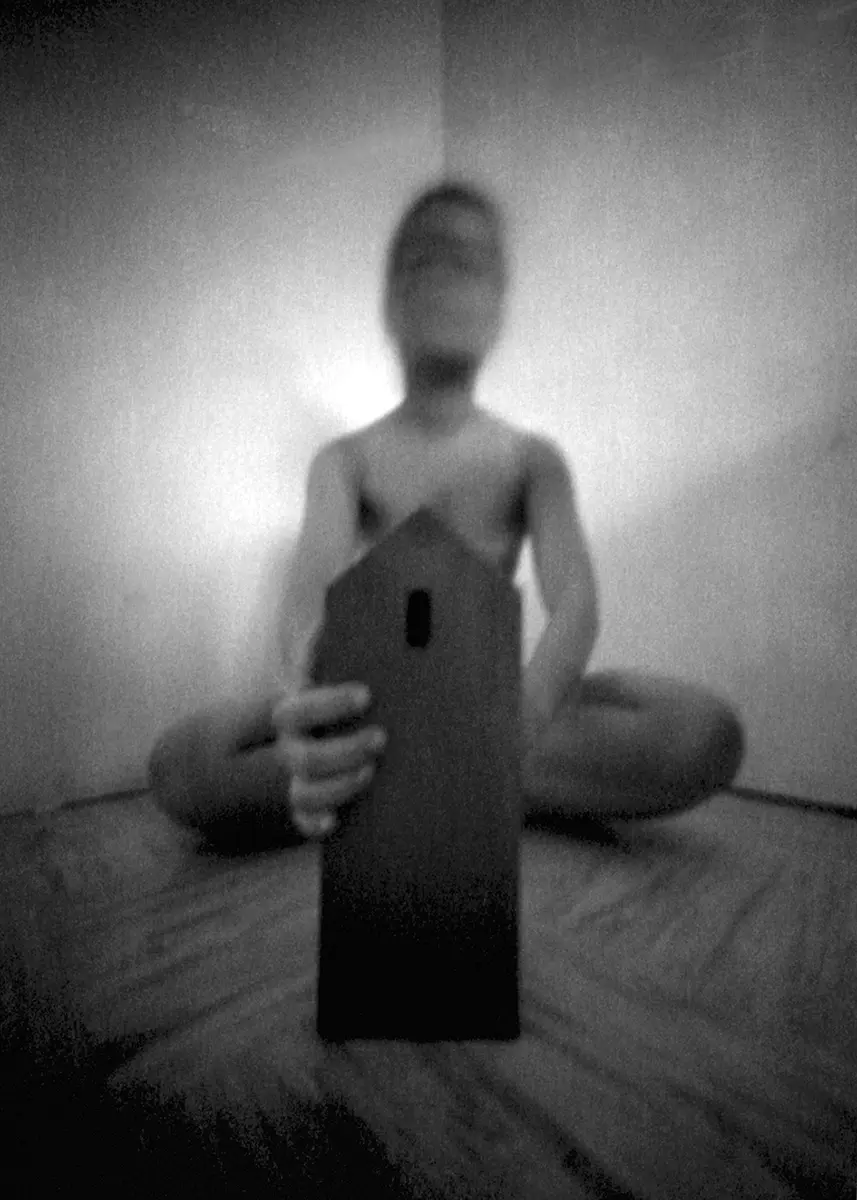
If, in previous works, like Ojos Negros, piel canela (Black Eyes, Brown Skin) (inspired by old calling cards), Patricia Martín's interest in the history of photography made itself obvious in the form of stylistic appropriations, in Residencia —of a more recent esthetic— the inclination is apparent in her selection of the most primitive camera (made of wood and cardboard) to capture the images. On the other hand, black and white exposure has been done with the most updated technologies "digital printing to sublimate ink" by means of which in the development of the project an amalgam of tradition and modernity is produced, seemingly to have been constituted as an interesting path for her and other artists. In this sense, the series reminds us of Tracey Moffat's latest work, Láudano or Los sueños (Laudanum, or The Dreams), sharing with it not only the artisan quality of the copies that alludes to old and modern pictorialismo but also to the oniric load that finds in these apparently imperfect and nebulous finishes an idyllic form of expression. Residencia is a photo gallery of ghosts, of apparitions. A part of the series, as in Utopías del espejo, presents a female nude, this time in a setting as closely identifiable with the domestic, subjected to the optic distortions previously mentioned. In the other, much more potent, the woman accompanies herself with attributes or prostheses that sometimes conceal her face. Recreations of ritualistic masking of totemic origin; but the totems, except the large head of a stag, are strange objects and somewhat abstract, besides being quite hard to recognize: a white ball, a tower, a large cannonball.
In photographic fiction, a figure withdraws and hides. Paradoxically, the public exhibition of the works brings her out of that confinement to take her, indecently, before the inquisitive gaze of the spectator. Patricia Martín, with all her technical and poetic skills, does not escape the powerful narcissistic tendency that affects today's art, situating herself in an ambiguous territory between introspection and exhibitionism.
ELENA VOZMEDIANO