
Sandra Cinto's previous exhibition at Tonya Bonakdar Gallery was an intricate exploration of lines in three dimensions. Linear drawings on the walls, combined with spider web-like cracks in glass and shadowy traces transformed the gallery space into an otherworldly landscape. With her most recent showing, the play of line continues but now it has grown into the third dimension and has taken on a decidedly sculptural manifestation.
While the exhibition is meant to be seen as an installation, it is more readily perceived as a series of objects or discreet spatial vignettes. Line and shadow are still prevalent in this show but they are complemented by photography and sculpture. Certain areas can exist quite independently, such as the space where a framed blank panel occupies a back wall, with an arm attached to/emerging from it. Another area contains a series of photographs of a little boy along with some reference to the installation itself. These mysterious pictures manage to both take the viewer out of the insular space of the installation and refer us back into it.
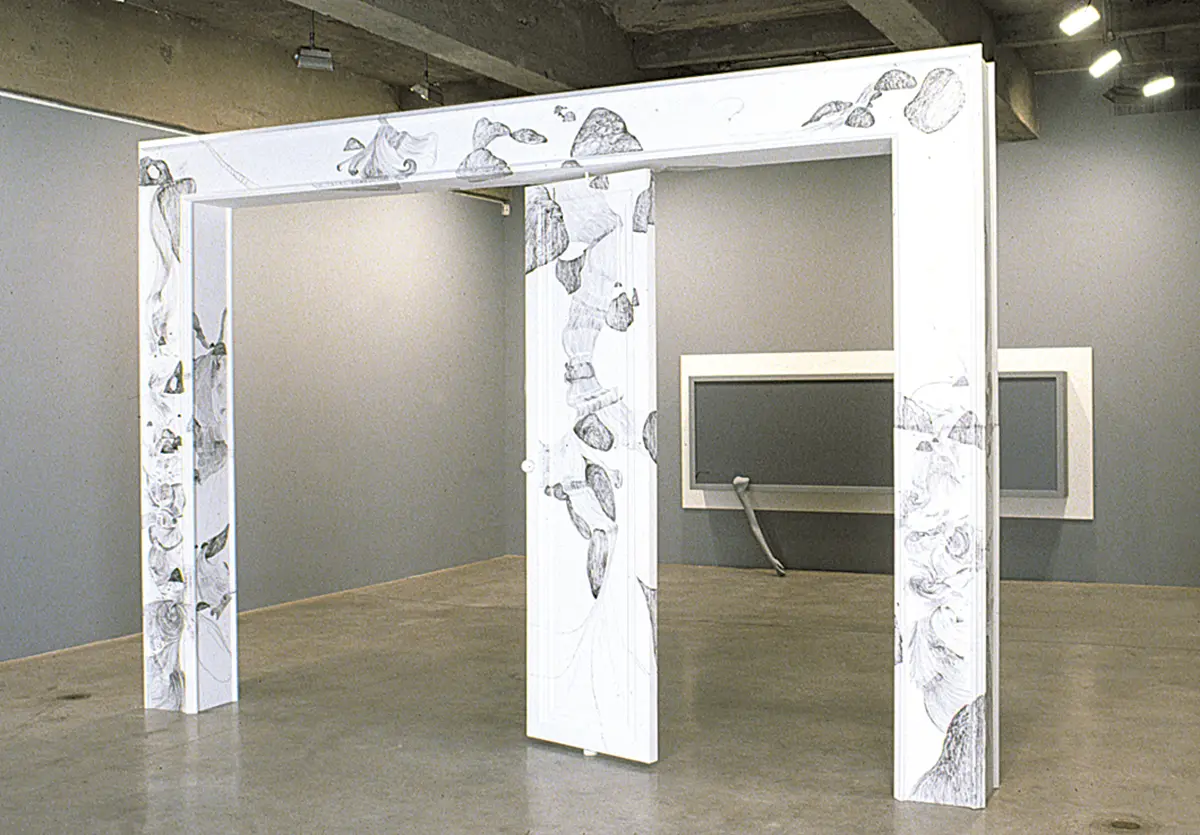
A consistent theme that permeates these pieces is the concept of frames and passages. Screens, openings, and passageways all suggest a transition of spaces and planes the way her earlier installation used line both real and implied to suggest spatial and scale distortions. What holds all of this together is a twofold strategy: to begin with, the walls are all a uniform gray, as are many of the frames and sculptures. This ties all the spaces and sculptures together and also makes the photographs all the more dramatic. Added to this slate gray are the many areas of white—usually filling door frames and marking the transitions from one area of the gallery into another. These "white" areas are actually filled with Cinto's characteristic threadlike line drawings. The bright white planes create interesting voids filled with abstract landscapes in which the scale relationship of the viewer to the work as a whole shifts.
At times it seems like there are almost too many ideas operating in this piece; the scale of the installation cannot support all of the different possibilities offered by the works. On the whole, this can best be seen as a transitional work for Cinto, one in which she anticipates any number of future directions she might pursue more comprehensively, and for the most part, any of them seem worthy of further consideration and development. In the meantime, Cinto remains one of the outstanding artists working today who is pushing the parameters and possibilities inherent in the art and nature of drawing.
JOHN ANGELINE