Tony Monsanto career's is one of permanent exploration. He is not content with being an appreciated artist in Curaçao, the Caribbean, and Europe - he's been invited to show his work in The Netherlands, Germany, France, Switzerland, and Croatia. Monsanto doesn't know of self-contentment and stillness; he demands permanent renewal and permanent improvement.
In the new, spacious Caribbean Gallery and Studio, located on the outskirts of Willemstad, Tony Monsanto displays recent works. Sensitive to the position of Caribbean artists, their legacies, and their problems, Monsanto has said concerning the current phase of his career: "These paintings follow my interest in an ancestral, multiethnic ancestral Caribbean, and the intersection of Catholic rites with African religions and the region's realities."1 Monsanto, who always affirms his identity as a man from the West Indies, and not just from the Dutch West Indies and Curaçao, hasn't lost a critical view of European societies.
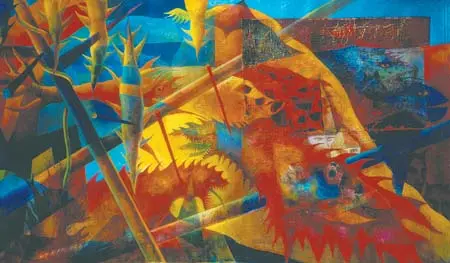
In the ascending process of his artistic production, Monsanto has continued painting. While experimenting with installation, which evidently attracts him as media for updating and reproducing language. Obviously, bi-dimensional expressions are not enough for him —despite his mastery of drawing— requiring the introduction of objects and constructions in his work.
Beyond the visual, Monsanto can integrate auditory elements, as in his Anthropophagy with Sound, one of the show's centerpieces. His exploratory spirit aspires to create multi-sensorial, totalizing experiences. Certainly, Tony Monsanto prefers to call "objects" "hung on the gallery's walls or placed on the floor" constructions than others wouldn't hesitate to call sculptures. But a certain academic "inflexibility" forces him to define categories: according to the artist, three-dimensionality generates variants that go beyond mere sculpture. Thus differentiated, installations, objects, assemblages, and collages offer alternative solutions to his insatiable creativity.
Monsanto's collages —there are about fifteen— present a wide variety of forms and aesthetic solutions. If Georges Braque, the genre's master, said "The senses deform; the mind forms," in Monsanto's case the senses, the mind and the materials used all give form, never deforming. According to the old tradition, his mixed media incorporates into a larger format simple pieces of newspaper, printed images, reproductions, or fragments of cloth or garments, or even his own drawings.
Of course, the point isn't to reintroduce external appearances, but to enrich and mold surfaces, strengthening rhythms and composition. It bears noting that Tony Monsanto, with those aggregated structures, joins together baroque and geometry, construction, and a certain organic quality, reality, and myth, particularly in the series Passage of Time, 2001 version.
Sometimes Monsanto uses abstraction in his pictorial interventions upon objects or his canvases and drawings, but he is primarily a figurative artist, a master of anatomic drawing Beyond the figure and some allusions to family, the body, a recurring element, expresses the human condition, the crossroads of humanity and its dramatic fate throughout history.
At the same time, a conceptual veneer complicates any interpretation of Monsanto's works. We are talking about the sacred, part of a search for absolutes, a primordial experience, and a truly universal endeavor of the spirit (if not omnipresent, extremely frequent). This ideological charge comprises Monsanto's Golgotas and crucifixions, hagiographies and religious effigies, and even evocations of a surprising syncretic devil.
Monsanto, being a man from the Caribbean by conviction as much as by birth, delivers his view of the world marked by the fantastic elements and celebratory magic of Afro-West Indian culture intermixed with the artist's metaphysical intent and his "transfigurations." These intellectual, psychological, and artistic values are a part of life, the overarching theme of Monsanto's iconography.
We don't know what the next experimental steps will be for Tony Monsanto. Perhaps, given the profusion of ideas and projects, he seems to swim in, not even the artist knows. After this solo show in Curaçao and his participation in the IV Caribbean Biennial of Santo Domingo, an intense international activity awaits him with the itinerant Between Lines, with visits to The Netherlands, Cuba, Trinidad, and several other Caribbean islands.
NOTE
1. Calabash. A Journal of Caribbean Arts and Letters, p. 171, Spring/Summer2001, Volume 1, Number 2, New York. This new arts and letters publication, produced by the University of New York, showcases Caribbean artists on its cover; Monsanto was pictured in the debut issue.
MARIANNE DE TOLENTINO