Bernardo Kliksberg writes in the daily La Nación of Buenos Aires that "we are no longer discussing values [...] it is time to take into account seriously the growing clamor for ethics."1
If art, within the spectrum of humanity, has always had the merit of bearing witness to the exaltation of life, at this point, and particularly after 11 September 2002, it would seem that the artists who, throughout their work, have especially dealt with human values acquire singular importance.
This is the case of Víctor Grippo, an internationally renowned Argentine artist whose work I saw for the first time in the Jornadas de la Crítica which took place several decades ago in the city of Tandil (Buenos Aires). It was a pulsatile object that tautened a surface by using kineticism in its biological, and not in its mechanistic, character.2 Attention to the nature and vital processes that he has maintained over time, creating works of notable originality.
His artistic personality became notorious after his integration into the Grupo de los 13, led by Jorge Glusberg.
The group was so-called because, in the beginning, its members totaled that number, which was later reduced to ten. Inspired by the ideas of Polish director Jerzy Grotowski, who in 1971 was leaving Buenos Aires where he had spread his concepts on "poor theater," the group formed a work team like "Grotowski's lab."
They turned up for the first time around the middle of 1972 in the group show Toward a Profile of Latin American Art in Medellín, Colombia. Toward the end of the same year, they all showed up in the rooms of the Centro de Arte y Comunicación of Buenos Aires, at the exhibition El grupo de los trece en arte de sistemas.
Víctor Grippo formed part of this group since its beginning, participating in its international recognition by winning the prize at the 14th International Biennial of São Paulo in 1977.
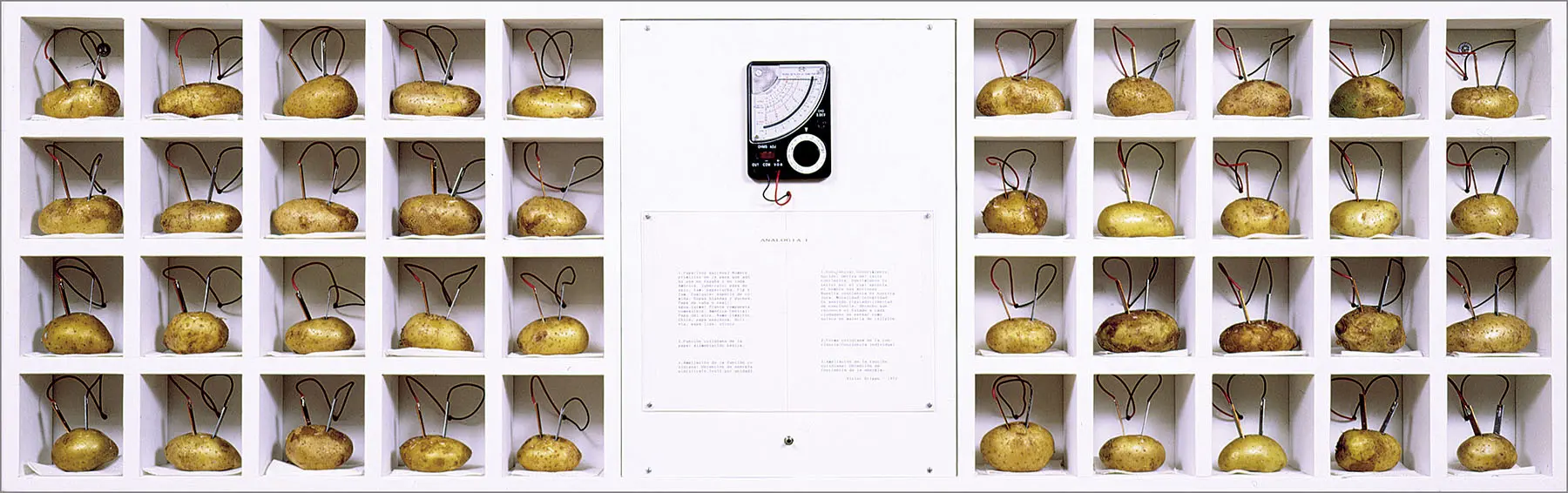
In 1971 he had already presented his work Analogía I, which today belongs to the Museum of Fine Arts, in which he formulated the basic panorama of the ideas that interested him. Forty potatoes placed in compartments were joined by electrodes to a voltmeter that captured and measured their energy. A disconcerting work due to the elements used and its conceptual problems, it has been interpreted in different ways. The potato is originally an American food, a poor food, that changed the gastronomic habits of Europeans. Is it an incitement to value one's own in all its dimensions? The potato is also a tuber that is not harvested from above; instead, it is uprooted from the very entrails of the Earth.
This artist's originality has a good stamp, connoting that which is American through a nutritive element. In the catalog that accompanied the show, he explicitly states his point of departure:
"1. Papa: (Quechua name) Primitive name for potato, still in use in Spain and all of Spanish America. Tuber: edible plant. By extension, any species of food; Regional Spanish words: papa de apio, papa de caña, papa real, Ñame cimarrón, papa del aire (Central America), papa espinosa (Chile), papa Lisa, ulluco (Bolivia).
1. Conscience: Knowledge, notion. Derives from Latin conscientia, the inner feeling through which man acquires an appreciation for his actions. Our conscience is our judge. Morality - Integrity. In a figurative sense, freedom of conscience. Right recognized by any government to each citizen to think as he pleases in the realm of religion.
2. Daily function: Basic food.
2. Daily form of conscience: Individual conscience.
3. Extension of daily function: Source of electric energy (0.7 volts per unit).
3. Extension of daily conscience: Source of conscience of energy."
In this sophisticated production of electric energy, which could be measured by a switch, there is an underlying search for a connection between art and science that, possibly, maintains a relation with his university training in this sense.3
But there is also his "ethical intention, an intention of true progress, turning into an integrator of multiple experiences (in opposition to the continuous fragmentation to which our society subjects us) in order to contribute to the conception of a more complete man", according to his words.
Accent on ethics and values, which he has never abandoned. Grippo has always wondered (and wonders) about the situation of man in the world. He himself has recognized that using physical energy and establishing an analogy with psychic energy for an expansion of the conscience was a difficult code to capture.
Before delving into other conceptual incursions that the artist conceived around the potato element, it is worth mentioning that the potato also connotes for him the hard labor of the field workers, their work tools, and their link to the land.
Van Gogh, regarding The Potato Eaters,4 writes: "I have consciously wanted to cling to the idea that these people, who under the lamp eat their potatoes with their hands [...] have also worked the land and that my painting thus exalts the manual labor and the food that they themselves have so honestly earned."
Like the Dutch painter, the Argentine speaks to us of the value of the humble, the ancestral, the daily, and the community.
In a later exhibition,5 he states that "I would have liked this show to be a clear thread that ran from the tripod on which my father practiced his Sunday operations down to the pot in which my mother stirred the food (both operators of fire and nutrition, which had to be observed, transformed, maintained, or distributed). Eaters of garlic and onion (and potatoes), they forced a difficult and ascending reality that may have determined my trade; and I may not have achieved much more than the transmitted meaning. But a restless clarity spurred on the justification of my curiosity, of the search for a meaning; a road from darkness to a minimal light. Without thinking about it, then, I began to articulate some symbols: the food of man, the energy and the rose, the imbalances and the consequent transformations, in order to contribute in some way to the renovating fire that does not always mean change, if there is no awareness of the preservable.
For those who, like myself, come from a race of immigrants, our landscape seems small. Forbidden from the knowledge of what is nearby, we want more, and the outside does not suffice. Hence the jump as a replacement for the placid, natural road."
That jump as a replacement for the placid, natural road is continued by the artist in a work called Analogía II, exhibited at the show Arte de sistemas en Latinoamérica in 1975 at the Espace Cardin, Paris. In this case, the analogy is established with the stone as a material linked to the potato.
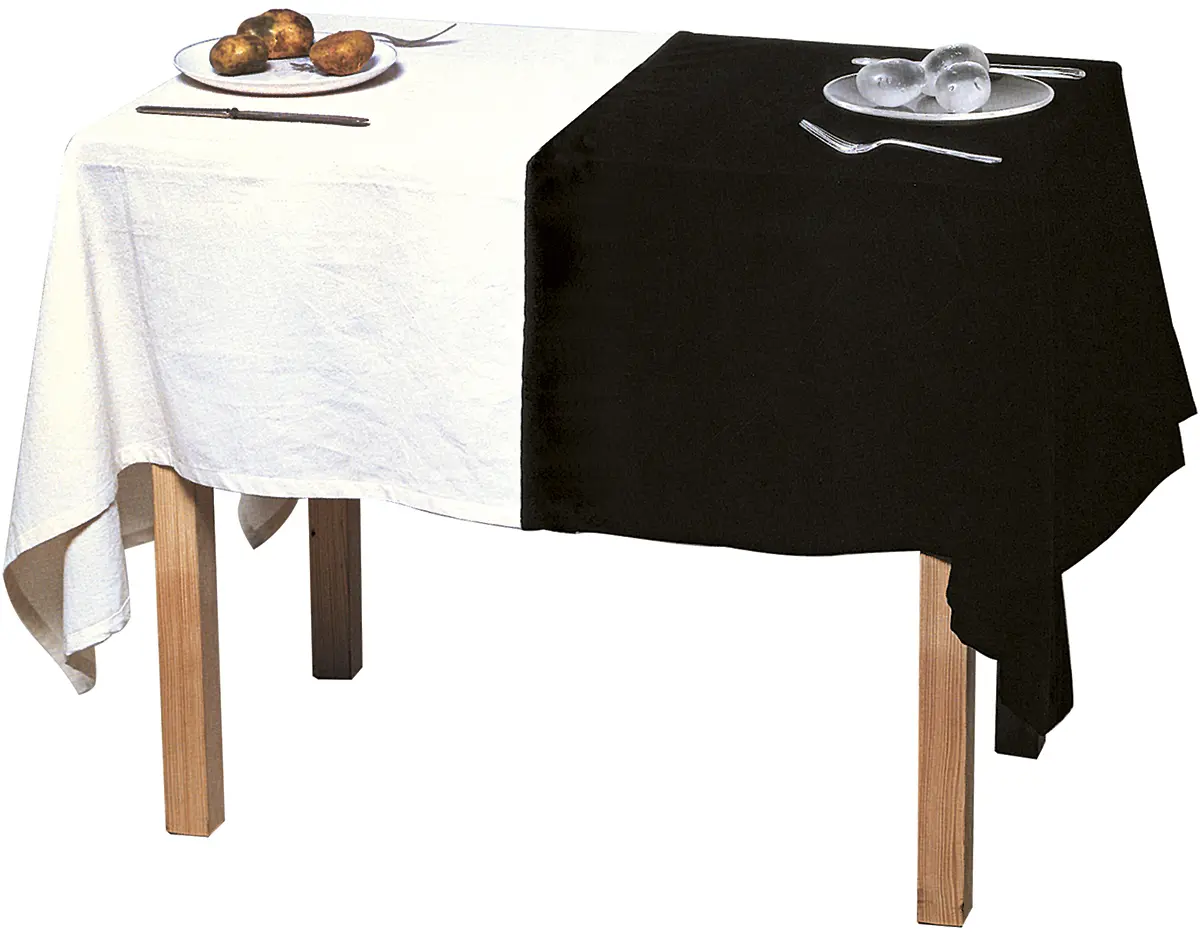
Nature and artifice that aesthetically culminate in Analogía IV, exhibited in Buenos Aires, as well as Denmark, England, Belgium, and The United States.
On a modest table, a white tablecloth marked off a sector with a plate, glass, silverware, china, and fresh potatoes. The other sector was of black velvet, with a plate, glass, silverware, and transparent acrylic potatoes.
In the first case, the cutlery was of an older type, more humanized, engraved in the old-fashioned way: "It pronounced the problems of homo faber."6 The goal was to formulate a dialectical opposition: the natural, with customary color and form, useful, edible, in the face of the artificial, colorless, inedible, useless. This was the extrapolated form, the synthesized aspect of the work.
It can only function aesthetically in the situation in which the creator thought it up, in a play on language.
When he presented it, he took it to the end of the montage in order to choose the place that everyone had discarded and to break from the competition. Luis Camnitzer has called it "a classic work of Latin American conceptualism."7
There were other variants with the potatoes, on one occasion presented with their electrodes upon a table, a chair, and on the floor.8
Another aspect of the question: the force of nature and of the expansion of life appeared in a work that consisted of a conical metal shape, containing humid, natural products which, upon fermentation, produced the rupture of the container.
Moreover, it is not infrequent for Grippo to accompany his plastic work with words: "if humble seeds, in a complementary marriage with water (mediator between life and death, in the double current of creation and destruction) awake their destiny, initiate a harmonic phenomenon, which science partially explains to us and which are capable of tending toward their "final being," displacing the fixed element that imposes itself, changing shapes, bursting into a space beyond what is assigned, how could we not catch a glimpse of the mystery, the precariousness of the continent before the living content, the poetics emanated from a simple experience, symbol of the periodic regeneration of nature and of man, of death and resurrection."9
Ricardo Martín-Crosa, an Argentine critic who has passed away, wrote that this "work manifests itself to the conscience like the image of life; life transgresses the work, amplifying it, turning it into another moment of its act of imagining and expanding; finally, it bears witness to itself like an incorruptible attempt to break the limits."10
In the same year of 1972, during which he presented Analogía IV, a work with which he won second prize at the Museum of Modern Art of Buenos Aires, he participated in the show Arte de Sistemas II, organized by J. Glusberg in the Plaza Roberto Arlt of Buenos Aires.
Grippo's work was Horno de pan (Bread oven), made in collaboration with sculptor Jorge Gamarra, and Rossi, a peasant also in charge of making and distributing bread.
It was comprised of a bread oven just like those used in the Argentine countryside. It had been moved from one site to another, and it was presented along with other artistic expressions, thus producing a semantic fission.
In the aesthetic space in which it was placed there, it recorded the presence of homo faber, constructing the oven and making bread; the energy of the fire as a transformer of the food; the countryside in the middle of, or differentiated from, the city; the artisanal product differentiated from the machine-made one; the sacrality of the bread, which also acquires the symbolic character of the transmutation into spiritual sustenance. The donation of the bread meant accenting, in the same way, the community character of this food when it is shared.
The work of this creator always returns to the humble, to nature, to the elemental human links, making us reflect on the point of inflection where things lose their relation to life.
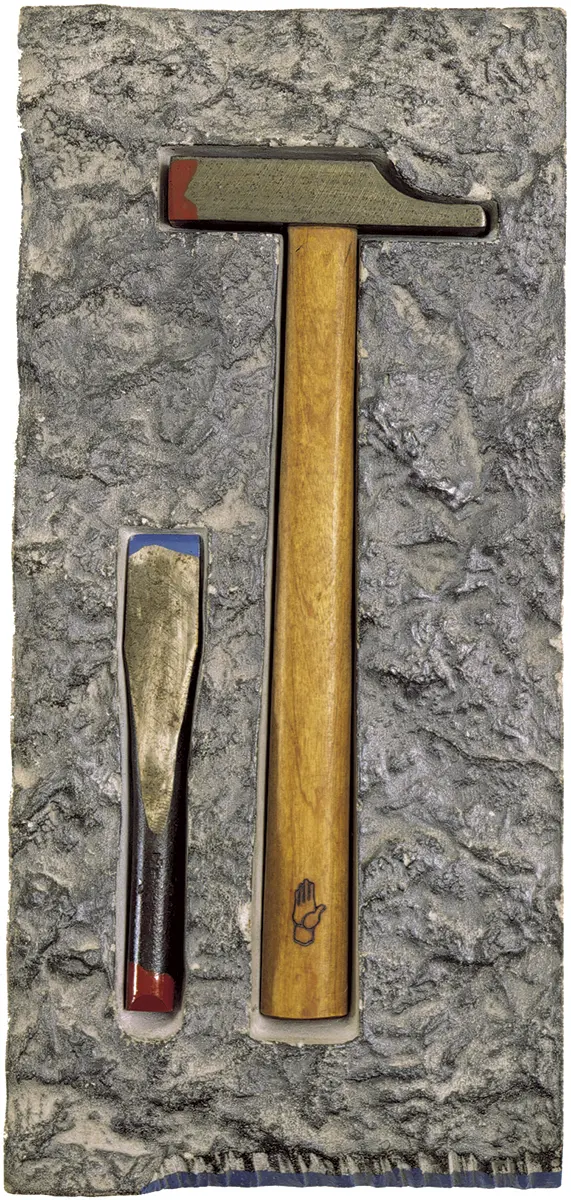
In addition to the sacralization of food in its symbolic capacity, next in the show comes Los oficios (The trades, 1976) to consecrate manual labor; once more, homo faber, a man who "earns his bread by the sweat of his brow, a man who with his trade constructs his habitat, cultivates the land, makes his meal."
In the presentation of the catalog he expresses that "when man built his first tool, he simultaneously created the first useful object and the first work of art. From that point on the tool was present in human action on the planet, formulating questions, and new alternatives.
Associated in the practice of trades, man asks and the tool answers, the tool asks and man answers, in Nature's long process of modification.
Modification of matter and modification of the spirit, in an interaction between thought and the outstretched hand. (There are moments in man's work when it is impossible to define if he is the one who guides the tool or if the tool is what moves his hand.)
Now, in a period in which there are fools who brag about not knowing how to do anything with their hands, we await another era in which man, absolved, recovers the love of trades and of exercising his conscience, and may shorten the distance between knowledge and action.
Perhaps at some point, the effort sustained and coordinated effort may improve man and society, and once again the harmony between art and work may become valid, in a unique human ritual."11
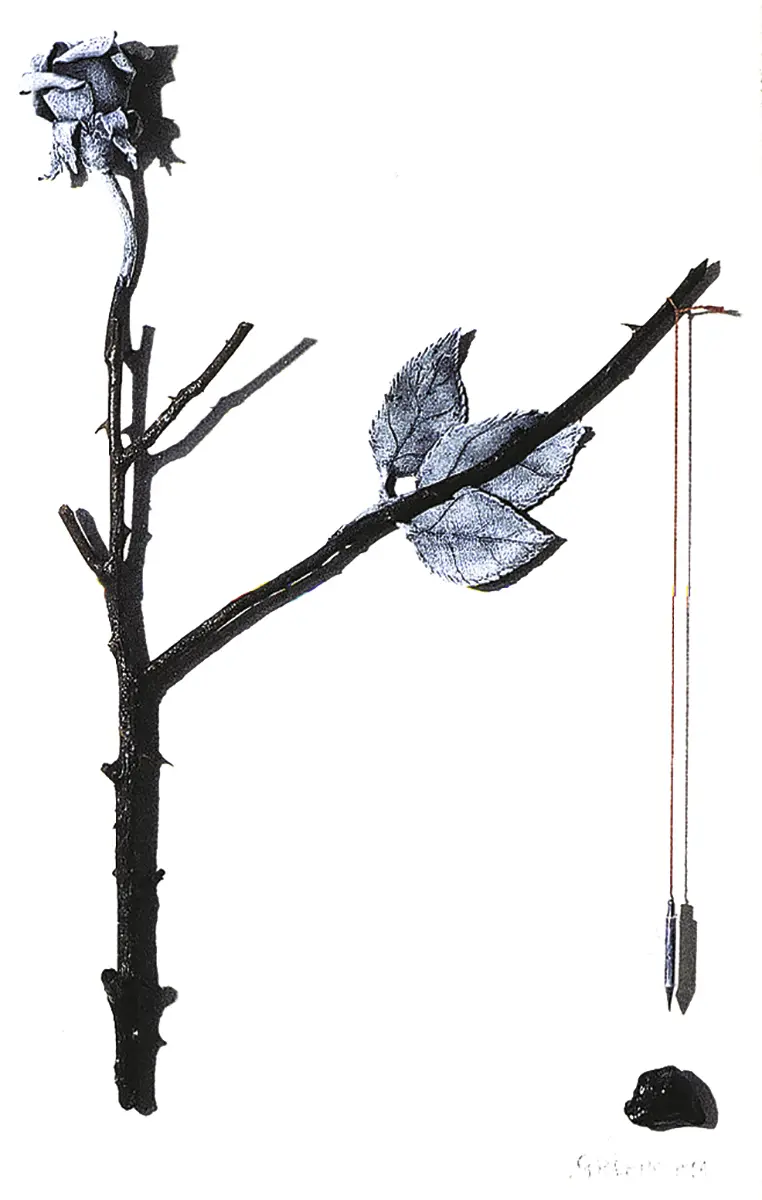
For the artist, three trades become emblematic: bricklayer, blacksmith, and farm worker. Their tools (pincers, tongs, pulley, hammer, plumb line, and others) continued to appear until the last show in April 2001.
They speak to us of a human space of action, centered around immediate practical interests and needs. They speak to us of an articulation of time, of a creation process that is also an entry into daily life, and to the hope and safety that are valid for survival.
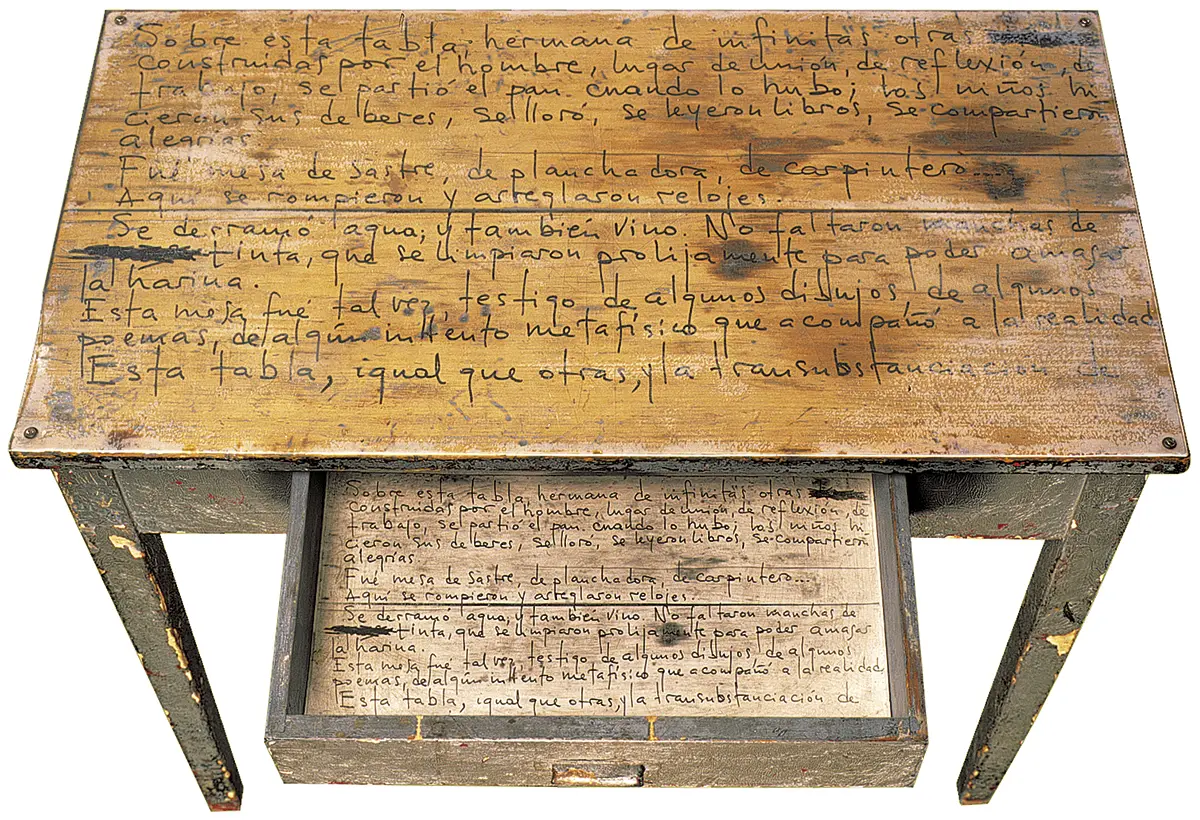
Previously, at the Galería Arte Múltiple, he had developed the theme of the table, which he called Tabla (Board). A theme that was materially and conceptually inscribed in his earlier work, but which comes with the character of a significant point of arrival.
The table is the place for work, creation, sharing food, a reunion, and, also, an altar where human action is exalted through love and transmutation.
In the case of Grippo, the table chosen is a worn-out table that knows about uses, sorrows, and joys, and which was covered on top and on the open drawer with inscriptions, manuscript texts that speak of a higher level of human symbolism and awareness.
Grippo, like Beuys, prefers simple materials and, like him, confers a new dignity and new utility on the used.12 Both bet on an active viewer and know how to make us reflect on today by turning, on one hand, to an expansive concept of art and, on the other, to primary and strong vital connections, buried by a consumer society.
Mercedes Casanegra, in a recent article,13 includes Grippo among the artists who, adhering to Octavio Paz's idea of "a conception of the universe like a loving order of correspondences, preserve with their compassionate action" the memory of the totality in aesthetic attitudes that reestablish us as harmony and not as fragments. That desire for harmony is expressed in another text by Grippo that accompanies his 1989 show Cercando la luce,14 in which he presented plaster scale models of community places in the open air.
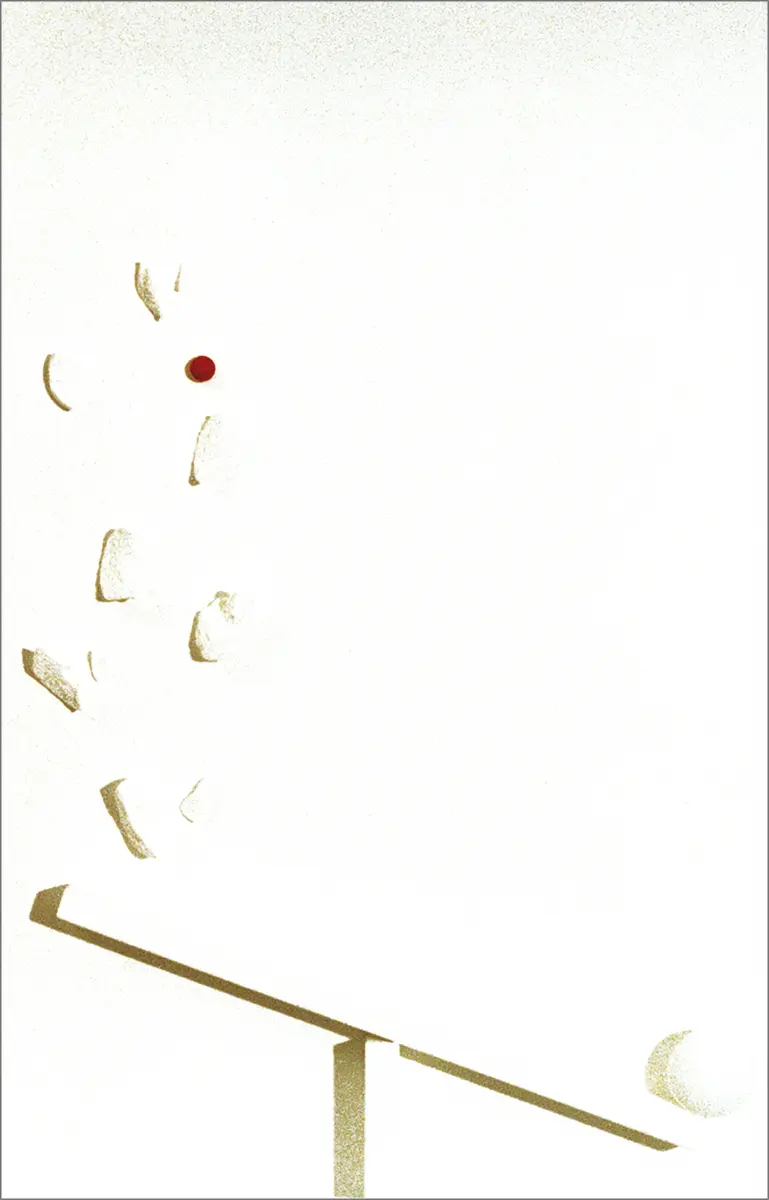
A fragment of his text reveals that "Man who shuts in the Universe will see the Sky and the Earth, and the latter on top, while action and contemplation will be one single peaceful act that accompanies Nature in its Unity."
In the 1983 show Frate focu,15 he cites the Lyrical Writings of St. Francis of Assisi, the reference to the brother fire, and he then clarifies that he had already appeared in The bread oven.
He himself affirmed that "I take it as a common element of nature that has accompanied man since he was a man and which is a transformer of that nature that man used throughout the process of modification of his own human condition. Fire is indispensable for cooking, eating, making tools, for the diverse techniques that man has applied in his different operations [...] Prime matter is everywhere, in sight, and yet to discover it is the most precious thing because what we discover is form. The simplest thing can be transformed into the most elevated, in both senses, into the material and spiritual which should never be separated."
In this show, he presented his boxes that, like those of Joseph Cornell, know how to assemble with great originality elements from daily life and a masterful poetic freedom.
In the case of our artist, the boxes are painted an impeccable white; they impose distance, and they become abstract through the predominance of the viewer. Their intensity emerges from their concentration as they group and conform with accurate and relentless lucidity.
A certain analogy with the boxes as a demarcated place of unusual meetings, but even more secret is Grippo's "little bags."
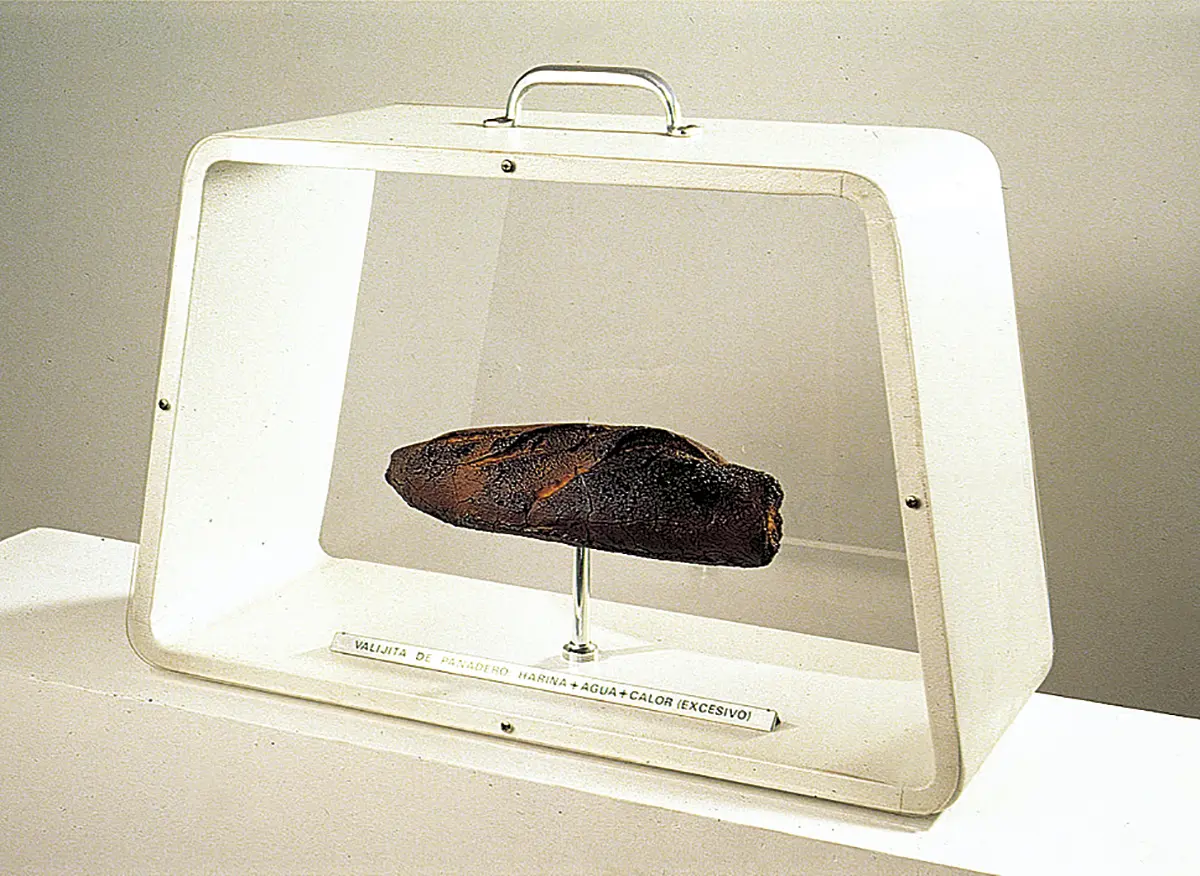
Valijita de Panadero (Baker's Little Bag), and Valijita de albañil (Bricklayer's Little Bag), take us back to the artist's concerns with trades, but we should also keep in mind Albert Einstein's Little Bag and Le Corbusier's Little bag, among others.
Grippo seizes dailiness, once again, in order to lead us to reflect on our limits and the possibility of transcending them. The mirrors included adding their quota of virtuality and uncertainty, of intangibility and fallacy. It could be recalled that Liliana Porter, before her departure for New York in the '60s, worked in other ways with "little bags," as did Duchamp in his well-known Green Box and Bag Containing Box.
We find strong threads of coherence with his previous work in his latest and recent show, and also new objectivated questions on different proposals that integrate into his significant universe with ease.16
In it we again find the worn-out tools of "the trades" in a semi-empty, semi-shady space that he calls La reflexión de la luz (The reflection of light), alluding to that possibility of extrapolating matter and sublimating it.
We find another reference of the same sort—in the subfloor of the Ruth Benzacar Gallery, where the show took place—in El tiempo del trabajo (Work time). It was comprised of a common cement mixer, in operation, with pieces of marble and a semi-liquid substance, which were turned regularly in time, accompanied by the noise and the change provoked by the displacement.
The texts of the artist always accompany his work: "My things are in this show, simple elements that still work." As always, he works with white, aseptic, and bright environments.
We must keep in mind, in the same vein, his boxes with plumb lines and level bubbles marking a virtual horizon. The constant search for equilibrium?
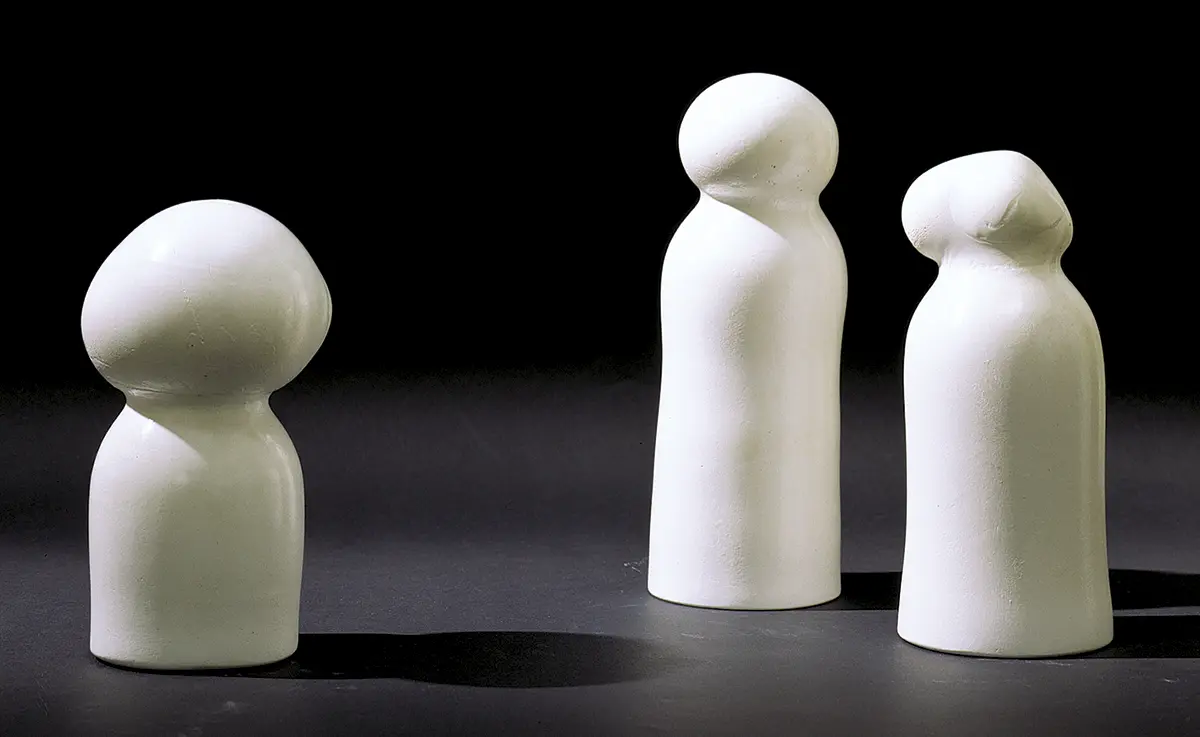
The Anónimos appear, grouped together in showcases that are perfect and white like them, erect forms of an organic character, of tactile volumes, where a slight narrowing seems to mark the difference between head and body. He calls them "Clones of a single nothingness" and "almost shapeless beings, dauntless presences without a soul, held up neither by roots nor by land."
It is impossible not to recall the Portuguese writer Saramago, author of All The Names, with that civil record that attempts to catalog the living and the dead, but life explodes (like the grains in Grippo's metallic molds), sowing disorder and anonymity, the confusion of the unthinkable.
Another great Italian-Argentine sculptor, Aldo Paparella, achieved a synthesis of his historical moment—he was born in 1920 and died in 1977—with white, immaculate, almost luminous shapes, but Grippo is later. Grippo does not mention the fall of the great accounts, but rather their character as witnesses of a period in which the language that is used does not satisfy him and he has to invent another, where the materials that are used do not satisfy him and he has to search for others. It is out of necessity that he does it, and his syntheses have an enormous contemporary and humanistic dimension. He works with primary, basic, elements and situations, typical of the first articulations of man with his medium, his partial and modest balances, and his loving and bloody relationship with things as an attempt to survive, exalting life within that hard reality.
In this sense, Grippo has developed an entire line of conceptual research, provoking situations of defamiliarization and surprise, accompanying the image with profound and poetic texts. Austere, severe, he created a symbolic world of strong poignancy and originality.
He has always sought, not reason, but a reason for being, and he himself expressed that "Something has been refined. What remains has entered salvation [...] Harmonic sounds will be able to be heard and the birds will show the way of Life—as always—but their songs will resonate intelligibly for all."
*All images illustrating this text are courtesy of Galería Ruth Benzacar.
NOTES
1. Bernardo Kliskberg is the general coordinator of the Inter-American Initiative of Social Capital, Ethics, and Development of the Inter-American Development Bank (BID). First prize: Visual Experiences. 3rd Festival of the Arts of Tandil, province of Buenos Aires, 1970.
2. First Prize, Visual Experiences. 3rd Festival of Arts of Tandil, province of Buenos Aires, 1970.
3. He had studied chemistry at the University of La Plata.
4 Nuenen period, 1885. Private collection.
5. Víctor Grippo, Obras de 1965 a 1987, Fundación San Telmo, Buenos Aires, August-September 1988.
6. In the words of the artist in an interview.
7. ArtNexus No.33, Colombia (1999).
8. Energía vegetal, in the Centro de Arte y Comunicación, Buenos Aires, 1976.
9. Víctor Grippo, Galería Arte Múltiple, 19 August to 13 September 1980.
10. Idem note 9.
11. Cited in J. Glusberg, Del pop art a la nueva imagen (Buenos Aires: Ediciones de Arte Gaglianone, 1985).
12. The expression comes from Klaus Honnef, Arte contemporáneo (Germania: Taschen, 1988).
13. "Signos de memoria y compasión," Revista Casandra de Cultura Contemporánea, No. 13 (2000).
14. At the Galería Castagnino in Buenos Aires.
15. Galería Arte Nuevo, Buenos Aires, October 1983.
16. Elena Oliveras wrote a chronicle of this show in ArtNexus No. 41, Colombia (2001).
NELLY PERAZZO
University professor, art critic, and researcher. Full member of Argentina's National Academy of Fine Arts.