
Anabell Guerrero's photographic work develops in two opposite and mutually complementary registers, relating to the level of the private as well as that of the collective and the social. Born in Caracas, Guerrero opted for a full-time career in photography after having studied Economics and Political Science. She has lived in Paris since 1986.
Guerrero's previous works dealt with the notions of the private and the hidden, through the unending secrets that, according to her, human beings and their nudity offer as topics for investigations at the individual and the collective levels. The artist has shown a sustained desire to capture the true external landscape, but also the internal one, that is nudity: Anatomía de los sueños (Anatomy of Dreams), of 1986, a series of female portraits and nudes; a study of male nudes titled Una cierta ausencia (A Certain Absence) in 1987; or her Últimos limbos (Last Limbos) (1987-1992). When her sensibility is not expressing itself through the meandering and infinite lights of the human body, it is discretely filtered into portraits such as those she made for the International Parliament of Writers. In 1992, she undertook a visual investigation of the locations of the European arrival in the Americas (Américas inencontrables [Unfound Americas]), and after that, in 1997, she produced two series dedicated to the topic of death (Duelo de aves [Mourning of Birds] and Mortajas [Shrouds]), followed the same year by Los refugiados (The Refugees) and Los desplazados (The Displaced).
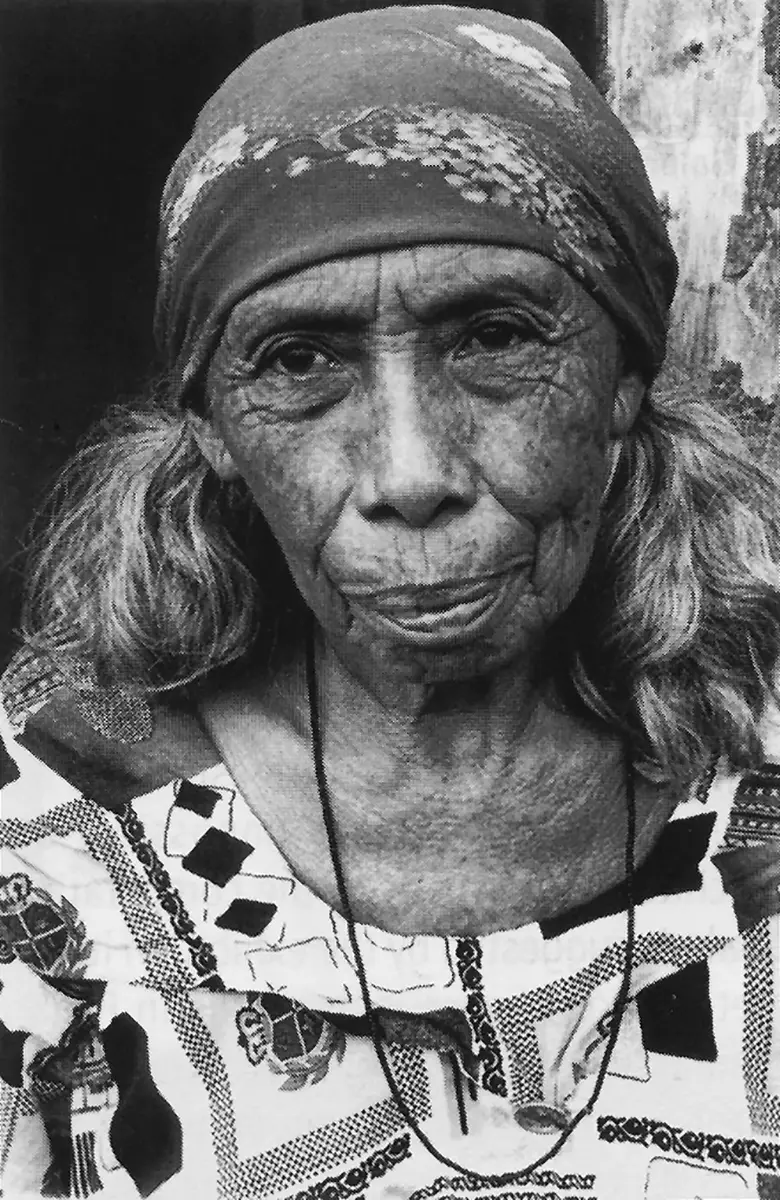
In 1998, Guerrero began working with the Wayú people of the semi-arid peninsula that lies between Venezuela and Colombia. This work, part of her "American" explorations that started in 1994 in a fishing village in Venezuela's Isla Margarita, resulted in the series Trópicos-Tropismos (Tropics-Tropisms).
The most recent series presented now takes as its subject Las mujeres indias de La Guajira (Indian Women of La Guajira) (Venezuela-Colombia border) and is comprised of 18 vertical black and white, large-format photographs (2.4 m x 60 cm). With this Parisian exhibit, which comes after a show at the famous Chateau d'Eau Municipal Gallery in Toulouse (devoted, under Michel Dieuzaide, to contemporary international photography), Guerrero's work shows once again, in a vein that goes beyond visual anthropology, the fine grain of her gaze when trained upon a subject that moves her both culturally and humanely. Guerrero's gaze is not that of someone who examines or questions with the goal of verifying a fact and offer a testimony, but that of someone who shares and communicates from a complicit closeness, filled with emotion and respect. These words of Jean Genet, chosen by the artist as an epigraph for her show, clarify the meaning of her quest: "To protect and use all the images of language because they are in the desert, where we have to go in order to find them."
These portraits of women are portraits of resistance, the resistance of a society threatened with extinction. "Cornered by drug traffickers and chronic unemployment, this peculiar society tries to resist through the force of a culture intent on maintaining its identity. In essence, the battle is fought by women. They represent at once the foundation of the family, the memory of traditions, and a safeguard against clan divisions, always on the verge of reappearing," as M. Dieuzaide writes.
These portraits are all formal, presenting their subjects in a standing position, dressed in colorful long clothes. The faces are weathered and they all express a grave form of nobility. At times, the sketch of a smile seems to animate sets of eyes lost in nostalgia or lamentation. In any case, their calm strength questions us, overtaking our emotions.
The artist has opted, stylistically and conceptually, for the fragmentation of her images; she elongates profiles to reinforce the solid, unmovable presence of the subject. The repetition of certain details piling up one on top of the other stretches the body and gives the portraits in the way of female icons or totems, a multifarious identity, metaphorizing the forced matriarchy through which a resilient vital force is made manifest.
To bear witness in the field and to estheticize the most somber realities (in the manner of Sebastião Salgado, even if his magnificent work is sometimes vulnerable to criticism for its excessive aestethization), taking them as support for conceptual and visual messages and using them as social and personal justification, is something this artist can achieve in her work, thus becoming an essential witness. But not every way of doing things makes this possible. To live within a situation, to share a passion or an obsession (as in the case of US photographer Nan Golding, in an otherwise entirely different register) so that one is not an observer but an actor; such closeness transforms photography, and it also transforms the spectator's gaze. The distance between the observer and the image is erased by the photographer's lived experience, transported in the precision of the photograph at a given moment.
This is precisely what Guerrero's portraits of La Guajira women teach us. Their faces, hands, and even their feet are a just presence. In a discourse attempting to capture the present in its infinite density, nostalgia is not what is, but what it can be made to say.
CHRISTINE FRÉROT