
In a posthumous homage commemorating the 20th anniversary of Antonio Berni's death, the Centro Cultural Borges in Buenos Aires exhibited Los monstruos de Berni (Berni's Monsters) between October and December of last year. The bulk of the multi-material constructions was complemented by a series of painting objects, oil paintings, collages, and masks executed by the artist, who was from Rosario, Argentina, between 1953 and 1977.
Curated by Elena Oliveras, who also wrote a critical essay, the mega exhibit highlighted Berni's groundbreaking contributions to the poetics of the object, the culture of environmental art, and the ephemeral art in Spanish America.
The genesis of Berni's multi-material monsters can be traced back to early 1964 when he began to execute a series of large-scale three-dimensional compositions based on industrial refuse. A repertoire of gigantic figures would slowly emerge as a critical alternative to pop art's esthetics of consumption.
The patient gathering of the almost-infinite spectrum of objets trouvés—door knobs, popular masks, toilet seats, fiber baskets, pieces of burlap, brocatos, screws, stockings, shoes, women's intimate apparel, wigs, brooms, brushes, egg cartons, soda caps, discarded mannequins, rubber stamps, lamp pieces, and other urban detritus—will constitute the amorphous and diffuse base with which Berni will give body to the neo baroque category of the monstrous.
Taken to its "zero degree," this residual materialness will be resignified by the artist into objectual assemblages with porous appearances and menacing gestures.
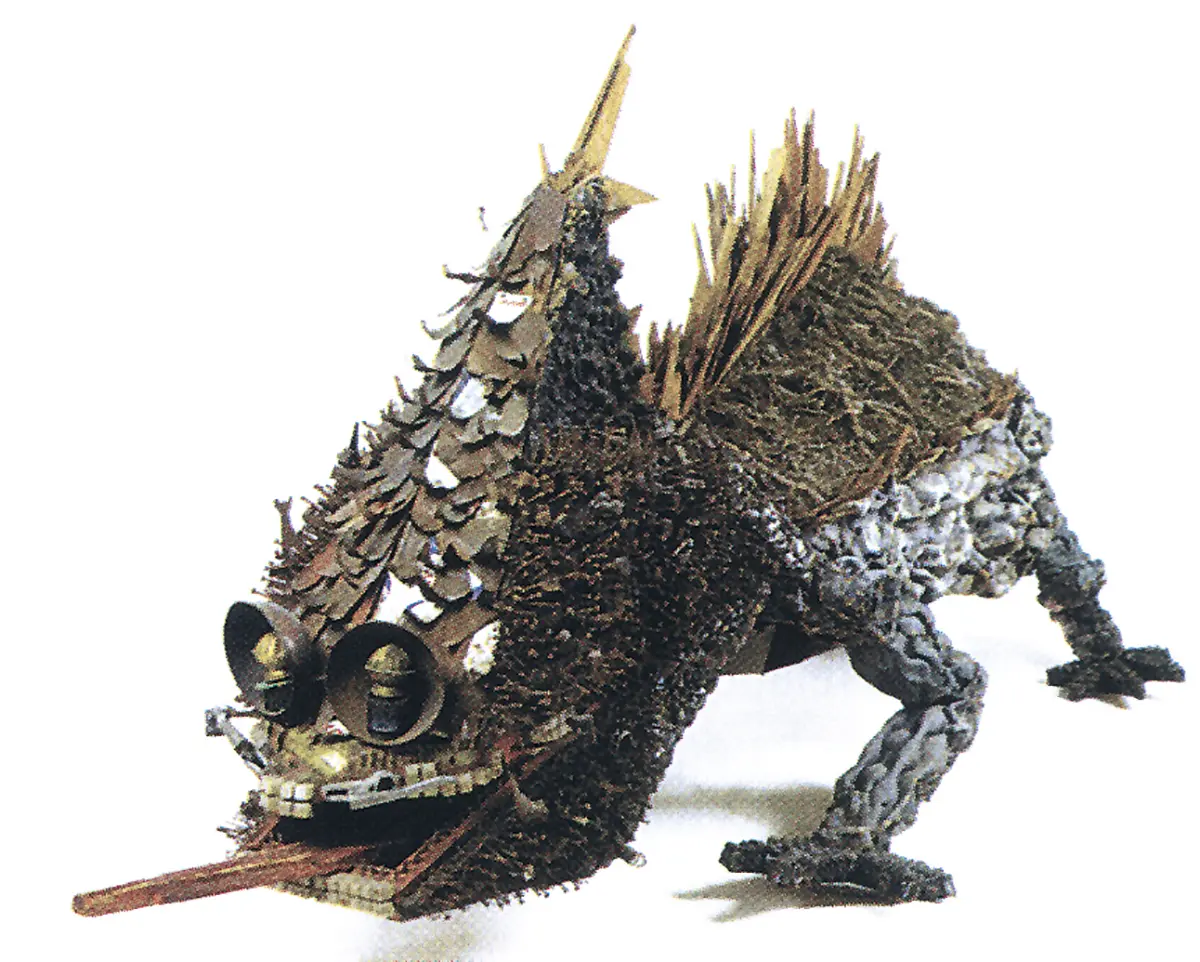
For Elena Olivera, the show's curator, Berni's motivations in this type of work are three-fold: first, to highlight the material, granting it total predominance in the most unusual combinations not devoid of humor and irony. Secondly, to occupy practically all the immediate spaces by invading our own space with this genre of installed bulks. And finally, "to give content more visibility," placing the object as the raw material for his surroundings and environments. At the same time, the researcher places Berni as "one of the indispensable references of Latin American ephemeral art," since his work is in direct relationship with being an implacable critic of society.
Having already debuted in huge paintings, collages, and engravings dating back from the early 1960s, these prodigious beings, extrapolated from the plane to the real volume, jump directly to our side, inhabiting the same territory as ours. Their physical grandiloquence summons us and makes us uncomfortable. Like human counterfigures, they reflect miseries—our own and others.
The show's curatorial script is defined by successive stories amalgamating the works in a net of associative chains. Within that esthetics of monstrosity, we have sub-series or thematic categorizations. Olivera highlights the first group of monsters: those making up the stormy world of Ramona Montiel, the show's thematic axis. Then appear those that go beyond psychological laceration by alluding to social disgraces, war, genocide, devastation, and sacrifice of innocent victims. And then we have the interplanetary or intergalactic monsters borne out of science fiction and disaster and horror films.
Allegories of Excess
Monsters are always excessive and destabilizing. Their intimidating presence shakes the very foundations of certainty, which is where the world's apparent regularity rests. If we were to define it, it would be a force that's both shocking and alienating that, coming from the universe of fantastic science, breaks through the registers of reality in order to override it. In this sense, what's monstrous ends up having a relationship with another principle of the neobaroque: disorder, or chaos.
In Berni's work, the efficacy of the monstrosity discourse lies in two intrinsic qualities: showmanship and spectacularity. The monster always sins of excess, never of defect. This prodigy of nature is made to please the senses. Chimerical and fantastic, ominous, horrendous, and execrable, monsters beg to be seen, touched—and why not—heard, smelled, and tasted. Before them, the esthetic moment is exerted from a sensitivity that has been refined and expanded beyond the optic and haptic levels. Like pieces from a cabinet of curiosities, Berni's monsters offer themselves to the spectator by relishing in their piercing and perturbing baroque sensuality, and by putting the status of the pictorial and sculptoric languages in crisis.
On the other hand, due to its unclassifiable character, which stretches the boundaries of what's possible, the monster is a mystery, an enigma yet to be solved. Its marginality is always a risk factor; it constitutes an exogenous element that destabilizes daily life's affable and comfortable tone and the rules needed in order to know it and understand it.
There's one common trait among these creatures of the witches' sabbath: excess, both as a constitutive characteristic and operational strategy. In Berni, such excess redoubles itself visually by means of allegory, a rhetorical procedure. Allegory, or "continued metaphor," as Aristotle defined it, is a symbolic representation of abstract ideas by means of figures, groups of figures, or their attributes. By using several metaphors consecutively, the allegorical resource discloses, in the artistic as well as the literary discourse, a sense that's both straight and figured. In Berni's Monsters, allegory provides a group of descriptive and/or narrative elements emphasizing, at the level of the material used, several details or nuances surrounding the concept or the quality wished to be given meaning.
Berni's monsters are personifications of human "depreciated values," animal-like prototypes of certain subterranean vices and defects. In them, we notice a double function: the metamorphosis from human to animal, and vice versa.
The bestialization of the human reaches its climax in La sordidez (Squalor), a multi-material construction in which niggardliness, meanness, and miserliness are made explicit. Thus the huge, frightful beast, piercing and scaly, whose skin is made out of thousands of rusty nails. It entirely absorbs anything that's dirty, miserable, or impure. This insidious archetype summarizes a strange mix of horror and anguish. Presented as a true antechamber of hell, it reeks of death, vulgarity, and destruction.
In Un monstruo (A Monster), we have a formal solution that's more constructive, in virtue of the assemblage of intensely-colored geometrical elements and playful resonances.
Not only excess as the result of representation becomes evident in Berni's objects, but also in his cycle of paintings and theme-based allegorical collages, where the two-dimensional support becomes sumptuous, dense, and magma-like. By itself, this new materiality allows for the pictorial textures to coexist with the accumulation of outside refuse. That's how the scenographic aspect of monstrosity becomes real on the plane, on the large-format canvases, where the tension of opposing forces is stretched to its limits. Close to what Pierre Restany defined as "a new realism of pure sensitivity," Berni combines materials and clumps them together fortuitously, creating a hodgepodge of tragicomic artifacts immersed in the folds of abjection and madness.
In this body of works, abjection functions as the lack of acknowledgment of what's near. Overflowing from itself, the subject finds the impossible within itself.
In Powers of Horror, Julia Kristeva defines abjection as the instance that requests the subject while pulverizing it. It is a different essence than the sinister, and more virulent; nothing is familiar in abjection, everything becomes estranged, unknown, even our own memories.
Berni's figurative continuum works around the recurrent use of his two protagonists in this epic poem, Ramona Montiel and Juanito Laguna. Both cheap serial story icons, are formally different but become one in content, according to the artist himself, "since I made them like collages from refuse materials, because that was the environment where they lived, and that way I wouldn't appeal to sentimentalism." Ramona's emblematic figure is the plot's knot and axis of this narrative labyrinth. Her changes of fortune unleash the monsters' saga. The artist says: "In the forsaken solitude of his room, guilt's atavistic conscience, in Ramona he builds hallucinating and dark monsters, and his early morning dreams fill with ancestral nightmares and repressions and fears." Subjected to an unprecedented neo-dadaist type of exorcism, Montiel's figure concentrates all of the allegory's narrative force, and, in a more fundamental way, a certain type of eroticism linked to consumerism. In this regard, Berni was accurate in pointing out the difference in treatment given to each of his characters. The street prostitute's icon, it is resolved from an array of colorful silk and rayon, passementerie, brocatos, bibelots, and lace, all low-quality. We can point out El sueño de Ramona (Ramona's Dream) (1997) as an example. It is a collage on hardboard where textures function as clearly ostensive visual signs providing the semantic anchorage needed for this new mythology of everyday life. Kitsch's cheap tinsel and false luxury warn us against Ramona's hidden intentions: to imitate high society's ostentation as well as the displacement and consumeristic behavior of its members. Comparing the body of painting-objects, we can highlight the following: Estudio para bacanal de Ramona (Study for Ramona's Orgy, 1962), El monstruo de la pesadilla de Ramona (The Monster in Ramona's Nightmare, 1962), La pampa tormentosa (The Stormy Pampa, 1963), La mayoría silenciosa (The Silent Majority, 1972), and La boda (The Wedding, 1976). The indiscriminate conglomerate of objects and bric-a-brac gives all of them a brutal expressive tone, making them into true still lifes of consumerism.
The Object's Added Artistic Value
The Bernian baroque theatricality is condensed by accumulating and emphasizing heteroclite objects, according to an iconoclast behavior that recognizes, for itself, the autonomy of a sociological real that's constantly transforming. For this, the artist uses repetition and a hybridizing combinations. Both being principles of the Neobaroque, they allow him to show the morphology of the juxtaposed and/or assembled elements. According to these additive procedures, diverse materials refuse to superimpose one another serially and progressively, migrating from the center to the periphery in order to configure the object's or the collage's structural scheme.
In this language of synthesis and proverbial bombast, the excess is not only representative but also narrative, confabulating, sexual, collage-like, and material. Using a parade of opulent, extravagant, and anthropophagous figures pointing toward concupiscence, the artist argues a certain type of order, norm, or system. It is well-known that any society qualifies as excessive for any external element it cannot—nor it wants to—digest or absorb in function of its difference.
In the Monstruos saga, Berni's critical realism returns the object itself to the object's image. These bricolages, composed of elements of refuse, metal scrap, and junk, are the source of a narrative style alluding, in a metaphorical code, to the city, the shanty town, the factory, the machine, and the mass media. But, unlike the Duchampian readymade, which is essentially self-meaning, in other words, it allows for the found object to speak by itself, Berni is not happy with only showing it; he wants to estheticize it. In this sense, he expands the readymade's interpretative horizons by creating a bridge with the object's sociology. By retaking the object surréaliste's strong tradition, much alive in Paris of the 1960s, his post-Vanguard visée brings him closer to the group poetics of Nouveau Réalism.
By placing his thematic center in the sociopolitical context of 1960-1970 Argentina, Berni exhibits the national folklore and paraphernalia found during the desarrollista push, Illia's radical government, and the military dictatorship's bullet-riddled years. Treated with sophisticated vulgarity, these "microtales" bring to light the marketing and consumerist apparatus' absurd and perverse mechanisms ruling the flow of the great Latin American cities.
Monstruos was shown in 1965, in the artist's retrospective show held at the Instituto Di Tella. In it, were two well-differentiated series: Los monstruos del infierno se disputan a Ramona (The Monsters of Hell Fight Over Ramona) and Los monstruos cósmicos (Cosmic Monsters). The anthology covered from 1922 to 1965, and it included paintings, collages, engravings, and diverse multi-material constructions.
Two of these bricolages, La sordidez (Sordidness) and La voracidad (Voracity) were shown once more in the Versiones del Sur (Versions of the South) mega exhibit, held between December 2000 and February 2001. They were shown in the section called "Heterotopías: medio siglo sin lugar" (Heterotopias: Half-century Without a Place), 1918-1968, organized by the Museo Reina Sofía in Madrid.
On the other hand, the series Robots articulates a discourse that's parallel to the monsters populating Ramona's nightmares. Of smaller size, this group of soft sculptures is integrated by several figure-objects that resemble true automats, suggesting the mutation from the human to the mechanical. These multi-material constructions allude to the thermonuclear orgy after the Cold War, and to the always-latent danger of a worldwide bacteriological holocaust. Such dolls were presented as part of the installation La masacre de los inocentes (The Massacre of the Innocent), which was part of the extensive anthology that the Musée d'Art Moderne de la Ville de Paris dedicated to Berni.
Closing this well-done exhibit are two multi-material constructions shaped as masks, with undoubtedly pre-Columbian nuances. They are based on a revival or high-brow quotation of iconographic motifs from the Mayas and Aztecs.
CLAUDIA LAUDANNO