
Without a doubt, it feels strange to see a portrait of Frida Kahlo popping up again in the work of a Mexican painter. It could be interpreted as a shameless wink to a market obsessed with the famous artist-diva-icon, but in Arturo Elizondo's work, both Kahlo and Tina Modotti, as well as other highly commercialized personalities who have come to embody the Mexican identity to foreign eyes, appear as part of a personal quest, as an exercise in soul searching and a struggle to define oneself.
In Elizondo's paintings, these cultural and national references are not used as celebratory or reverential evocations and are not meant to elicit nostalgia. Instead, they are an attempt to reveal unsuspected connections and establish cultural links between the past and the present, more similar to the way a poet manipulates language and ideas than the cynicism characteristic of postmodernist art. This is the most important difference between Elizondo's work and the early eighties paintings of David Salle, Julian Schnabel, and even Julio Galán. In a way, the celebrities from the Mexican artistic pantheon are used as malleable materials—devices intended to trigger emotional responses in the viewer. Emulating an anthropological perspective, Elizondo reconstructs time through the examination and decontextualization of his subjects, as well as studying their cultural artifacts. To further explore this analogy, Elizondo plunders anthropology journals in search of images of natives and aborigines to incorporate into his work and expose the often dehumanizing and mostly pseudoscientific Western view of the less developed, the savage, the other, autrui. At the same time, these images are used to reflect on the political and economic aspects of globalization, not in terms of the diversity of global culture but in relation to the dominion of one culture over everything else.
Arturo Elizondo is an artist who still considers painting to be his life. For more than a decade, he has resisted the temptation to follow artistic trends and incorporate video, installation, or any other media into his work. He has remained loyal to painting. Nevertheless, the temptation to explore other languages and forms of expression exists. So instead of just putting down his brushes or replacing his canvases for monitors, Elizondo decided that it was time to revisit Marcel Duchamp, the artist who he considers to be the founding father of most of what we take today for avant-garde. The result of this research, an actual pictorial and philosophical investigation, is Elizondo's most recent show: À mon ami Duchamp, a series of eight paintings and nine drawings that deal with the usual blending of icons and retro imagery that have become Elizondo's trademark, but with the obsessive presence of Duchamp and his legacy.
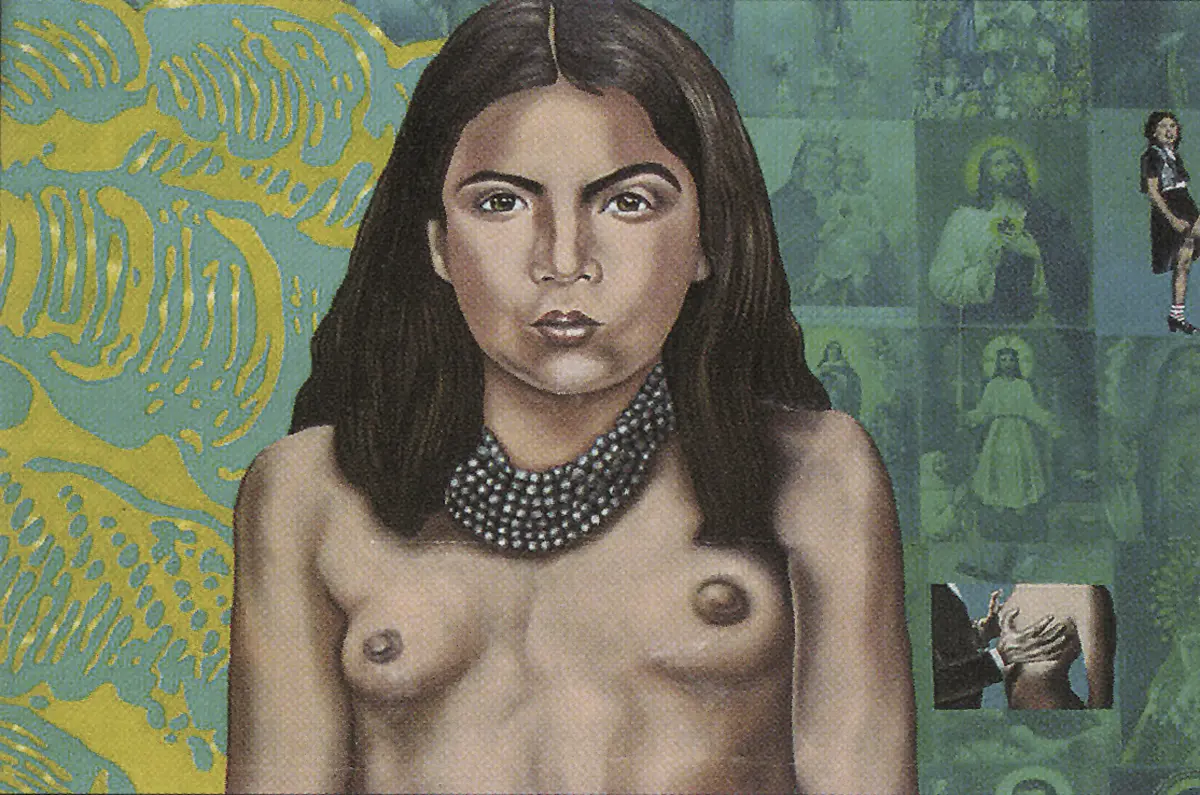
Elizondo attempts to rewrite or reinterpret history by mixing, incorporating, and reconfiguring a variety of images. In his new show, Elizondo uses once more references to nineteenth-century popular, provincial, Mexican photographers such as Romualdo García, as well as a variety of surrealist and dadaist images and portraits of some of the main personalities of these movements like Aragon, Buñuel, Tanguy, Man Ray, and Magritte. Elizondo works his canvases at different levels: the background, in which he tends to fuse images with thickly painted textures, usually has an almost abstract quality. Over that surface, he paints characters and objects and establishes a sort of dialogue among contrasting elements. In this particular case, the artist re-appropriates the re-appropriated objects that Duchamp transformed into art and turns them into characters. The compositions with elements that are heavily charged with meanings create in his paintings a sort of open narrative in which the viewer is invited to read a story.
In some paintings like Black Xocolatl, he creates a sort of tense contradiction between the pictures of saints, Madonnas, and Christs in the background and the sensuality of two women at the forefront (the duality: innocence/defiance). Elizondo's work is, in a way, extremely literal, so in this painting, the religious and mythological background for his images is in effect a collection of religious pictures. In the center of this painting, the image of Duchamp's Chocolate Grinder is superimposed on Posada's La muerte Catrina, in a strange and ambiguous reference to sex, with chocolate as the aphrodisiac and death as a feminine and seductive skeleton. Elizondo explores here the relationship between sex and religion, particularly the most blasphemous and deviant aspects of Mexican Catholicism owed to its pre-Columbian influence. The artist seems repelled and fascinated, amused and tired of the rapturous images of devotion that have become, in recent years, an over-exploited cliché.
Children are a familiar subject in Elizondo's work. They represent for him "a lost world of dreams," as he told art critic Christian Viveros-Fauné, but also they imply a world of discovery, amazement, adaptability, innocence, and surprise. "Children perceive reality and truth in a way adults can't," he explained to me. Probably what Elizondo is looking for is to possess those qualities, not foreign to Duchamp, use them in his approach to creation, and, particularly, explore the strange and chaotic world of 21st-century arts through the eyes of a child.
NAIEF YEHYA