
At the heart of Mexico City's historical center, inside the Ex-Palacio del Arzobispado, a few dozen meters away from the National Palace, the Metropolitan Cathedral, and behind the pre-Hispanic Templo Mayor, we find one of the most relevant shows of Carlos Aguirre's last working stage.
It is called Obsolescencia programada (Programmed Obsolescence). A sizable part of the works embodies the contradiction between balance and tension. Many of them have been made atop delicate supports that tend to weaken under the constant weight and yield to the laws of gravity, which would cause them to collapse on top of the viewers, at least metaphorically.
But what truly falls over them, and we're not talking figuratively, is the total symbolic weight of some of Aguirre's proposals regarding ecology, politics, information manipulation, and even social criticism.
By being one of the most demanding draftsmen around, Aguirre has chosen the medium of drawing to give body to his works which, even before occupying a physical space, slowly emerge, detail after detail, in the artist's sketchbooks. A couple of decades ago, drawing, which he carefully combined with graphics intervened directly, as one of Carlos Aguirre's bulwarks. Today, with all that mastery, completely objectual pieces (conceptually and thematically) see their first hours of life on paper.
During a long time in the production of graphic arts, Aguirre worked utilizing a system for carefully transferring images without damaging the books from which they were extracted. "I used to respect books, but now, in this new stage, I think many of them are dispensable. Today I prefer trees," he has said, not without the demerit of questioning the editorial works, such as the thick encyclopedias of his childhood that today he intervenes to make his work, that long time ago were indispensable tools for the education of past generations.
This direct questioning of old editorial pieces not only goes against their antiquated value as a source of information that's been confronted with tools such as the Internet or the quick and thorough thematic compendia you can find entirely on a single CD-ROM, but it also tackles the obsolescence of such works even as editorial materials that through the years have shown that more than works of culture, they are blocks of juicy printing businesses.
That's the reason why a good part of this exhibit is dedicated to books, but seen under the optics of the dismembered and disarticulated object. The books have been sectioned, perforated, replaced, extended, opened like a flower, or arranged as if a staircase. And they are books that now, from their new position, tell us something else; artistically they have another meaning although essentially they continue being books with altered and mutilated contents.
In the last couple of years, this creator has distanced himself from what he produced in the past. The artist insists on a cyclical renewal: "I have forced myself to change. You cannot be an artist if you don't make important conceptual shifts. It happens to many artists who repeat themselves while they claim they're doing research. It seems to me that they turn into cheats because they're always producing the same things."
Aguirre has always made openly radical proposals. Reviewing his trajectory, we can see that every three or five years there is a shift in his artistic proposal. If before we had the Emiliano Zapata figures, the carefully crafted graphic works, the direct historical references, and the veneration of the books with which he worked, today we have, in another frame of mind, steel, wood, human bones, even the letters of people who promised their mortuary ashes after their demise. This last one is, without a doubt, one of the capital pieces of Obsolescencia programada.
We're talking about a way of conceptually tackling the topic of death that goes beyond the works of Mexican artists who've dealt with it as individuals — Arturo Rivera, Alejandro Montoya, Teresa Margolles — or as part of an organization such as the controversial Grupo SEMEFO. Aguirre's work reaches far beyond.
He asked several friends if they would donate him their ashes once their bodies were cremated. The ashes then would be used in a piece by Aguirre. The writer Carmen Boullosa, the businessman Bruno Newman, and María Isabel Laza agreed to grant the strange request. Certified by a notary public, signed by two witnesses each, these three individual persons agreed, in writing, to transfer the ownership of their ashes to Aguirre for a period of three years after signing the agreement (In all cases the contract has expired, and the three persons are still alive). Although one of the pieces is made from human bones and unspecified particles in suspension, it becomes evocative. Human remains, in this case, femurs, along with skulls, are one the most well-known and divulged mortuary symbolisms around.
Alongside the upsetting of death, there's the declaration of ecological disasters provoked by man. Madera y hachas (Wood and Axes) is a representative piece within this vein: A cut, shaved, and smoothed wooden trunk has axes incrusted in several places. The axes' handles are unpolished tree branches; being the ones shaved and smoothed when industrialized, the handles are now wild and ordinary. The inverted papers ironize on an idyllic nature that appears to want revenge.
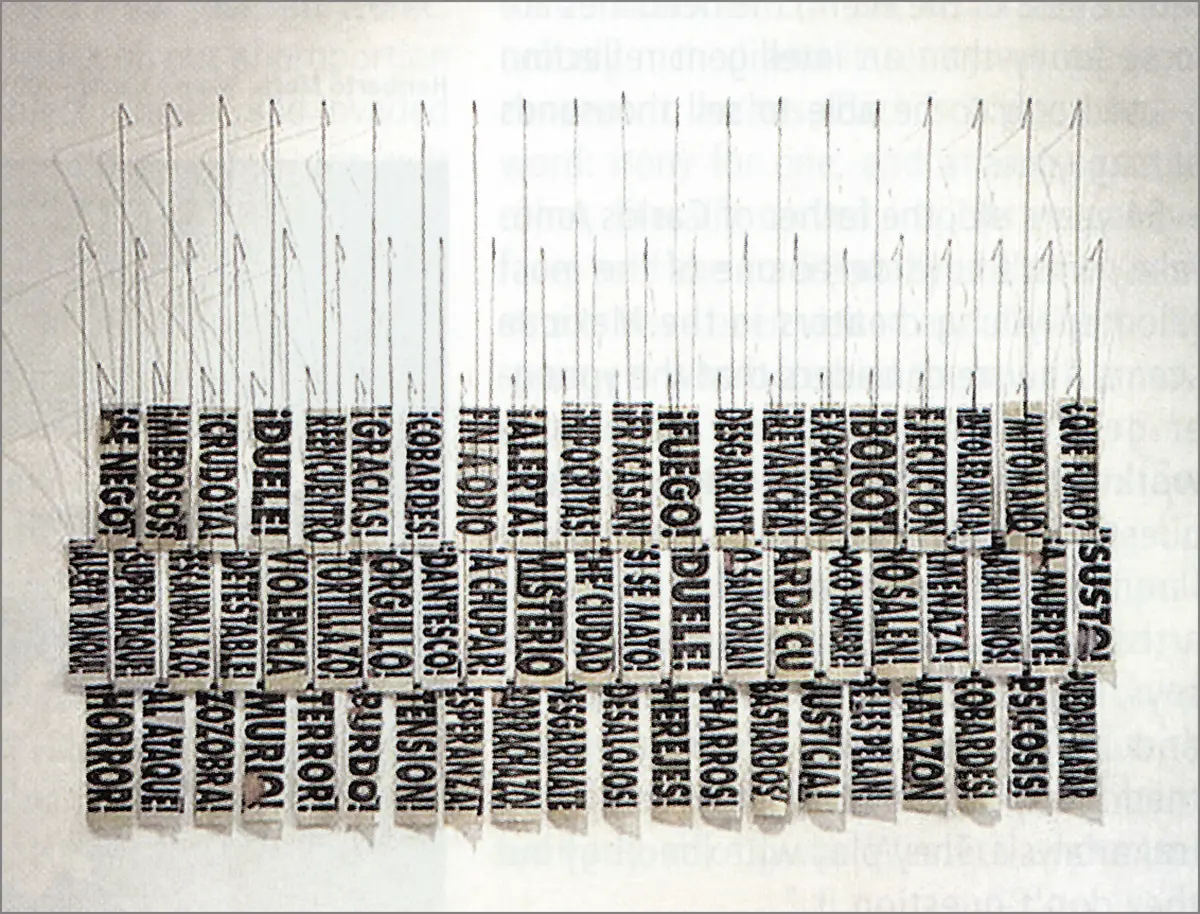
Regarding criticism of mass media, there's one piece that's made up of Mexico City's afternoon sensationalist newspaper headings. The selected words "Thank you!," "Charros," "Bastards!," "Justice," "Pride," "Hope," "Tension," "Fear," "Died," etc." are suspended from wires presenting them at the same level, side by side. Without a doubt, these words, now decontextualized, are stronger today than when they first came out as part of a sensationalist article. This puts in evidence the manipulation and dirty handling that mass media performs on language.
For an upcoming exhibit in New York City, Aguirre is preparing a similar piece, done with headlines from TIME and Newsweek. Through the headlines, he will bear witness to the 9/11 events. Notwithstanding the seriousness of the event, the headlines are funnier than an intelligent reflection — used only to be able to sell thousands of magazines.
54 years old, the father of Carlos Amorales, who's considered one of the most talented young creators in the Mexican scene, Aguirre considers that the younger generations of artists are closely working with an ideology without really questioning it, which marks a huge difference with the attitude that the elder artist's generation took. Young artists, he says, "don't analyze contents. That's my and my generation's advantage over them. They have not engaged in a political analysis. They play with ideology but they don't question it."
Not without humor, he relates that when he was a 25-year-old artist, he'd be honored to exhibit alongside artists who at the time were in their fifties, but that now that he's 54, he feels privileged every time he's invited to exhibit alongside 25-year-olds...
Obsolescencia programada ends with a bucolic, romantic piece. It is a series of tree forms that have been placed on a wall so as to appear as shadows of trees. Each one was made with the dust that fell from the books the artist had cut for other works. The absence/presence binomial turns around to become a passionate denunciation of deforestation, one of the worst ecological problems worldwide. And he continues to also point out the uncontrollable production of junk books filled with clichés, far away, as we have seen, from what a book should be in terms of culture — an extension of human thought.
SANTIAGO ESPINOSA DE LOS MONTEROS