
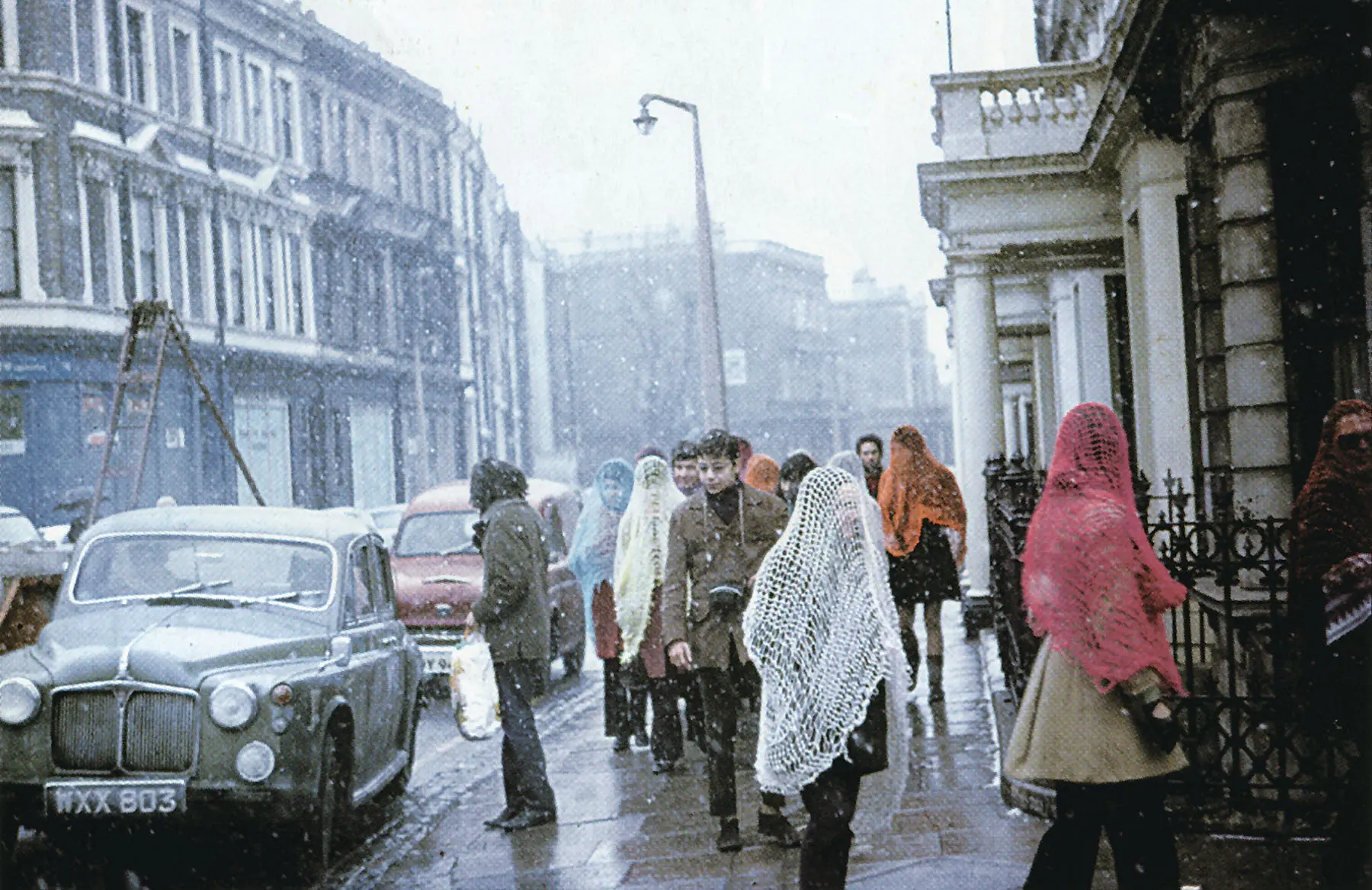
On March 7th, 1970, the young Venezuelan artist Diego Barboza carried out in the streets of London the action work titled 30 muchachas con redes (30 girls with nets). Barboza was able to gather thirty young friends whom he covered with colored nets that he himself had made. Dressed in this way, the girls went out to walk confidently through several important sites of the English capital, raising uncertainty among the passersby. They had received from the artist instructions to remain immutable and calm in the face of the hounding and curiosity of the people.
This event, totally imbued within the experimental poetics in vogue in Europe during the '60s and '70s, nevertheless marked for the Venezuelan context one of the first steps toward an opening to the conceptual or non-objectual contemporary artistic trends.
For Barboza, the goal of this action was to create an atmosphere of play, of mystery, of festivity, in order to integrate an idea of total art into a daily situation.1 This event of selective participation certainly paved the way for participation in the civic environment charged with poetic connotations, and it would make up the conceptual core from which the artist would later develop the entire poetics of his action works.
Barboza, who was born and raised in Maracaibo (capital of the State of Zulia, known for its wealth from oil and its particular culture), had been experimenting since 1969 with works that involved, on one hand, a distancing from the notion of the work of art associated with the object, and on the other hand, the participation of the viewer as a fundamental element of the artistic experience. The first of these actions, realized in a private space, was called El cuarto plástico (The plastic room) or Cámara (Chamber), and it was carried out by the artist in his student room in London. This "chamber" was a transparent and flexible plastic cube inside of which was inserted a vertical cylinder of the same material. The artist invited the participants to enter the cylinder, placing hats, nets, or masks on their heads in an insistent act of making the event an essential part of the creative experience.
But these interests actually had their antecedents in Barboza's period of training and in the early years of his career in Venezuela. Since the beginning, the artist had used newspaper collage in his paintings, showing an unusual self-confidence for a budding artist. As an "artist who breaks traditional molds," his work was reviewed in 1963, during his first solo show, which took place in Maracaibo. But it would be in Caracas, roused by the effervescent sociocultural climate of the Venezuelan capital of the time, where the artist would begin to concern himself with the viewer's participation and, above all, with making the artistic experience an event that could overcome the artistic conception and appreciation based on the "object of art."
In this sense, his show from 1967 in the Caracas Atheneum marked a milestone within the national artistic panorama, considered by some critics to be the spark of many of the conceptual works that the artist would later develop. On that occasion, Barboza exhibited objects that needed the manipulation of the viewer in order "to be complete" as such. Chests of drawers, moving bodies, and spheres needed this participation in order to unfurl all of their plastic and humorous power. The artist also handed out small objects and images among those present, which constituted "something without precedent in Venezuela."2
Uniquely complementing the experiences in the making of objects that his friend, the great Venezuelan creator Mario Abreu, had assimilated, as well as the works dealing with the viewer's participation that made up the theoretical base of the expansionist movement (rooted in abstract geometrism), Barboza had achieved a new method of inquiry and of multiple possibilities. It was during a search for new roads for his creative interests that, on his own account, he left for Europe in 1969.
Enrolled in the London College of Printing, Barboza found in the English capital in the late '60s the appropriate culture for his concerns. He visited numerous shows, but Hélio Oiticica's Tropical Eden at the Whitechapel Gallery would be the one that would decisively mark the course of his creation within the field of action art. "It is Hélio's work that led me to the idea of breaking with the object [...] the encounter with Oiticica made me aware of this; it ended up breaking obstacles for me and it gave me a decisive impulse for my later research."3
The English Period
After 30 girls with nets, Barboza carried out a series of Expressions (the name that the artist gave to these participatory events) in which, little by little, he would involve the participation of the people as a random element, leaving aside the controls of choice and even of behavior.
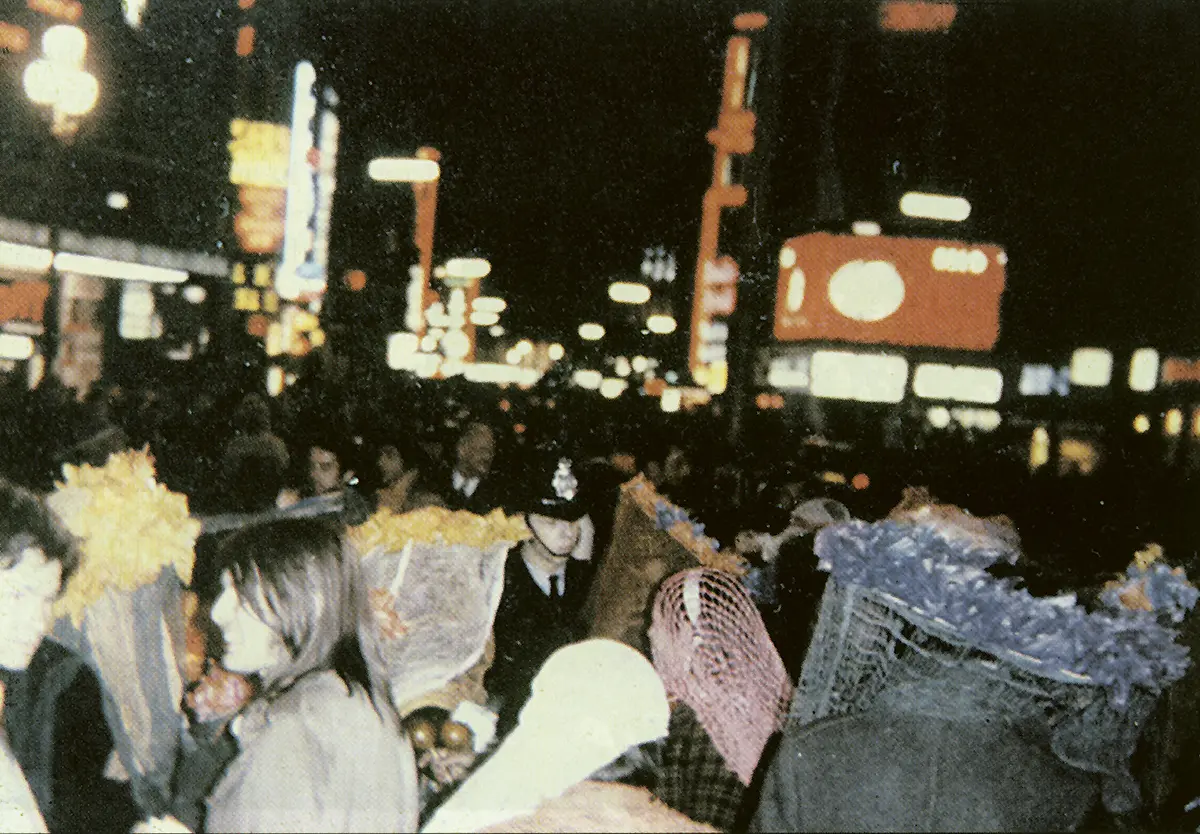
On 23 October 1970, he presented the event Put on a net and come along, also known as Con redes y sombreros (With nets and hats), in which the participants came out to walk with their faces covered with fabrics, nets, and hats made of paper flowers. The group of individuals had gathered in the London New Arts Lab, where they painted and exhibited their works, in order later to march as an anonymous mass—hence the covered faces—toward Piccadilly Circus, Trafalgar Square, and St. James Park. Although the artist had proposed an itinerary, it was the participants who decided, as the action developed, what was to be done. For Barboza, putting on nets and taking to the street produced "a direct relation between art and man; the event in the street is also a demonstration of art that alters the daily behavior of the people [...] This demystifies and breaks with the idea of art made for the small minorities."4 In December of that same year, Barboza carried out a similar event that he called Expresiones en el mercado (Expressions in the market). Here, the crowd of participants went to places like neighborhoods, restaurants, and markets, in search of the participation of the average spectator with a view to creating a group expression. This event would be undertaken in Paris, where it was able to capture the attention of critic Frank Popper.
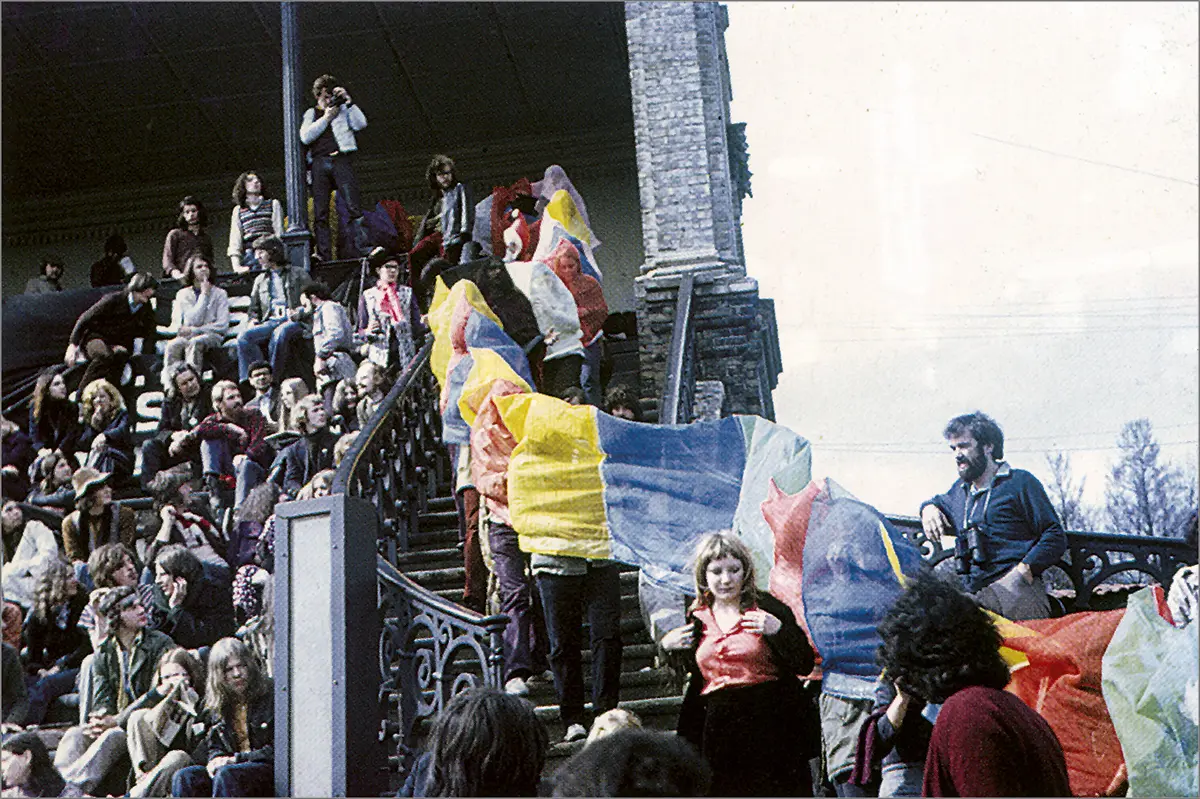
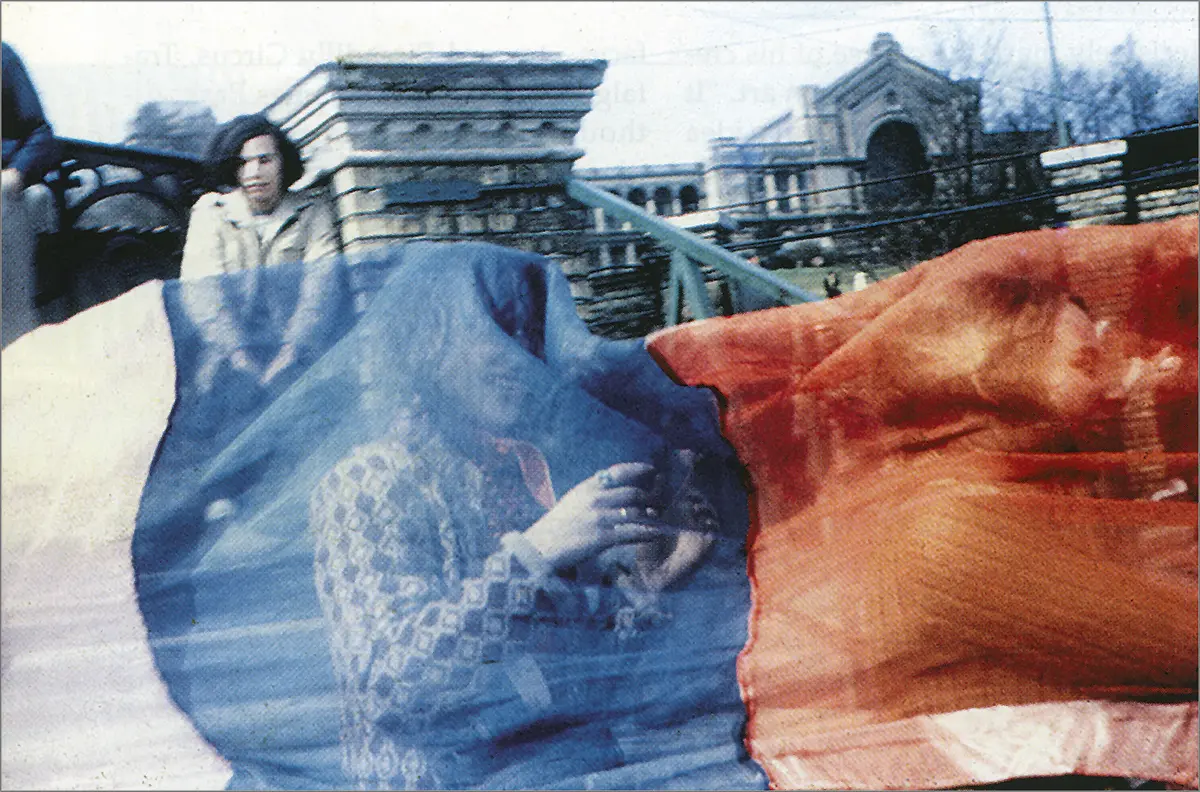
In 1971, the artist burst into the Speaker's Corner of London's Hyde Park with the Expression called The Centipede. This was realized with a sort of worm of colored fabric on which compartments for each one of the participants had been created. It was a "synchronized expression" since it hindered the participants from acting in an individual fashion. That same year, Barboza would perform his first experience relating to mail art: La célula humana (The human cell), a numbered sheet to be distributed by mail with the goal of having the receivers establish planned contacts among themselves.
The following year he created People Tied Together, also known as Expressions at a Laundry, in which a group of individuals was tied with pieces of fabric, and they walked to a laundry in order to wash and dry the ties that bound them.
Just before his return to Venezuela, Barboza created Danger King-Kong and Expressions in Oval House. Both experiences (which foreshadow the change that his poetics of action would take upon returning to Venezuela) were cut off from the previous ones, inasmuch as they were carried out in closed spaces and did not involve group participation. The former approaches the notion of performance, and the latter, closely linked to the ideas of Oiticica, was planned as a festival in which typical elements of magic and South American life were incorporated, with a strong accent on the folkloric element.
The English period of Diego Barboza's work is characterized by what Frank Popper identified as an attempt to wrap up the street and the public in the aesthetic experience, while the role of the artist is limited to provoking situations that allow him to create psychological reactions among the participants.
Caracas
Diego Barboza's return to Venezuela, with all the baggage of experimental and conceptual art obtained in Europe, has noticeably influenced the national plastic environment. We tend to forget, in light of the current state of things, and after having lived through the boom of the conceptual currents of the '80s, the solitary process of this creator who certainly opened the doors to countless possibilities for creation that can be tracked in our context even today.
It was Diego Barboza who carried out what I consider to be one of the first installations, conceived in the current sense of the term, in our country: Vota vaso vasura (Vote cup trash, 1973), a metallic fence that had white letters over a red background that read vota vaso vasura, and which was accompanied by a water filter with disposable cups and a trashcan through which the artist wished to allude to the electoral environment that the country was experiencing, and to the almost unconscious act of voting. Art critic Roberto Guevara would later call this work "the filter of awareness."
The poetic actions—or Expressions—carried out in Caracas slowly take on a character of popular participation very similar to some folkloric manifestations. In 1973 he created a new version of Danger King-Kong that he called Cuidado King-Kong (Be Careful King-Kong). In it, "I seated a girl dressed in white who had a tray and there she had some little sheets of paper that reproduced a poster that appeared behind her, which read 'Be careful!'s The activity consisted of daring to cut out the figure of King Kong; once cut out, he came to life, and we had to stave him off."5
Cachicamo Uno (Armadillo one), which was the name of another of those expressions created in 1974 in the Caracas Atheneum, was a festival in which the viewer (acting as co-creator of the experience) interacted with various elements arranged in the room like "stations," closely tied to Venezuelan popular culture. This experience was conceived in order to stimulate all of the senses, wrapping the public up in a universe of sight, touch, smell, and taste.
Also, the renowned Caja del Cachicamo (Box of the Armadillo), although it was a work of art in the street made to stimulate public participation, refers us to some games or "diversions" typical of our folklore. A wooden box was set up, out of whose sides came to some long intestines made of red fabric on which was written the word cachicamo. The strips had bells glued onto them and they were carried, to the rhythm of the dance, by two people who encouraged the people to participate.
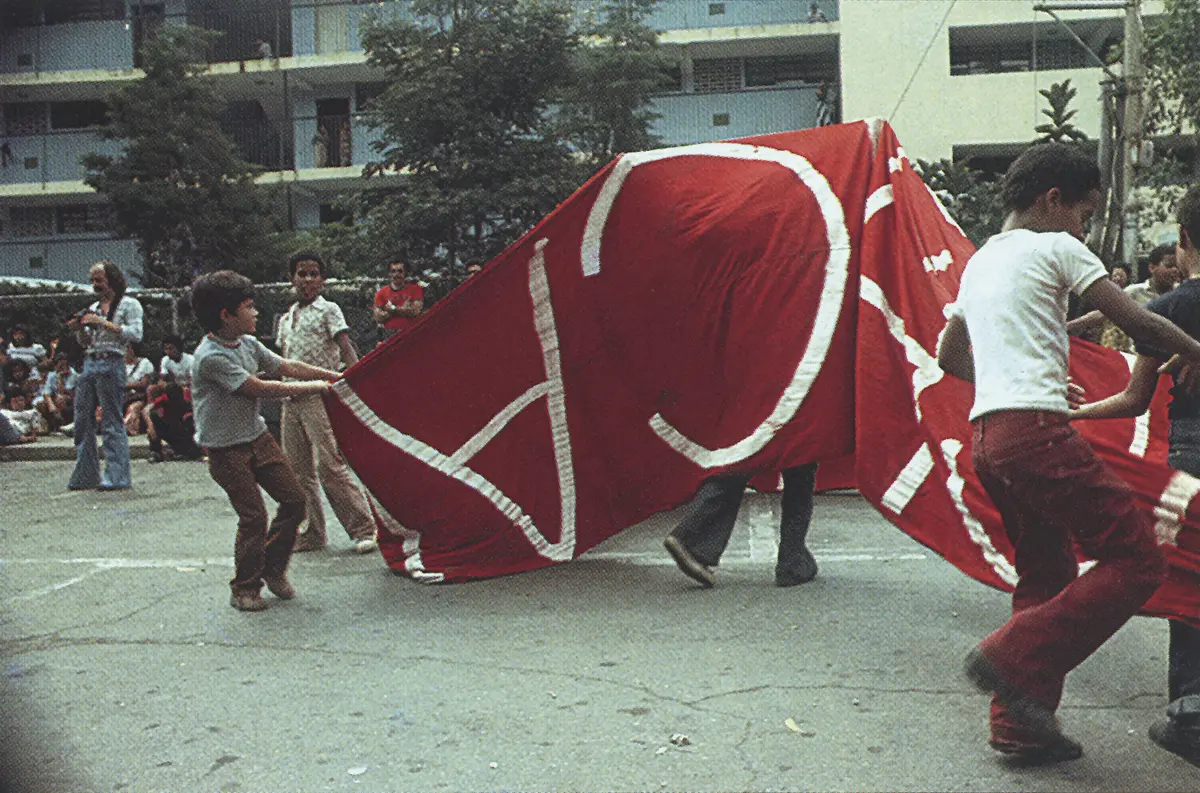
Parallel to these expressions, Barboza showed the sketches that he created in the moment of designing these actions, as well as the photographs from his research. In this, he also acts as a precursor by lifting the dead weight of the prevailing conventions and using the photographic image as a document and as an autonomous plastic image in which the artist also unfurls all of his talent as a drawer and painter.
But perhaps one of the most interesting moments of this career was comprised of the mixed meanings and play between reality and fiction that Barboza brought about with his Proyecto Guarandol. Here, the artist proposed an action in which a helicopter flew over the towers of Parque Central (an architectonic complex located in the center of Caracas whose east and west towers make up the highest buildings in the city) and left long strips of canvas with the inscription "Arte como gente/Gente como arte" (Art as people/People as art). Later, these strips were released in order that they might fall freely onto the public streets. The artist photographed a scale model and photographic views of a montage of a small paper helicopter arranged on a window, through which he was able to create "realist" images that acted like photographic registers of an experience that had never occurred. In fact, the Proyecto Guarandol constituted a utopia due to the technical impossibility of carrying it out and to the great risks that its realization took.
Another of the activities carried out by Diego Barboza during these years was the one related to mail art. The same activity had emerged from a casual encounter that the artist had with Julien Blaine, editor of the magazine Doc(k)s, specializing in ultra-avant-garde manifestations. Blaine introduced him to mail art, and in 1976 Barboza decided to create Buzón de arte (Art mailbox), a tabloid in which he gathered and published the most significant mailings. For Barboza, the experience of mail art was essential for redimensioning his conception of the artistic processes and of the demystification of the figure of the artist and of the work of art. Mail art is an interpersonal expression in which any type of experience can occur, even conceptual; the important thing is the intimate act of receiving something. Its goal is not to end up in a museum, nor is it the artistic object in itself, since what is received can be transferable. That form of expression helped me a lot because it freed me from the egocentricity of the artist and commercial temptation. In mail art, the artist ceases to be an emitter and becomes a receptor and the work is depersonalized.6
In the '80s, Barboza already formed part of a group of non-conventional artists who worked with methods derived from experimental currents associated with the non-objectual. That is how he carried out works like Impresiones alrededor de un cilindro (Impressions about a cylinder), created with cushions of organic shapes that rested at the end of a large plastic cylinder, and Protestas, in which the artist took up once more the idea of the hats with paper flowers, but whose structure drew it closer to an individual performance than to the event of group participation.7
On 28 April 1985, Diego Barboza created what would be his last action work: De la Escuela de Atenas a la Nueva Escuela de Caracas (From the Athens School to the New School of Caracas). This would be a work of selective participation, plastically beautiful, charged with poetic allusions, and somehow, by finding inspiration in the pictorial work of Rafael de Sanzio, it functioned as a premonition of the distancing that Barboza would make evident with regard to non-objectual forms, and of his slow and successful approach to painting.
The artist gathered a group of friends whom he dressed in colorful Greek tunics. They came together in the Parque Los Caobos of Caracas and they slowly walked toward the spaces of the Galería de Arte Nacional. They met in one of the rooms where Rafael's work was being projected. With this piece, presented again in the XLIII Salón de Artes Visuales Arturo Michelena (Valencia), Barboza won the Premio Fundación Banco Consolidado for the specialized field of Non-Objectual Art.
Return to Painting
It would seem ironic that this artist, to whom we owe one of the most solid works in the Venezuelan conceptual tradition, and who occupied the post of the precursor of these tendencies in our country, would give up his non-objectual work and take up painting once more.
Diego Barboza's announcement about this in the mid-'80s certainly raised countless controversies, doubtless grounded in the idea of art's evolution, which saw that return as a step backward. Today, in hindsight, the artist recognizes that his project of making participatory art for the masses in Venezuela was paradoxically turned into an art understood only by the elite who were aware of the latest international avant-garde movements.
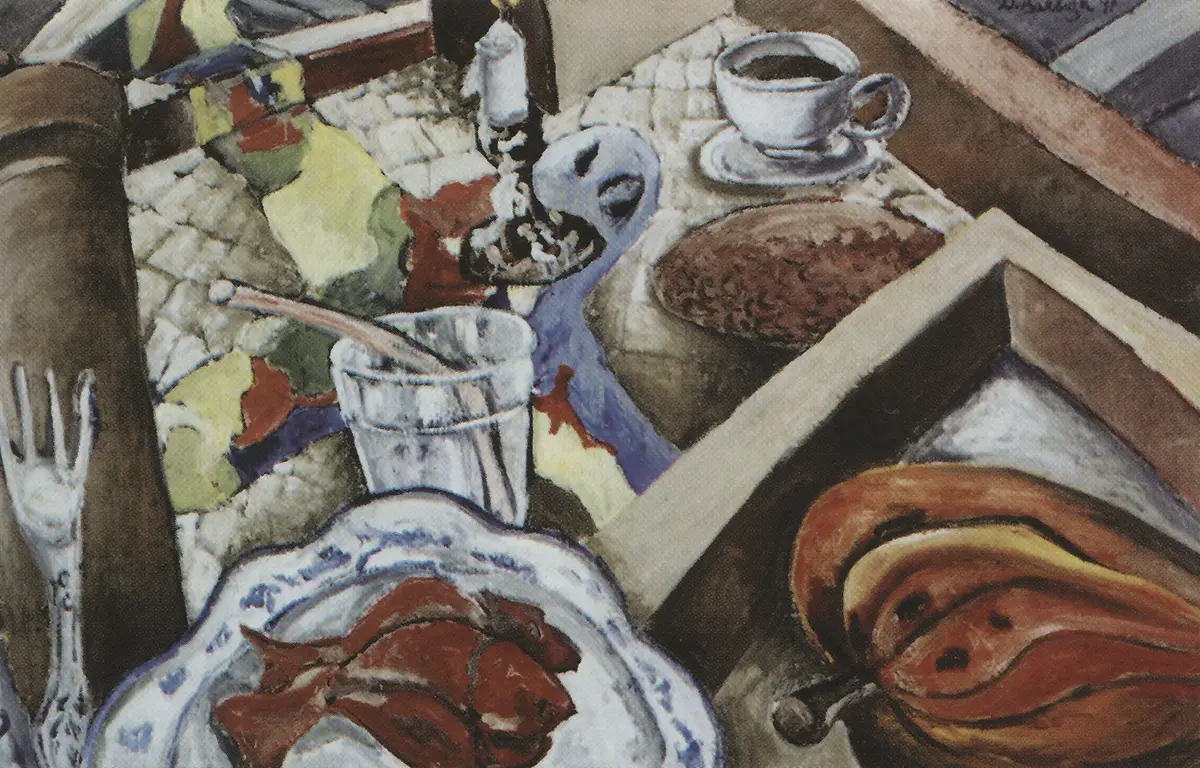
Diego Barboza's road back to painting was a long one. On it, Barboza revealed himself as a talented drawer and perhaps as the most exquisite collagist of our country.
Since the goal of his creation was always to achieve a way to communicate between art and the people, and a totalizing conception of the creative act, the artist decided to withdraw back into painting, a medium of expression in which he knew how to make out a path attached to our creative traditions, and a more direct possibility to communicate with the viewer. Diego Barboza, who received the Premio Nacional de Artes Plásticas in 1997, is one of our most talented painters today. He was able to develop a personal style, reinforced by the taste for the doughiness of the material, the love of voluptuous forms of beings and tools, and full of deep expressivity.
Nevertheless, his legacy as the precursor of action art in our country is undeniable and deserves to be rescued, spread, and studied, with a view to laying the foundations of a true history of Venezuelan conceptual art.
NOTES
1. Diego Barboza, Expresiones, material diagrammed and printed by the artist.
2. Gioconda Espina, "Poemas de acción" y otras expresiones de Diego Barboza (1954-1984) (Maracaibo: Ediciones Pancho El Pájaro, 1992) 20.
3. Interview with Diego Barboza by Katherine Chacón on 22 April 2000. Mimeographed material.
4. Diego Barboza, Expressions. Printed flyer for the "expression" Put on a net and come along (London, 1970).
5. Interview with Diego Barboza by Katherine Chacón on 22 April 2000. Mimeographed material.
6. Ibid. 7. This work was presented in Colombia, as part of the 4th International Art Biennial of Medellín.
KATHERINE CHACÓN
Venezuelan art critic and researcher.