
For the second consecutive year, the Spanish agency Enersis organized a painting contest in Santiago de Chile. The guests for the year 2000 contest were 35 Chilean artists. For the most recent event, the organizers decided to extend the invitation to include painters from the five countries the agency has economic interests with Argentina, Brazil, Colombia, and Peru, as well as Chile.
The cultural consultants Aurora Balart y Elena Marinovic, and ABS Gestión Artística y Cultural, having had the experience of the first contest, took over the responsibility of organizing the entire event. It is fair to mention the excellent job done in the different organizational aspects that an important and complex event like this requires.
The organizers traveled to the five countries mentioned above, contacted artists, and curators, and selected their guests, always keeping in perspective the opinions of local personalities. In Chile's case, their selected guests were those who had no previous participation. The organizers' aim was to find an ample panorama of painting that's presently being done in the five countries in question, without following any style, tendency, or particular trend. In the month of September, all artists not originally from Chile were invited to spend three days in Santiago, the home base for the contest. They had the opportunity to meet their Chilean counterparts and to get to know the city. This meeting introduced one of the most important aspects of the contest: the authors were invited, not only were their works presented anonymously, as it's customary in events of this nature, but Enersis also organized a splendid symposium of the artists, thus adding a distinctive touch to the invitation.
In addition to the invitation to the Chilean capital, the contest also offered three important prizes and a nominal stipend for the acquisition of all their works, which now form part of the agency's collection. Moreover, the Chilean public had the opportunity to appreciate these works at the Museo de Bellas Artes from the latter part of November through January 2002. These exhibits have also been planned to take place in all the other guest countries. The show is accompanied by an excellent catalog.
An international panel of judges had the arduous job of selecting the winners. This fact should not be taken lightly. It is extremely difficult to establish parameters to objectively judge so many works of such a dissimilar nature. The panel of judges was led by Professor Milan Ivelich, the director of the Museo de Bellas Artes de Santiago. The rest of the panel members were: Lisbeth Rebollo, President of the Asociación de Críticos de Arte de Brasil; Jorge Glusberg, the Director of the Museo Nacional de Bellas Artes de la Argentina; Pedro Gjurinovic, Director of the Museo Pedro de Osma, in Lima; and Colombian professor, historian, and critic Germán Rubiano Caballero. The panel of judges was also joined by two high-ranking executives of Enersis.
Each artist participated with one piece done specifically for this event. The material or technique to be used was not pre-determined, but the format had to adhere to the following measurements: 1.30 x 1.70 m. There were no age limits for this event, and the age range was ample; for example, we found older artists like the Chilean Matilde Pérez (1920) and young starters like Colombian Johanna Calle (1965). The selection was risky because it contrasted well-known and tested trajectories with the first steps in the professional life of younger artists. The most homogeneous and smaller national groups were Colombia and Peru. The largest representation was from Argentina.
Seven artists from Brazil were invited, two more than the rest of the countries. This was due partly to the proportion of the vast territory of the country and partly to the magnitude and quality of its artistic manifestations. In any case, it would be ideal if five artists could really represent the artistic reality of an entire nation. And, if in other areas the nationalist factor seems a thing of the past, in the artistic world the global phenomenon is quite obvious. Individual contributions are now more important than the place of origin, or place of work, of the author. The content of the works makes it clear: Chilean artist Altamirano's Dead Cow could have been done by a Belgian or a Canadian. Nothing in it signals the national origin of the author.
The contest proposed a theme: Energía y Vida (Energy and Life), "...full of possibilities and implications," according to Alfredo Llorente Legaz, the president of Enersis. It is common for many artists to avert this type of theoretical frame of reference. What is unusual is for someone to adhere to it. This contest did not reveal any such novelty. Master José Balmes intervened his canvas with electric wire and ceramic bobbins as isolation conducts. In reality no artist in this contest limited himself or herself to the theme. The question remains whether it is realistic to set thematic labels for this type of artistic endeavor, considering they are usually ignored.
The following artists won prizes: Arturo Duclos (Chile), Bruno Zeppelli (Peru), and Carlos Vergara (Brazil). The panel of judges also made honorary mentions of the following artists: Maricruz Arribas, Carlos Altamirano, Margarita Gutiérrez, Eduardo Médici, Thomaz Ianelli, Matilde Pérez y Gustavo Zalamea. The Corporación de Amigos del Arte made two other honorary mentions of Matilde Pérez y Juan Antonio González.
I will now discuss some of the works, starting with the winners:
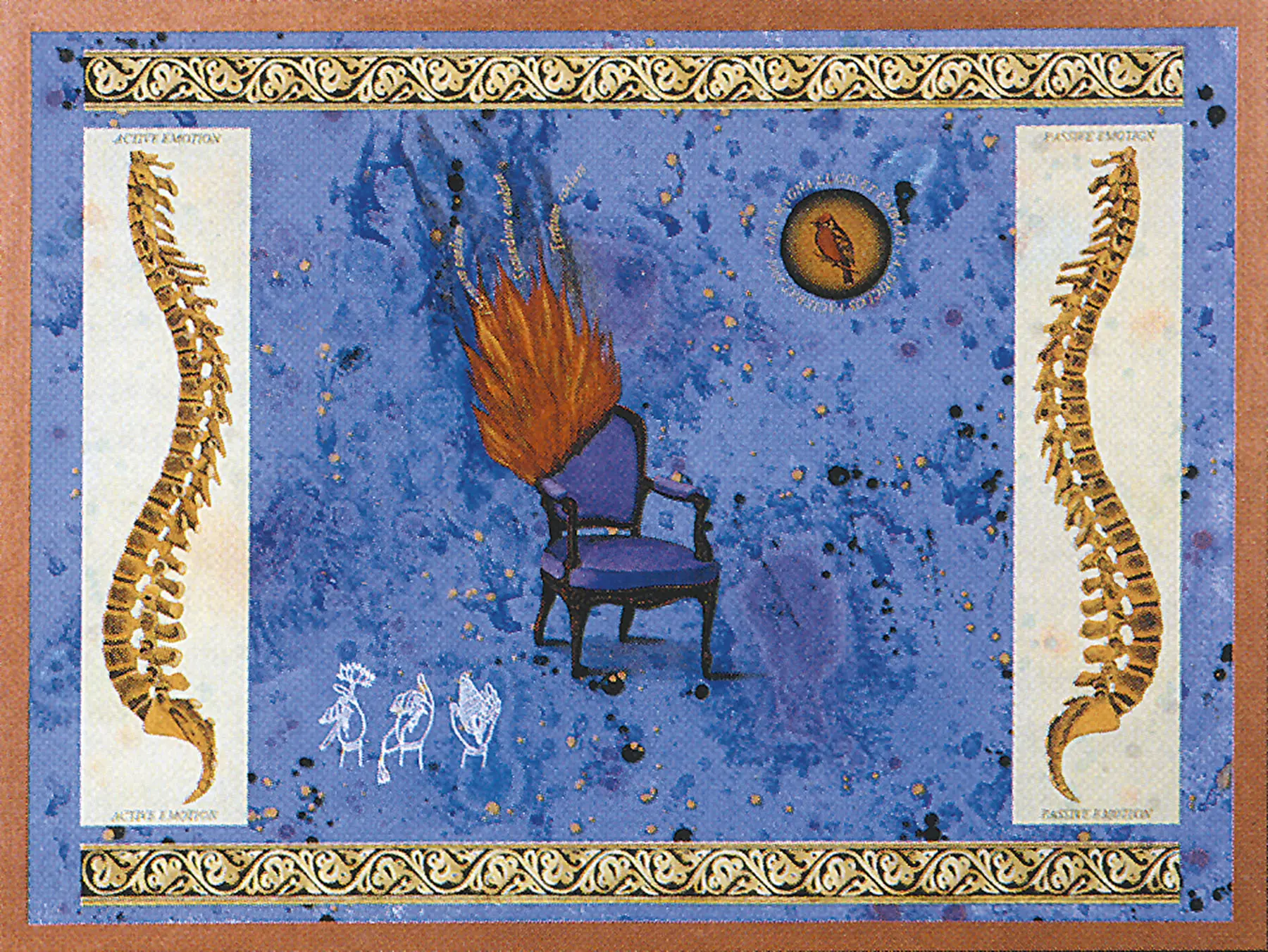
Arturo Duclos's piece, titled Ars Magna Lucis et Umbrae, perfectly adheres to the symbology and resources the artist has been using for a long time. Bones, fire, texts. "My work delves into metaphors of material and spiritual nature, related to the counterpoint of energy and life." Various fields of overlapping images appear on a blue background, bordered by a brick-red perimeter, and touched with small, black, violet, and gold spots The background is flat and simultaneously spacious. Following the horizontal plane of the upper and lower margin are two straight, architectural-type, ornamental Grecian frets "representing vegetation" framing different visual fields. On both sides and in a mirror-like manner, two rectangles encase respective vertebrae in profile, accompanied by a text or legend. If the Grecian frets contain rectangles, the texts seem to contain the bone structure. Duclos employs these images to produce a precarious balance between the anthropomorphic and zoomorphic. In the middle of the painting, there's a square-shaped space where a chair "in style" is burning (the flames, similar to the inferno of primitive art, are resolved in written texts.) At the bottom, three hands in white lines respectively hold a flower, an oriental rosary, and a snail. Their morphology seems to allude to Budha. In the upper part, at an angle from the hands, is the piece's title, the artist's name, and the date, as written text around a circle encasing a small red bird.
The piece by the Chilean artist is of great complexity. The elements employed convey various levels of interpretation. There are allusions to medieval times and to the Dutch 17th century, and definitely to the "euphuist" architectural and (scientific) naturalist drawings. The multiplicity of languages, English, Latin, etc., function more as graphic support-matter for the images than as actual idiomatic content-matter. The painting conveys contemporary, unsettling, and cryptic contemporary poetics. Perhaps a referential code can be found in the counterpoint proposed by the artist himself.
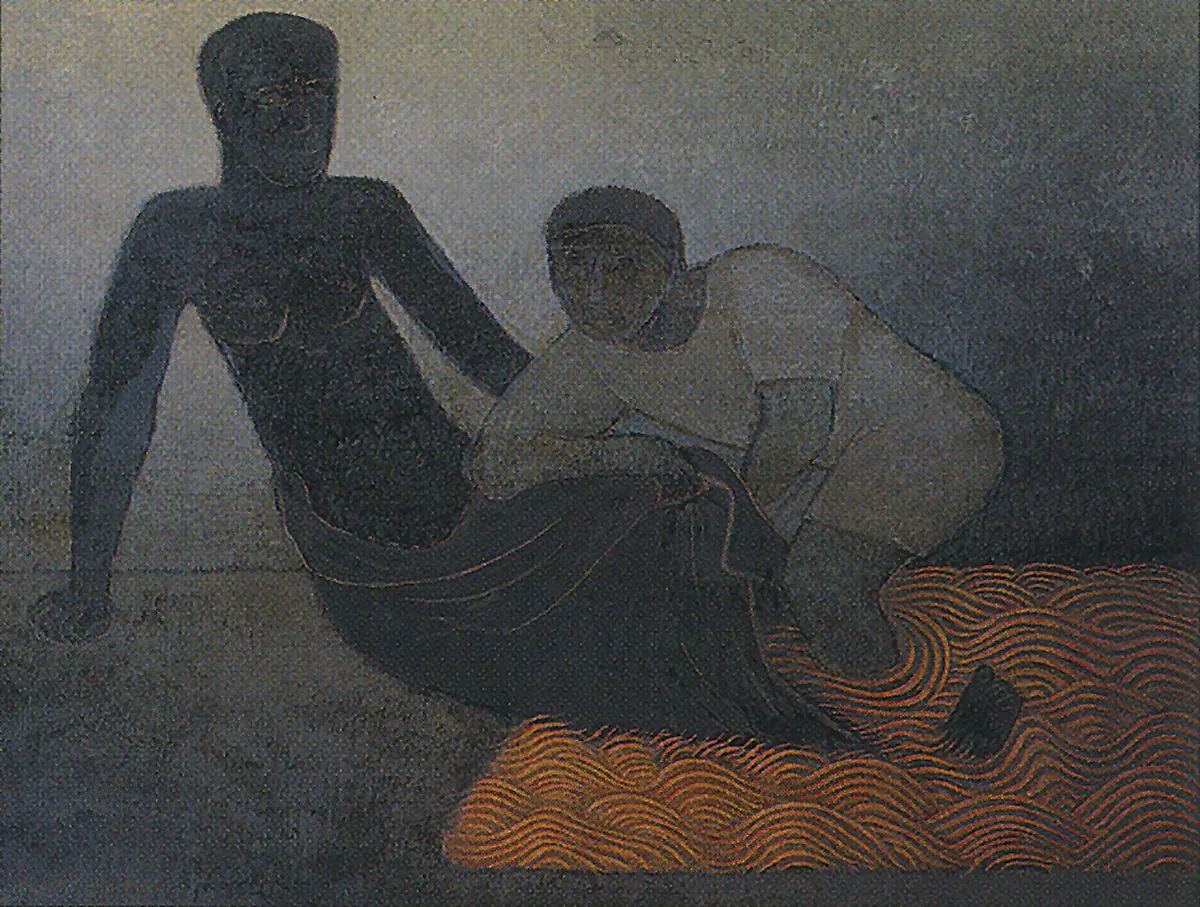
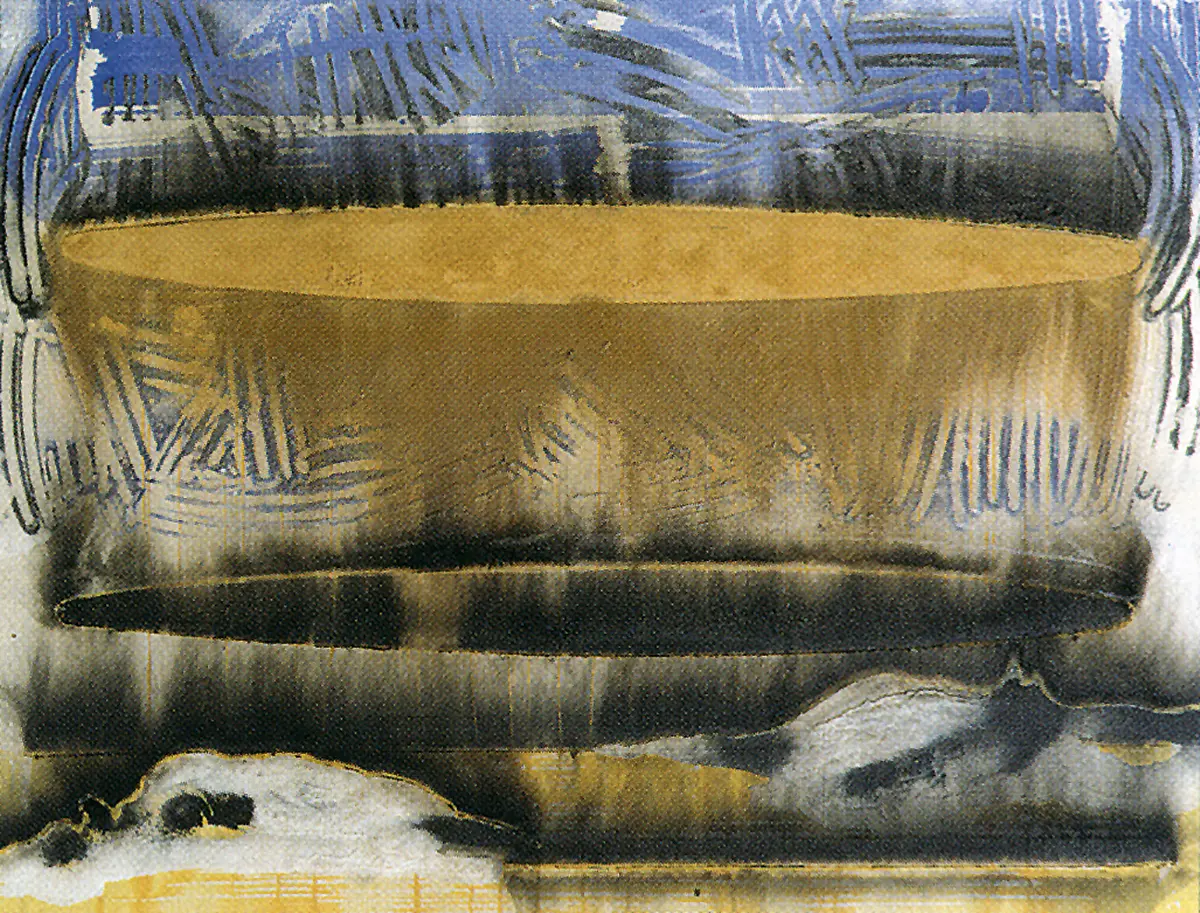
Bruno Zeppilli won the second prize. Most part of the canvas is taken by two characters. One of them appears dark, crouching, leaning on the right shoulder and half-covered by a gown. It reminds us of a Classic figure of Etruscan sepulchers. The features of the face, the details of the clutched hand, and the folds of the gown are depicted with defined strokes. Another crouching figure wearing a short tunic gown leans on the former. This one is lighter but still gray. The surroundings are all gray, except for a rectangle in perspective, signaling water by the use of yellow and orange curved lines; it complements the characters that seem to be immersed by the surroundings, as someone who seems to be watering their feet on a hot day. The lighter figures seem to be staring at the other one as if questioning him. The painter speaks of a feminine and masculine character, but the figures appear ambiguous. This simple painting has the unfortunate defect of being too similar to the work of the Peruvian artist Tilsa Tsuchiya, without the oneiric charge that characterizes her work. The third prize went to Carlos Vergara for his piece titled Calor (Heat): "Fire, transforming element. Earth, a stable element. The painting conveys its constitution. It does not show, it is."1 The piece is abstract, and elaborated meticulously, using mixed media, that employs a horizontal order. Grays, terracotta, dry-blue. Of the ten pieces that could be called abstract, Vergara's piece is singled out as the most peculiar. It moves between the simple to the profound. The oblong shape of intense ochre suggests a circus floor, or the surface of a melting cauldron, mirages that obviously vanish as soon as we see the glazes in the lower part of the piece. There is correspondence with Rauschenberg by way of the figurative manipulations that combine with pictorial elements proper, like the blue brush strokes of all the upper area, or its double, it's negative, in the middle section.
Among the artists that received honorary mentions were Margarita Gutiérrez and Gustavo Zalamea, both Colombian. Gutiérrez presented an abstract piece that's characteristic of her work, but it was also innovative. A grid that emerges from the center of the canvas serves as a "motif" on a blue plane furrowed by curving, light lines. A rigorous composition makes itself known under the apparent informality. Color is regimentally controlled.
Zalamea's piece is more like a collage than a painting, although the spectator has a visually flat surface before his eyes. Here's what the artist has to say: "Campo de energía (Field of Energy) alludes to the birth of the world. The irruption of energy materializes in a painting of an elaborate plot and monochromatic, worked with essential materials: seeds... and resistances (electrical)..."1 With this piece, Zalamea radically breaks away from the imaginative and fantastic figurative art characterizing his work. No whales in Plaza Bolivar. The piece is closer, in appearance, to the gestural art of the New York school, or to European formalism. I say "in appearance," because his procedure requires the laborious task of blending and gluing the materials to achieve a few rhythms that move the surface in the manner of a primary plasma. There is no sign of a gesture here. There is a slow process resembling the gradual deposit of material that comes to form part of a fossil. Conceptually, the piece by Zalamea adheres to the theme of the contest.
Other pieces of merit, that did not get the judge's attention, were Victoria y rayo (Victory and Lightning) by Juan Lecuona, and Mecánica do precario by Emmanuel Nassar. The former combines pictorial and graphic sources on a surface that's organized as a triptych. The Victoria stretches its black wings over the sides and it appears destroyed by lightning of intense blue rays. A simple mechanism, a sort of pulley barely visible, painted with a white stroke, is leaning on a vertical support, right in the middle of the canvas, that starts to burn. The whole is on an intense, blue plane.
I finish this review by pledging a dedicatory homage to the Brazilian Thomaz Ianelli, who died before the opening of the exposition of the Concurso Latinoamericano de Pintura Enersis 2001. The kites flown by children he painted shall keep his memory alive.
The participating artists were:
Argentina: Juan Lecuona, Luis Felipe Noé, Eduardo Médici, Oscar Smoje, and Luis Wells. Brazil: Mario Camargo, Fabio Cardoso, Eduardo Eloy, Thomaz Ianelli, Emmanuel Nassar, Helio Rola, and Carlos Vergara.
Colombia: Johanna Calle, José Antonio González, Margarita Gutiérrez, Beltrán Obregón, and Gustavo Zalamea
Chile: Carlos Altamirano, José Balmes, Arturo Duclos, Rodolfo Opazo, and Matilde Pérez
Peru: Maricruz Arribas, Alicia Cabieses, Hernán Pazos, Eduardo Tokeshi, and Bruno Zeppelli.
NOTES
1. It is worth noting that Abstract Art from Río de la Plata, Buenos Aires, and Montevideo, 1933-1953 was later shown in Mexico City's Museo Internacional Rufino Tamayo. The institution's reputation and museography allowed for an enriching reception and showing of the works. A generous display of documents, some of them under glass and some others for the public to peruse was included in the hall exhibit. The same catalog, with excellent reproductions, was used in both Mexico and New York.
MARÍA ELVIRA IRIARTE