
At first glance, Fabián Marcaccio's painting appears to emerge from the tradition left by the Chilean Roberto Matta, whose fluorescent-green seaweed explodes at great speed. Present is also Burri, the Italian painter who in the 1970s texturized his paintings with deerskin; he serves as a vague reference to understand Marcaccio's pictorial memory. It is precisely here, on the appearance, where we must read his work anew.
Marcaccio appears in the New York scene just when the Neo-Geo group is becoming something else. He is able to introduce his discourse, which centers around the dialectic between matter and painting's supports. Everything there has been convulsively elaborated for digestion and a possible evacuation.
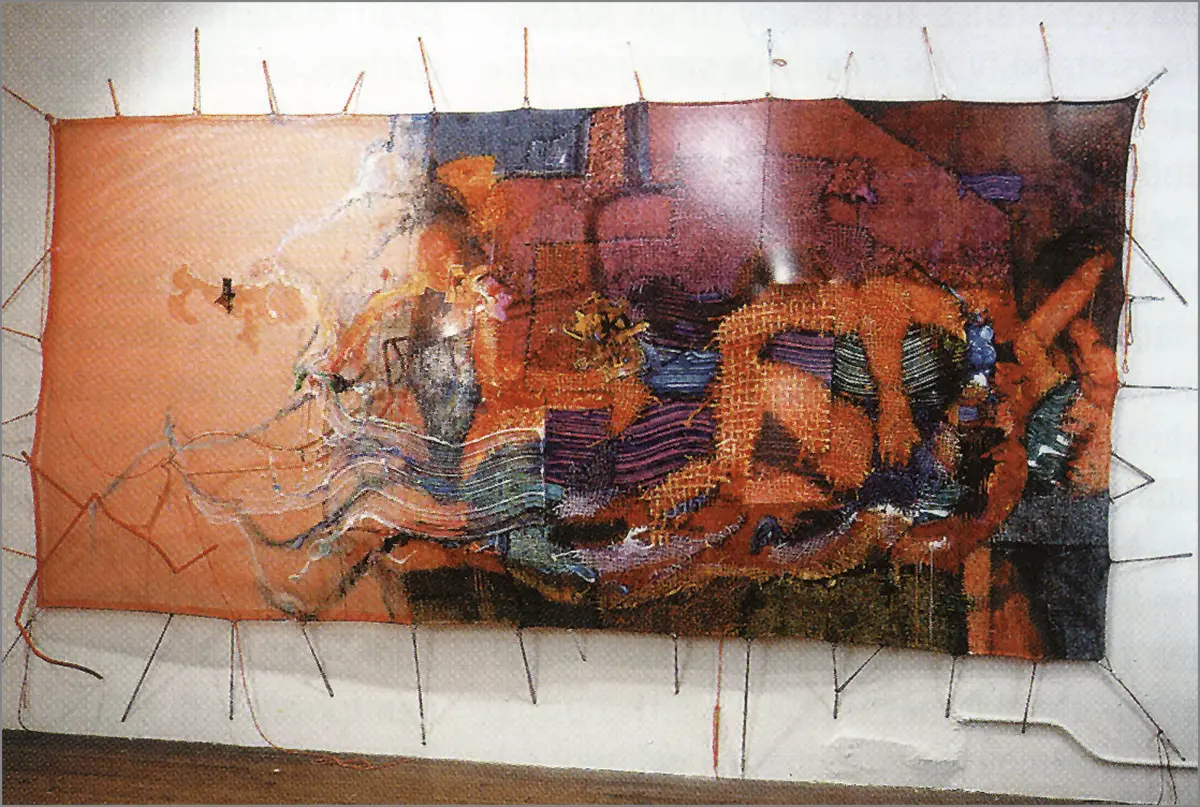
Generally speaking, the nature of painting is quite arbitrary. To have a certain control over its processes is something that many painters have desperately tried to do. Even artists such as Gerhard Richter try to exercise control—or indeed they do so—on the language of his doughy colors. The control exercised over the pictorial process and the wish to know why certain things are done at any given moment, has pushed many artists to find solutions in other media, or to systematize the processes involved in their work. This implies getting closer to a "scientific" practice. From there on, one can work with controllable information. In this fashion, Marcaccio set out to formalize the lack of control and gestuality commonly found in abstract painting. To make three-dimensional the mimetic characteristics of his strokes, the cloth, and the frame, he injects a variety of technical resources. The final result is that each brush stroke gains a logical significance, according to the artist's biodegradable or biodynamic ideas. The show held recently at the Kevin Bruk Gallery was clearly representative of Marcaccio's latest works.
In recent years we have seen how photography has turned into a medium that's equivalent to painting. Skillfully, Marcaccio, in his painting, uses that transition to suggest a pictorial experience, to force matter into continually existing as if inside a set of parentheses. If some decades ago, the dilemma of contemporary art was a debate between painting and sculpture, the debate today seems to be between painting and photography.
Marcaccio has been able to give his paintings organic attributes. Both the support and the stroke seek to get closer to the BIO (life) element. His works always seem to be mutating, fermenting, or being infected, changing the surface's aqueous appearance (An esthetic of decomposition?)
If Fontana attacked the support to give it an eternal wound, Marcaccio seemed to contaminate it and turn it into an autotrophic organism, only to subject it to a slow, autophagous process.
It's worth of noting that Marcaccio should not be considered a matière painter, despite his interest in the matter. His method has an almost sarcastic hue. His abstract paintings are not part of a philosophical tradition. On the contrary, Marcaccio has set out to upset the tradition a little, acting like a plastic surgeon who constructs his painting's skin, and then deliberately he gets near his work's final result that by then looks like a huge science-fiction screen.
EUGENIO ESPINOZA