
Despite the fact that he exhibited several times during the 1990s, the revealing launching of Guillermo Iuso (Buenos Aires, 1963) took place in 2001, with the publication of the book Estado de Boarding Pass (Boarding Pass State). With this self-edition, presented within the frame of his solo show in Galería Duplus, the artist set for himself a high-risk path that this second show (in Florencia Braga Menéndez's and Marcelo Schuster's brand new gallery) ratifies and aggravates. Estado de Boarding Pass involved the reader-spectator in Iuso's private life, retold by the artist himself through the written and drawn systematization of his obsessions. The work's tone was critically introspective; from the 'maturity' of the present, the artist analyzed the excesses he committed during his adolescence, registering them meticulously in notebooks and loose sheets scribbled with color fibers. From Estado..., hand-written lists of expenses, consumption, diseases, trips, sexual preferences, and favorite drinks and drugs become the central axis of a work-in-progress that feeds off Iuso's daily activities and cannot be finished unless he dies.
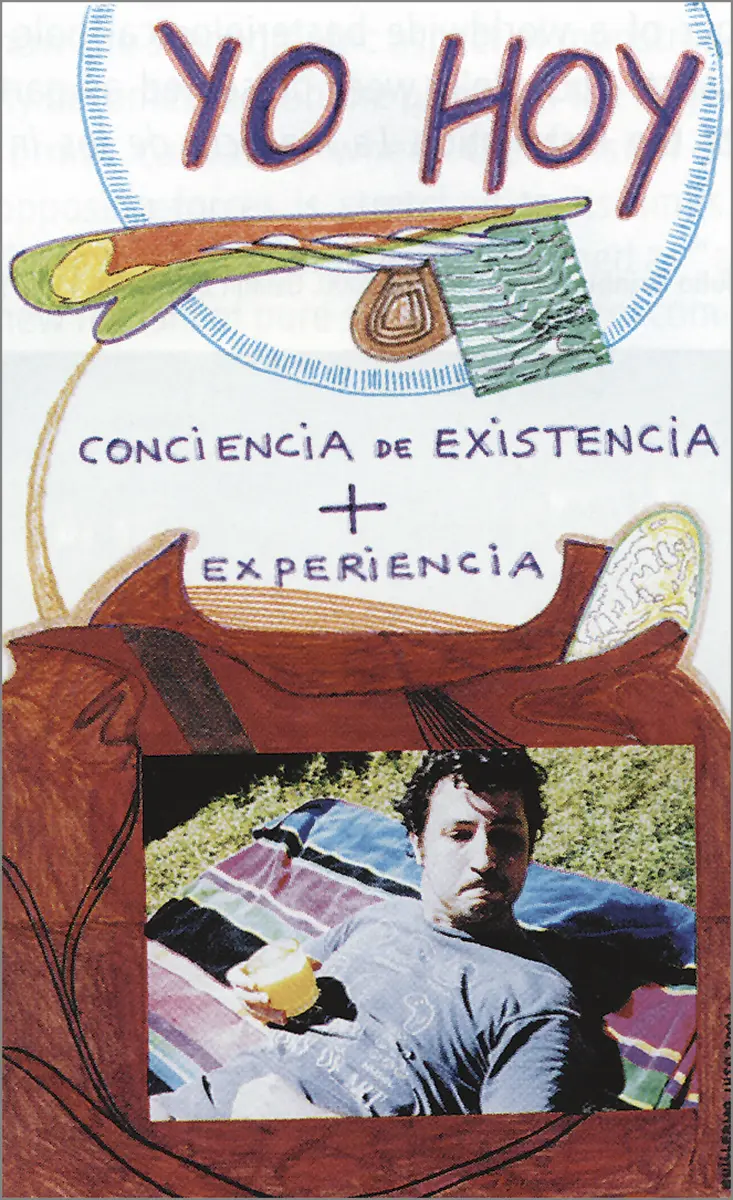
In his work, the hypothetical tension between reality and fictional representation becomes blurred. The veracity of what's narrated becomes secondary from the moment numbers and stories dumped on the paper reach a dimension of their own, at the margin of the luso person-personae. Even if it's his face that appears on the collages including lists and photographs, and even if the phrases indeed tell of things that have happened to the artist, the sum of all the works forms a sort of organic (venereal and eschatological content) machine (of rational nomenclating operation) that's self-sufficient, as historically has been the case of the great works of arts. It sounds paradoxical, but Iuso's self-referencing efforts end up annulling his ego to give room to a fascinating product in which the subjective marks are no longer at the service of the author's will. When he serializes 'his love story with Valeria' with dates and intimate details; when he documents the goals he scored in the 'painters' soccer match' (a legendary pastime among Buenos Aires' artistic elite); when he registers the details of his 'sex with whores' or collects epithets others have given him, luso dodges fugacity's mandate and blends himself into the making of a work of art.
Searching to freeze contingencies (be it transcendental or trivial), luso inserts himself in the tradition of the epic self-portrait, an epic that takes delight in failures, excesses, and misfortunes. In this sense, events such as the physical aggression he suffered one night in a park become pieces, such as Mi estado después de la golpiza que recibí cuando me asaltaron en la Plaza San Martín (The State I Was Left in After the Beating I Took When I Was Burglarized in Plaza San Martín) and Mis actividades por la mandíbula fracturada (My Activities Due to My Fractured Mandible). The list ends with the phrase, 'I stay well inside my house, with the curtains drawn shut so I can concentrate on my work as an artist.' An endnote, a laconic observation: 'I am beginning to learn about patience and tranquility.' luso's categories and definitions reveal even doses of humor, literary intuition, and mania—traits found frequently in contemporary art, not always yielding interesting results.
In the brief span of time between Estado de boarding pass and his new exhibit, the artist made some conceptual and artistic decisions that enriched his work. Instead of using a basic evocative structure, he reinforces his anchorage in the present and puts himself at risk by generating autoanalytical pieces in almost real-time. These pieces, for example, derived from the street beating, or the beatings that have come from his stormy sentimental life, emphasize a certain element of morbidity that Iuso evidently wants to stimulate in the spectator. Current intimate details are more intimate than regular intimate details. The sensitive material with which he works is expressed through a language that's direct and explicit. In some cases, language ventures into high-voltage baroquisms; in other instances, it shifts into a blunt and concise mode (like in Contabilidad de algunas de mis actividades en el año 2001 [Accountability for Some of My Activities During 2001], a list including how many times he took a shower, defecated, got drunk, masturbated, vomited, and medicated himself, with clarifications on names of diseases and remedies used.)
Finally, from a visual standpoint, which is not minor in his creation, luso utilizes freely the ornamented, spontaneous, if not careless, style of the student who's bored and wants to evade the classroom's reality. He is the child drawing who cannot avoid filling the whole page, decorating the margins with color lines, making squares, or inserting little geometries between the text and images. 'I fall in love with myself because I feel like the special character in a book, I see myself living inside a movie,' he confesses in one of his most subtle pieces. Undoubtedly, Guillermo Iuso has found a way to captivate others by offering and recreating the hues of that love he feels for himself.
EVA GRINSTEIN