
Everyday objects become alive in Heriberto Mora's work. In his recent exhibit at Miami's Galería Praxis Internacional, Mora consolidates his artistic trajectory in a balanced proposal. Born in Cuba, he studied at the Academia de San Alejandro in Havana, lived in Spain, and lately has been residing in Miami. He has taken part in important group shows and has held several solo shows.
In Marta y María (Martha and Mary), a show that's traditional in terms of montage, Mora uses only what's genuine in painting to make his discourse. Each picture is a perfect composition, and neutral ochres over the range of ochres allow for a perfect concentration on the scene. By adding a high percentage of white to the color, Mora makes his palette pastel-like and thus achieves an "illuminated" composition in all of its extensions. There's light even in the darkest shadow. "In each painting, I represent an idea... Maybe this explains the sobriety of color; ideas have no colors...." In this fashion, the artist lets us see his poetics. In line with the author's Buddhist philosophy, each painting emanates and provides a meditative and contemplative environment.
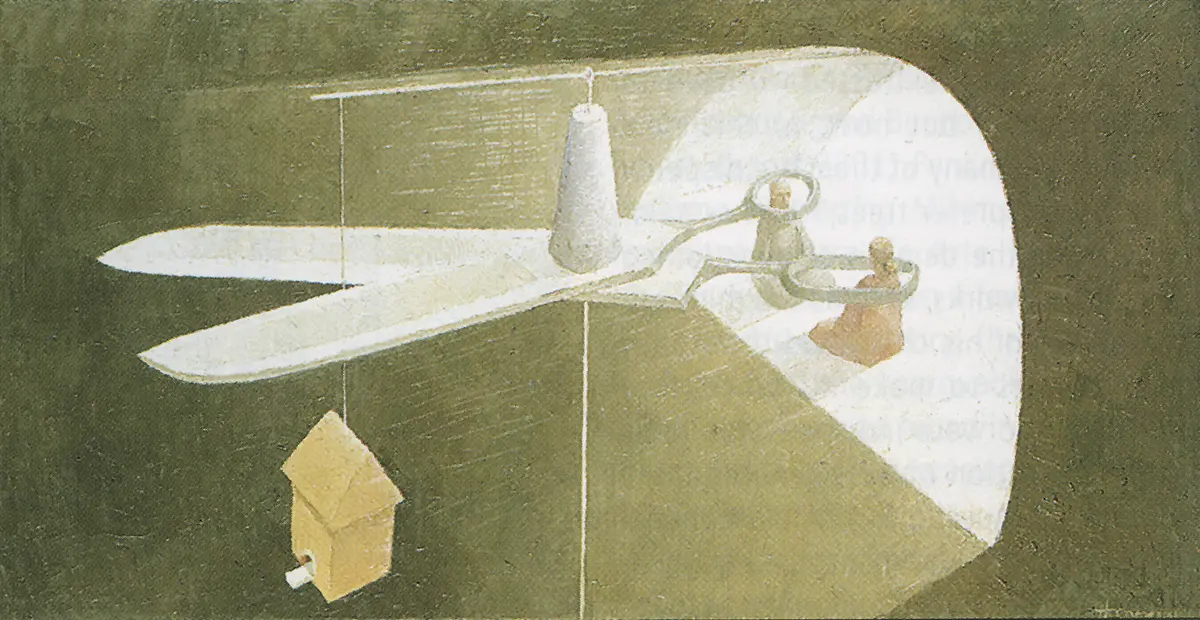
The fundamental protagonists are objects that by their meaning and use are considered fragile, but they acquire a conceptual strength when immersed in the artist's philosophy.
In this fashion, elements such as thread can become triumphant when, for example, they carry a tied pair of scissors while thousands of spools cheer on. In La estabilidad del hogar (Home's Stability), a piece that summarizes several of the show's elements again evokes the frailty of thread while it also shows its strength: a house hangs, and "every string" depends on the couple standing on each hole of the scissors' handles. Behind the apparent calmness lies a tension sustained by the coexistence that many times jeopardizes stability. Its discourse seeks to create a dialog about unity in the couple, about spirituality.
Another point to consider is one that becomes repetitive but that also has been placed well under the light. Each painting always shows a window: a possibility, an alternative to another way, where the light is bright. Human figures appear in some of the works; generally, they sit down, as if in meditation. But each piece, even without the presence of humans, works in function to a particular message.
Mora enjoys good painting, and his work shows it, but he also enjoys having a coherent discourse. His point of departure is his own experience; his results are coherent, reminding us of certain concepts that by their sole meaning are always there — time, fragility, and family, all explained by the artist's spirituality and sensibility.
MARISOL MARTELL