The artist brothers Iván and Joan Capote's most recent show in Havana Gallery is structured in two segments, each with a title that could be understood as clearly demarcatory, but which in reality announces a single topic: the dissolution of borders; a subtle activation of the spectator's mistrust from the space's very museographic organization.
The Capote brothers are part of the Galería DUPP project (From a Pedagogical Pragmatism, by its Spanish initials). Under the direction of René Francisco Rodríguez, an artist and professor at the Instituto Superior de Arte, DUPP carries out interventions and performances conceived around the aesthetics of the precarious. (By the way, Rodrígez received an Honorary Doctorate of Fine Arts from the San Francisco Institute of Art in San Francisco, California, for his teaching work with DUPP). The Capotes' show, although abstaining from performance as such, promoted a performative attitude through pieces whose functioning required the public's active participation.
'Hybridity is born there where borders are undefined' says Yoan in the show's postcard presentation. That sentence governs Yoan's proposal in the show, where he plays with the possibilities of design in order to offer an alternative vision of reality and its representation. The artist emphasizes sensoriality in objects and situations which, in turn, are redesigned in search of new meanings, symbolisms, and connotations. His gesture seems addressed to a sign of contemporary culture, where concepts undergo constant reordering, giving rise to an undetermined status.
Yoan alters original functions and destinations to create new ones. In Lagrimal (Lachrymal), for instance, a drinking fountain built by the artist with a relief sculpture of a woman's face in the upper portion, we are made complicit when we pay for the wine offered. Service is conditioned by the insertion of a coin and the actioning of a button, plus the natural 'coupling' with the object we need to perform in order to drink from it. This kinesthesia generates multiple readings, as it is used by a diverse public. At the same time, it creates a sense of guilt, since the spilled wine evokes the character's tears and brings the end result towards a texture of ambiguity, between dramatism and pleasure.
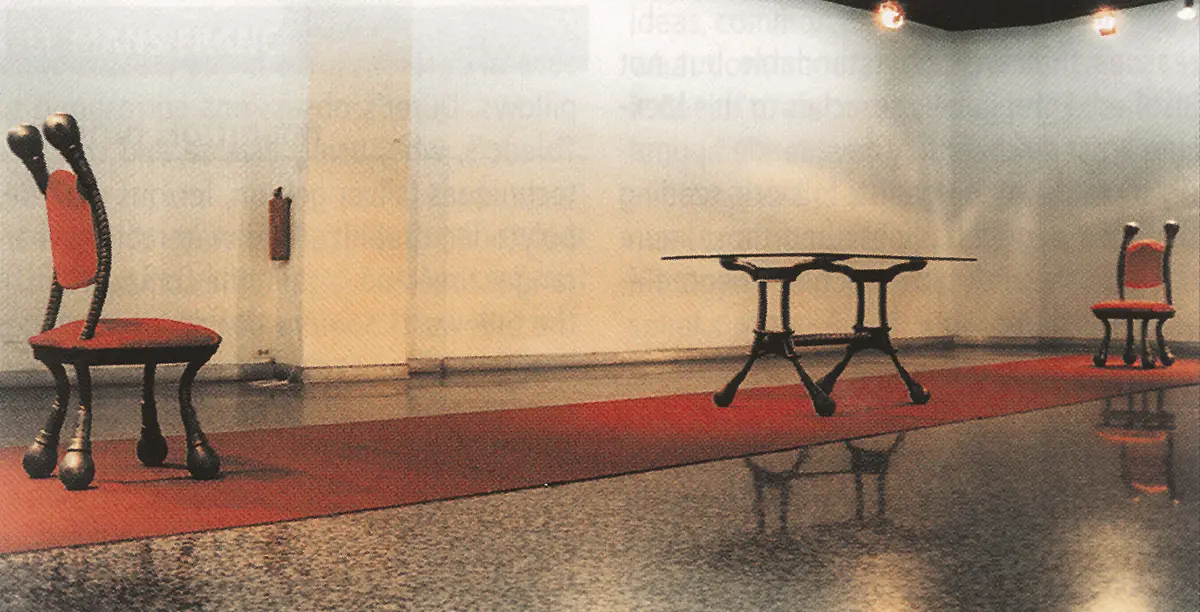
Another suggestive piece is Protocolo (Protocol), the recreation of a hall seemingly conceived for, precisely, protocolary functions. It contains a carpet, two empty and distant chairs, and a set table. In the background, we hear a crowd's murmur, but an intrinsic silence dominates the experience. There is no dialog, and immense emptiness commands the environment created by these pieces of furniture that turn out to be made (legs and backrests) out of microphones. We interplay with them because some are arranged so that it would seem a third person, someone not involved in the suggested ceremony, is to intervene. The microphones are the work's motifs, suggesting a questioning of whether it is the private that molds the public or the other way around, or whether in the final analysis contemporary society, apparently so interconnected, generates incommunication.
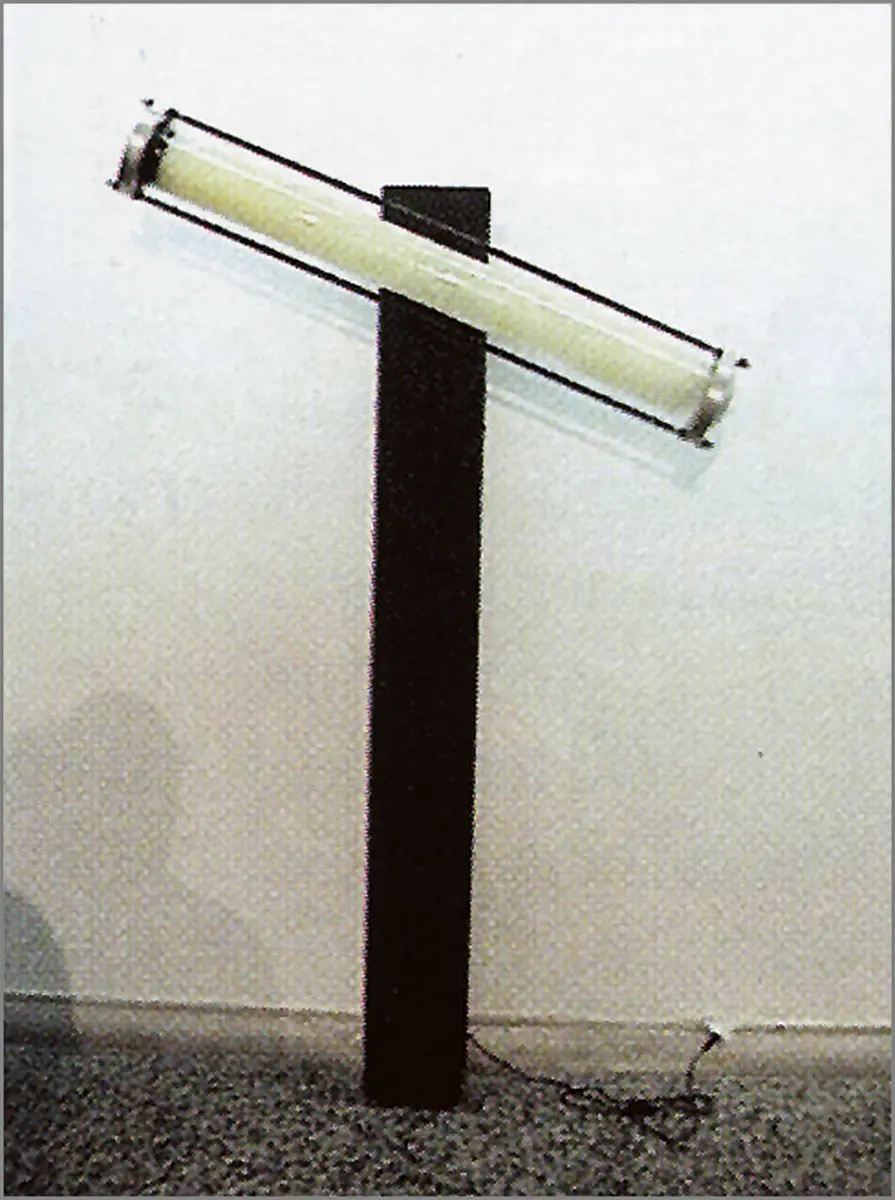
Iván's discourse is more sober than sensorial, and it translates into artifacts that incorporate movement but appear minimal, seeking the message's essence and eluding narrative and morphological distractions. This effect is attained through the recreation of natural, historical, and social processes, for instance in Fluvial, where Heraclitus' famous dictum on life is represented in an installation that connects to an electrical turbine. In Principio y fin (Beginning and End), where a wooden box is organized by separating two different types of sand, while a motor placed between them unites their grains, establishing what is ambiguous and relative in each term of the work's title. Possibly a comment on how life implies mixing, how nothing is one hundred percent pure.
In the presentation, Iván writes: 'Nothing remains pure in the face of contemporary society's permanent osmosis.' He points out the phenomenological 'contamination' we are witnessing today, for which he creates a personal, unprejudiced interpretation. Such is the case in Historia (History), where the artist places an electric rotor and helix on an acrylic panel. In one of the helix's ends, he places a marker; in the other, an eraser. When the rotor is turned on, the marker draws a possible history, while behind it the eraser eliminates its tracings, in a continued cycle of writing and un-writing. Here, the ephemeral character of events is subtly but emphatically expressed once again through the economy of means.
Iván's artifacts respect the concept of the 'minimalist white box,' using structures that are geometrical or close to a geometrical morphology, and reaffirming their expressive simplicity—something that is also stressed by the almost total absence of color since Iván's work tends to the monochrome. Language becomes readily accessible, uncongested by images.
Despite Iván's sober discourse, his artifacts transmit a singular spectacularity—one that is, paradoxically, very discreet at the same time. His works are an original proposition in Cuban art today, which lately has become vitiated by interventions that abuse the 'critic style' in order to achieve recognition. Iván's case is the case of an artist who makes sure he combines ingenuity and meditation to achieve empathy with the public.
The Capote brothers comment on the hybridity that the current erasure of borders seems to generate; they speak of the inevitable joining of opposites in our society, marked by all kinds of exchanges. The Capotes seem to invite us to reorganize our own phenomenology, benefiting from art as a permissive field in which to reinvent ourselves, beyond conventionalisms and inhibitions. They are very convincing.
AMALINA BOMNIN