
After building a career in geometric abstraction inside the visual traps of a subjective painting, Magdalena Jitrik (Buenos Aires, 1966) presented a series of small figurative portraits under the provocative title of Socialista (Socialist). Not in the least innocent, the title captured the attention of the critics, who flocked to the always well-visited Dabbah Torrejón gallery. This way, Socialista became one of the season's most commented shows—a season that drew to a close in December, just before a new cycle of unrest and violence, both political and economic, emerged in Argentina.
Seen from a certain point of view, the show turned out to be fairly conventional—painting on canvases no larger, on average, than 25 x 25 cm—even if it let us appreciate an imaginative and technically proficient artist. Jitrik offered a gallery of faces, mostly fictional, to which she attributed apocryphal identities. Up to that point, there was nothing 'new' enough to justify the excitement. Already in the 1990s Remo Biachendi had brought us a series of supposed Bauhaus professors, very Central European in their appearance, who had been exterminated by the Nazis. Moreover, since some time ago, Víctor Florido has been using the same red-and-gray faces of a different time, charged with an expectant climate that goes beyond this present time. These portraits enveloped in an air of persistent nostalgia, have been done before, and they will surely be done again in the future.
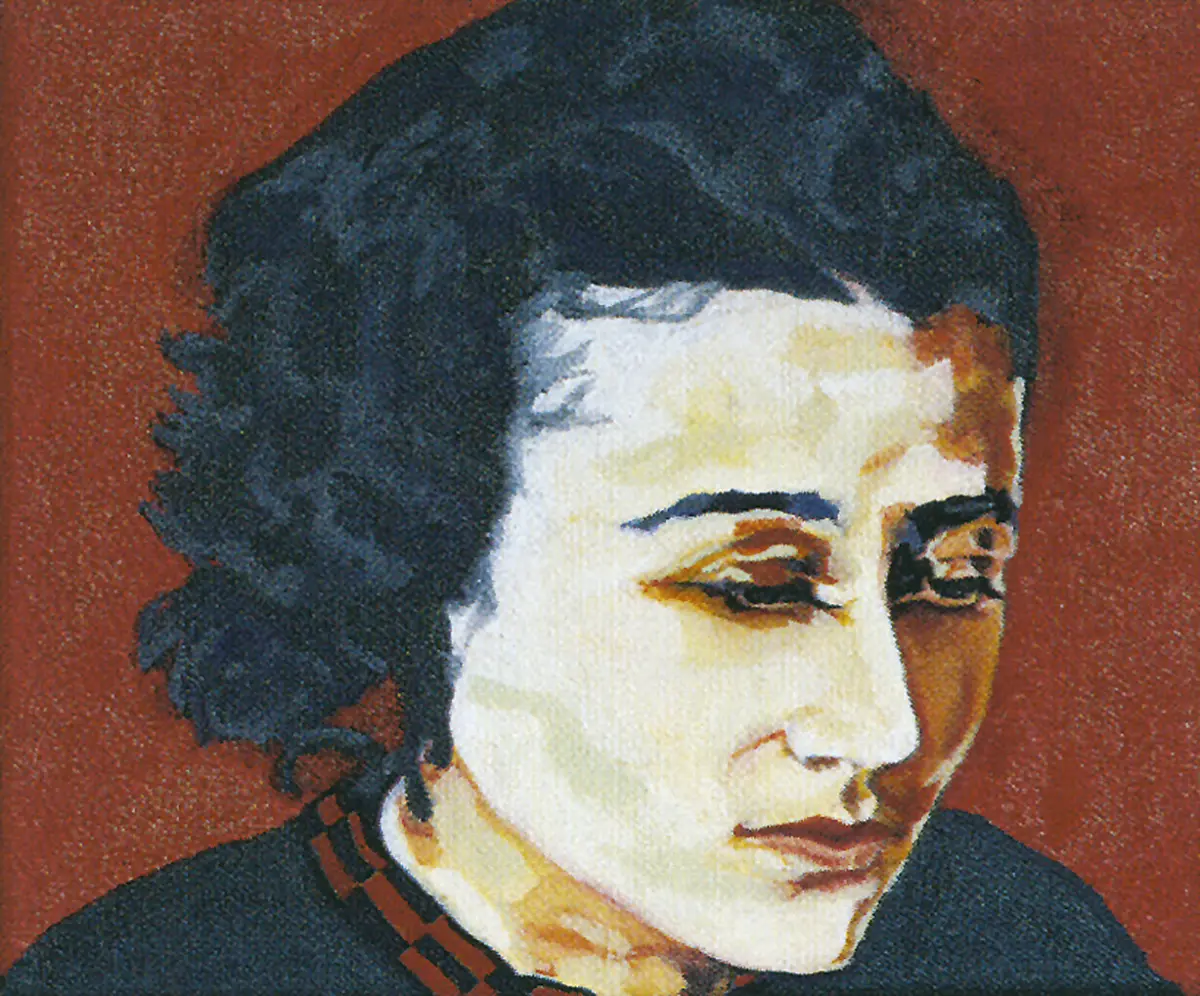
Individually or as a group, the faces imagined by the artist come from several sources. By the color of their hair and the clothing they wear, some of them seem to belong to an urgent Latin American present—including Salvador Allende. The figure of the martyred Chilean president is the only one that can be recognized and, as such, is the one that actually weakens the series. Other paintings, judging from their lines, their tones, and their composition, resemble characters from Central Europe during the interwar period, say from the 1930s. They seem to be members of the early, idealized socialist family, and not necessarily a contribution to the iconography of socialism's massive world. Devoid of any action, however, Jitrik's images capture a suspended moment; in those faces, we find a level of tension, a contained passion behind a mask of repose.
It is interesting to note that Jitrik's images captured the imagination of an art scene in Buenos Aires that was dominated by private games, childhood memories, design, decoration, abstraction, the coups of effect that, just like in video games, offer instant but fleeting gratification. The long decade of the Menem administration was in Argentina one of lightness and ostentation. The young art world of the period—i.e., those artists now approaching their forties—seemed to seek refuge in a tightly packed intimacy, bringing to bear seductive works and a different energy. Only a minority of artists were involved in the explicit discussion of social issues and political interests, in the topic of gender, and in a public stance about culture. The majority of artists didn't articulate a collective project, nor did they show any interest in taking the world into their own hands.
The impact of Jitrik's Socialista is better explained if one notes the prevalent mood in that art scene and the precise moment the country was going through when those portraits were shown. It was a period of disillusion and frustration, of impoverishment and corruption, which generated a large dose of impatience and which exploded barely a month after the show, as could be seen on the world's television screens.
As an antecedent to her surprising turn towards a consistent figurativism, we can register Jitrik's solo show of 2000, where she installed objects and portraits of anarchist militants for an Ensayo de un museo libertario (Attempt at a Libertarian Museum) at the Argentinean Libertarian Federation. Even if the provocative titles of some of her abstract works alluded to landmarks of worker's struggles—the Paris Commune, the Russian Revolution, the Chicago martyrs—nothing anticipated her option for a painting charged with the divisive experiences of History. The red-red of her background refers inevitably to an aesthetic and an idealized ethic.
Almost simultaneously with Socialista, Jitrik reaffirmed her commitment to an art that generates meaning and engages its times by participating in Riesgo país (Risk Country). This was a collective work (at the Arcimboldo Gallery, together with Marcelo de la Fuente and Diego Melero), and it ironized the presumed 'paradise for all' offered by the market economy and globalization. Along with this work, Jitrik's individual show contributed to marking a trend in local art towards questioning, reflection, and engagement with current affairs.
VICTORIA VERLICHAK