
Painting as a practice continues to be haunted by skeletons of times past. Twenty-first-century polemicists still attempt to discredit its viability, but to no avail, and often these critics sound as anachronistic as their assessments of painting that strangely echo the discourse of the latter part of the last century. Usually, the position taken revolves around the painting's implosion resulting from the collapse of its modernist weight.
This view and that of the painting's exhaustion generally stem from two trajectories. One concerns the theoretical leftovers that some critics still eat from the late 1970s and '80s construal of painting as anchored in the critique vehemently, yet correctly lobbed at the Trans-vanguard and Neo-Expressionists. Other polemics against painting come by way of the technocratic view that new media supersedes it—though this superfluously formalist digression is akin to the one that arose with the emergence of photography some one hundred and fifty-plus years ago. There are some painters, however, who have reworked the medium in interesting ways by meeting technologies head-on in both abstraction and figuration. Either directly, as is the case with David Reed and his abstract, painterly insertions into the films of Alfred Hitchcock, or in more subtle ways as evinced in the blurred, figurative photo-simulacrums of Gerhard Richter. Another artist who is coming into his own by way of a similar modus operandi is Marco Arce, as was poignantly exemplified in his recent exhibition titled I know what I'm doing (Wolves are not as bad as lambs).
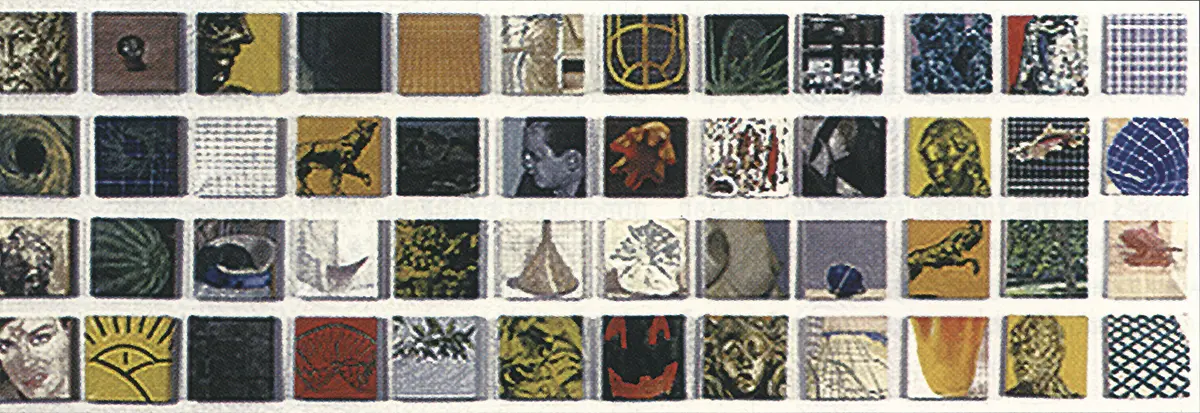
The show consisted of works on paper that were grouped as triptychs, polyptychs, and a series of 144 canvases that went under the same title as the exhibition. What is interesting to note is the title's allusion: to what and to whom is Arce addressing such a possible heated or ambivalent response? While these questions arising from Arce's self-assertion remain open-ended, his works operate less in the tradition of the brush and canvas, even though it is the artistic vehicle for the 144 paintings, and to a lesser degree the works on paper. Arce dispenses with the video and photo machinations of Reed and Richter but nonetheless deploys visual strategies that question the discipline of painting itself and the historical narration of recent art. And here is where Arce is formally aligned with the projects of the two aforementioned artists. Mining more archaic forms of visual articulation like the broadsheet, the flipbook, motion studies, and the storyboard via the formal lenses of drawing and animation under the overall, general aesthetic rubric of painting, Arce's work is a visual historiography of canonical works of contemporary artistic practices.
Usually, the politically correct have derided the canon as exclusionary, but Arce puts into question those artists themselves who have rightly earned such importance in the annals of contemporary art. So what was once thought of as the cutting edge—Paul McCarthy, for instance—can now be seen as the new orthodoxy that attacked conventions of a previous era. The subversive impulse of Arce's work is both as a thematic abrasive that bites the hand that feeds it and spits it back at its owner, as well as trying to flesh out new levels of meaning in the juxtaposition of various works from the immediate past. Rereading them in a kind Richterian atlas, Arce's imagery is a fragmented visual history where images enter into inter-textual dialogue as palimpsests, and become the demure and faintly heard artistic equivalents of the Tower of Babel.
RAÚL ZAMUDIO TAYLOR