
In Colombia, the prefix "sub" is key. It refers to something that actually occurs but is not seen. For instance, this is a country at war, but since the fighting takes place mostly in rural areas, it would seem to be an undeclared conflict. There is a link between drug trafficking and drug use, with far-reaching consequences for society in general; these consequences are lived daily, but they are also difficult to visualize. Historically, the hopes for a better world are only realized with money, which is in turn impossible to obtain, and the double moral standard characteristic of certain institutions is then veiled through a sophisticated "double gaze" with which we take in news and events.
The works in this exhibit refer to that attitude of uncovering those social forces capable of creating oppressive spaces and behaviors that are not clearly visible—spaces and behaviors that exist, to a degree, underground. The concept is clear, and the artist experiments repeatedly in order to find the best way to put it across. His investigation centers on the quality of images. This two-way project, developing an incisive and necessary idea and finding an accurate image to express it, can only be undertaken by an artist like Miguel Ángel Rojas, who has 30 years of experience on both sides of the image. Throughout his career he has found key signs to identify and to create spaces for, say, eroticism, homosexual relations, hidden but vibrant urban spaces, the Colombian middle class, the massacre of indigenous peoples, and the ecological war—issues he has always been vigilant about.
Following the route the artist chose for his guided tour, his exhibition, titled SUB, begins with an act of burying a Bible in the gallery yard, in a private event. It is difficult to accept, the artist reflects, that in our age people's personal decisions are still conditioned by dogmatic religious beliefs that impede the development of an individual conscience. This gesture originates the realization of two videos: One with the word "dogma" written on moving sand of a black-gray color, which disintegrates in front of the viewer with a menacing shriek; and another one with the word "conscience" forming on a soft, organic, almost virginal, material reinforced by the sound of laughter and children's games. These two pieces highlight Rojas' interest in the preservation of mental freedom, as he has said in a recent interview: "I have never been able to follow the voice of the Master." They also reflect his intention to permanently construct a personal, vigilant conscience.
The same idea is developed in drawing. Looking back on the history of Colombian art, we notice Rojas has distinguished himself as an artist who uses drawing intelligently and sensibly, and his influence has been key for later developments in contemporary art. He is a gifted draftsman, and he has always been guided by fidelity to concepts. For the latter reason, he has never fallen into pure aestheticism; his images are exact, and they are exactingly, painstakingly created. As Rojas has said: "A work of art has to be precise, but it also has to be able to feel life."
There are two types of drawings in this exhibition. Sueños raspachines (Coca Picker Dreams) is a series done in pressed and sewn coca leaf paper. On these papers, the artist carves up words and objects—words such as "desire" and "I deserve," and objects such as school desks, houses, chickens, tractors, crops, and everything a farmer desires and deserves. It is important to remember that raspachines are farmers who work on picking coca leaves; the support for Rojas' objects and words seems to imply that such dreams are illusions: carved as they are as holes in matter, they are based on emptiness and absence.
The second type of drawings are those realized by chiseling in small dots on coca leaves or one-dollar bills, forming small circles that are later carefully glued on white paper. Perhaps it is a rather abrupt association, but these remind me of pre-Columbian metal art, with which they share the precision work and the impressive craft. These forms on a blank space are so exact that they appear to the viewer as highly valuable objects, something reinforced by the presence of currency notes, but with ample aggregated value coming from an opportune reflection on the imbalance between drug trafficking and consumption. And, beyond that, the consideration of a whole system of domination of some countries over others.
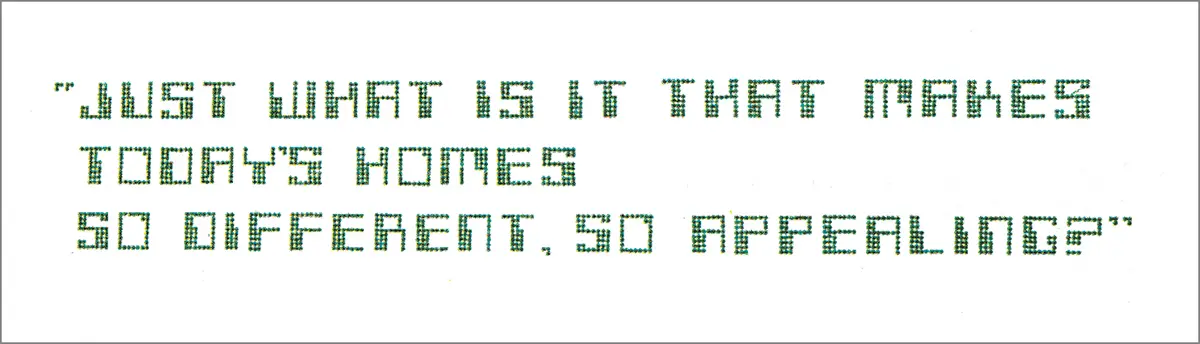
The first drawing, opening the exhibition, is titled Just What Is It That Makes Today´s Homes So Different So Appealling? It's a sign for Richard Hamilton's famous work from 1956. To ask at this point what it is that makes modern homes different and attractive, and to construct such a question with coca leaves, is to make evident the irony of a form of consumption at the center of what Western history wants to preserve as sacred: the home. It also brings about the disquieting idea that misinformation is what places such importance in production and veils the role of use, allowing us to forget that drug use is a part of daily life in the developed world.
In the next drawing, titled As I Opened Fire, Roy Liechtenstein's cannons and fire are also recreated with coca dots. On the top part of the image, Rojas writes (using the same material) the words addiction and storm. In an interview, the artist has posed a simple and direct question: "Is coca bad? Worse than war?" and in this work, his answer is rotund, as weapons of aggression are built with the very material under dispute. The artist answers his question with the most accurate image possible. It is interesting to note Liechtenstein's own reflection about his work: basically, he argued that representing US military aggression was not among his primary goals, even though he found it to be, as he did American foreign policy in general, barbaric. However, the turn of his work is accurate and not without perversion when he says "the topic of my work is our American definition of painting and visual communication". In truth, it is a confrontation with the viewer, as it places before his or her eyes the content and the form of their own daily lives. In my view, Miguel Ángel Rojas' images in various languages (Pop Art in this case, images related to the lives of indigenous peoples in others), as well as his experimentation with coca leaves and paper money, have to do with the search for a Latin American image that accepts the images developed by the mainstream of power but "contaminates" them with other forces; thus, pop images are undermined by coca and images from past value systems are corroded by money.
Dots as lines of power are clearly expressed in a diptych where two jaguars face each other, one made out of coca, the other one out of bills. This work is titled Es mejor ser rico que pobre (It's Better to Be Rich than Poor), a quotation from Pambelé, a Colombian boxer who knew well both extreme poverty and glory. Further examples of such complex construction of images are found in two landscapes: Teológico (Theological), showing an Indian, a jaguar, and an alligator, paradigmatic figures of a lost past, drawn with paper money; and Go On, which shows an American cowboy in the open range, drawn with coca. Mula (Mula [coca carrier]) is a drawing on cardboard, where a thin line has been cut out to remind us of cocaine use; the line is surrounded by small dots, like footprints of an obsessive walking in circles, of coca as well as money.
Dots in Rojas' work don't derive from the printed media, as in Pop Art, but from the artist's own experience. He acknowledges the form to have been present perhaps since his voyeuristic period, in the 1970s, when he snapped pictures of gay couplings through holes in the walls of theater bathrooms. Later, playing with the amplifier allowed him to reduce photographs to small fragments and dots; multiplying them, Rojas designed on paper or on walls apparently conventional forms such as oblique lines, hearts, doves, and comic strips—but those paper dots were in reality photographs of an intensely sexual underworld the spectator could sometimes make out when looking very closely. Reducing photographs is an exquisite resource to build multiple forms while at the same time, it contains, pleasantly and without stridency, erotic experiences; it is a beautiful image, that of the small dots being our point of contact with reality.
NATALIA GUTIÉRREZ