
In a trial by jury such as those we get to see in films, witnesses and defendants are usually limited to answering yes or no. The Law according to this seems to forget that most times in life things go yes, but / no, but. Because human life is a multilayered affair; nothing is in black and white, as Dostoevsky made clear in his novels. Thus, the exquisite subtleties of the Spanish language are present in Peña's most recent works. His "word games" with pure images could not probably be done in any other language. The title, however, is in English: From man-made materials to white things. Peña has a degree in English Language and Literature and is a self-taught artist.
In Cuban popular speech, the following expression has wide currency: No te vayas con la bola de trapo (Don't take the rag ball with you). What it means is: "Don't inadvertently make the wrong choice," or "careful not to make a mistake." Regarding Peña's most recent show, perhaps many people did take the rag ball with them (it also connotes a scam, to be taken in a situation). Beginning with the detail of the title, continuing with the show's distribution in two halls (in one, a black and white series titled White things; in the other, an untitled group of color pictures, which doesn't appear in the catalog), and all the way down to his sexual wordplay—all of these were resources Peña used to lay what amounted to a trap for the unadvised.
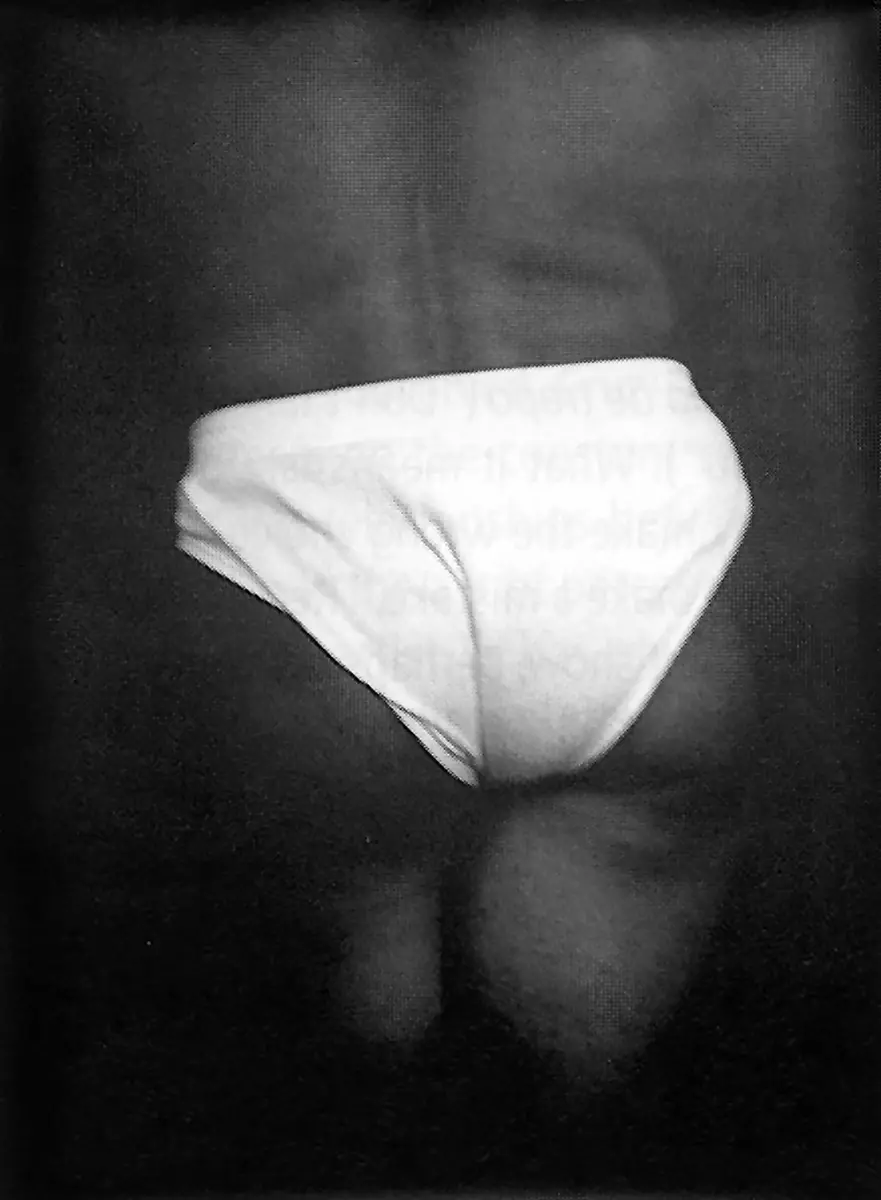
Man-made materials are the labels attached to products that, in a consumerist society, signal their synthetic nature. It's a way of announcing that nature has not been damaged in the creation of a product. At the same time, we are encouraged to acquire constantly, all the time. Peña is a black artist, but his white things are not intended to be read in a racial key. In the artist's allegorical translation, they connote accumulations. Western culture, white and male, has accustomed us to believe in the accumulation of objects and wealth as a mark of distinction; by the same token, the accumulation of knowledge is believed to imply the grace of wisdom. The point is to accumulate, whatever the item.
Peña's photographs are sensuous, and they impact us at first glance, be it for their size, the contrast of white on a very intense shade of black, or the magnification of body fragments. In a second reading, though, the commentary seems to address more conceptual matters; they point to more profound reflections, sneaked away from us through a trickster's aestheticism.
Peña is also what in Cuba is known as un hombre de la calle—a streetwise man—one who is anything but naive and knows human psychology well. He knew that presenting a group of photographs of an erect penis surrounded by tongues reaching out to it would ensure that his presumed homosexuality, or at least his bisexuality, would be widely commented on. But that is not the (rather banal) metaphor he labored at the II Salón de Arte Cubano Contemporáneo. Seen in isolation, that group of pictures could perhaps be interpreted that way—and Peña couldn't care less if it was. Seen in the context of Peña's body of work, it would seem another example of his sneaky sleight-of-hand strategy.
The amphibological aspect of his most recent images works, rather, as a hook to capture the viewer's attention. In reality, Peña is commenting on Western culture, on identity understood as an affirmation of being (without color, since pigmentation as a determining factor was imposed by Western culture itself), and, by extension, on racism (this at an unconscious level, in my opinion). The artist is offering these comments exploiting the possibilities of the resources that are within his reach; he doesn't have any answers and is not interested in suggesting any solutions; rather, he points to problems that exist, all over, even in that Mexican of indigenous features who accumulates some money in order to travel to Cuba and impress young women, whose bought adoration makes him feel as "valuable" as a white man.
It has been pointed out that Peña's aesthetic is ambiguous. In truth, Peña's work would be more properly described as ambivalent, which is not the same thing. Moreover, I would say the artist advocates a form of dualism, as it exists in the realms of religion, philosophy, politics, and so on. In religious dualism, two supreme principles are established, good and evil. In Cuba, to return to popular speech, evil is associated with the color black; one speaks of facing a "black future," of having "black luck," and the examples multiply (I believe this transcends national borders). When I asked Peña why his white things were not pink or green, whether he thought his option implied that the color white always predominates over black, he hastened to answer: "Because in Western culture pink means beauty, green means hope." It is really simple: patterns are imposed by Western culture. Similarly, when a group of white people accepts a black person, they usually comment "But you have a white soul," of "You are white inside." For Peña, it is incomprehensible that many people refuse to understand that some black folk feel perfectly comfortable as such, and are not interested in resembling whites.
Peña uses a kind of visual pun to discourse on the (also dualistic) opposition of spirit versus matter. What appears in color is human beings, without denomination. Material (white) objects invade the spiritual field in black bodies. A strange ambivalence is created again: What predominates in the material and/or in the spiritual, whiteness or blackness? In his artist's declaration at the most recent Salón de Arte Cubano Contemporáneo, he wrote: "In my photographs, skin represents human beings. Our flesh has been used for different purposes: cannon fodder, jail bait, barricades, and lust. I have cleaned it up, caressed it, compressed it, and photographed it to show it on gallery walls and homes, alongside deer heads and rhino horns; as a design prototype to cover walls, carpets, and upholstery. These pieces do not attempt to acknowledge any individual in particular; they are not fingerprints, they are not personal descriptions... One way or another, we are all raw materials for the same project."
ERENA HERNÁNDEZ