
Two blind persons who beg for a living in the downtown area were hired to perform their work in the gallery. Although their work day is longer, they were hired to play 4 hours a day for a whole month. Six loudspeakers were used to amplify their voices.
Continuing on with the series of actions he has performed by hiring people, Santiago Sierra's (Madrid, 1966) most recent piece was exhibited at the Galería Enrique Guerrero, in Mexico City. It had the title of Dos Maraqueros (Two Maraca Players), and it was shown from January 24 to February 21, 2002, from 2:00 until 6:00 p.m., Monday through Friday.
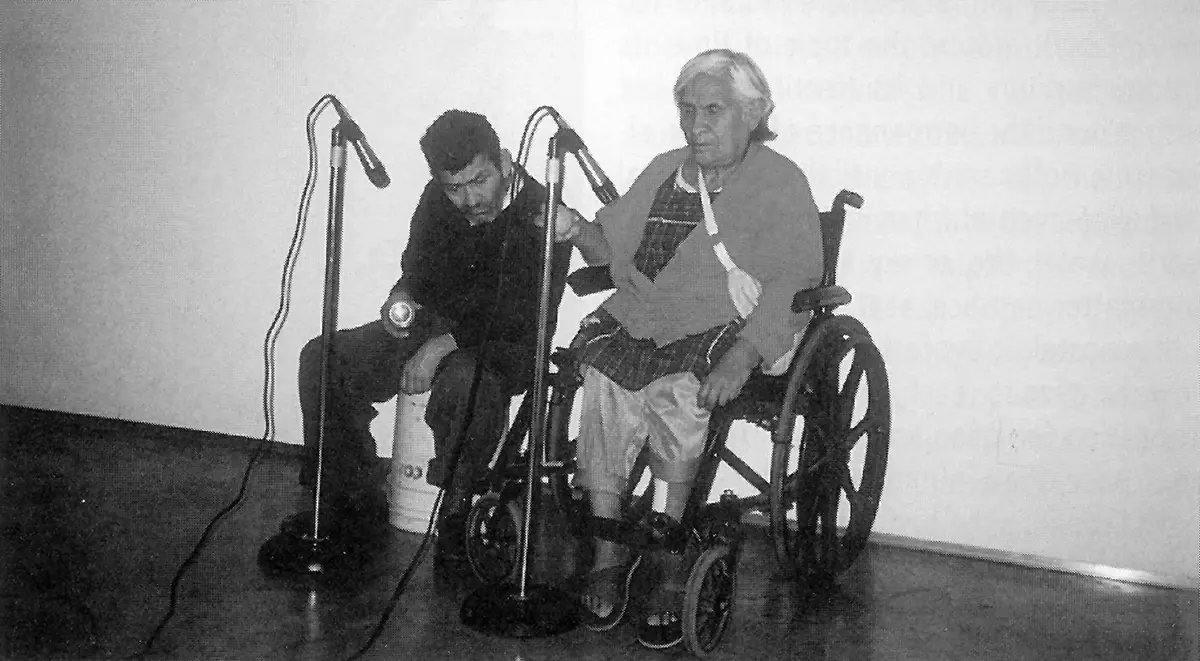
The action developed in this fashion: even before entering the gallery space, one could hear a mixture of rattlers and maracas engaged in a somewhat happy but tedious, simple rhythm. Sound grew louder as we neared the gallery. The gallery's central space was filled with man-size loudspeakers reproducing the sound. These six speakers were placed in parallel lines; we could move through the space only by wading around the huge equipment. If our curiosity to find out the source of the sound was big enough, we could find the answer in one of the space's corners, where two elderly persons, a blind man and a woman in a wheelchair, sat shaking a tin can full of coins (he) and a single maraca (she). It's the same activity they perform daily out in the streets while they wait for a token of charity. This action remained in the gallery for a number of days at a determined time.
As is expected from all of Sierra's actions, the public experiences a mixture of feelings ranging from morbid curiosity, abuse, and social conscience to banality and the absurd. It's an explosive combination that made people actually leave the site of the action and seek the comfortable spaces of the hallway leading to the gallery or the second floor, where the artist had 11 photographic documents and small-format texts of actions he has produced before.
Always impacting, Sierra's actions never lose sight of the esthetic value for they are developed in environments where persons and objects are placed according to careful calculations. I cannot think of the hired elderly couple's experience when they heard the visitors' comments. Some of them were surprised and full of admiration, others took it as a social event and went about is casually as they spoke and laughed loudly.
In each case, Sierra makes an incisive case on working activities, the way the system exchanges time for money, and the impact this has on the individual. What happens after two individuals are transferred to a gallery, their sound is amplified, and they are given a payment that's equivalent to what they earn on the streets? At what moment are they turned into subjects observed by art enthusiasts who, without judging their integrity (in this case, the maraca players are not doing anything different from what they normally do), see them as the articulation of a discourse installed in the present, where each part of the system is challenged? These questions invariably accompany Sierra, whose works, without a doubt, are at art's margins. The documents—the actions' results—compile black-and-white photos together with the actions' explanation cards (they are always done in the same format and using the same font, speaking loudly for Sierra's strictness with his works.)
In the last couple of years, Sierra has become a household name in the international art circuit. He has participated individually in the most recent Venice Biennial as well as in Basel Fair; Kunst Werke, Berlin; PS1, New York; Mexico City's Museo Rufino Tamayo; and The Havana Biennial, among others. Collectively, he has participated in Shelf Life, Gasworks Gallery, London; Marking the Territory, Irish Museum of Modern Art, Dublin; ARS 01- Unfolding Perspectives, Kiasma, Helsinki; Políticas de la diferencia (Politics of Difference), in Belo Horizonte and Buenos Aires; Barcelona Art Report 2001; Pervirtiendo el minimalismo (Perverting Minimalism), Museo Nacional Centro de Arte Reina Sofía, Madrid, just to mention a few.
His work's consistency, the care placed in each detail, and the unarguable conceptual and theoretical load found in each action, place Sierra in an increasingly solid position in the art circuit.
FRANCISCA RIVERO LAKE