Reporting on the event's opening last November 3, the local newspaper El Mercurio christened the VII International Painting Biennial in Cuenca the "Globalization Biennial." Indeed, participating artists had been invited to meditate on the topics of globalization, nomadism, and identity, an invitation that many but not all took as a point of departure for their works. More important than the topics suggested by the organizers, however, was the conceptual broadening of the Biennial itself in its eighth edition: a new openness towards "total art," or, more specifically, an invitation for artists to present works in any medium or technique, taking into account our age's many varieties of cultural production. Strangely, this very openness was contradicted by the event's official name, which still refers exclusively to painting, and by the somewhat ambiguous statement of purpose that painting would remain "the central axis" but that new artistic propositions would be "privileged." In the end, about half of the 52 participants presented paintings or works incorporating painting into their mixed techniques, with an interesting counterpoint in the selection of photographs, sculptures, installations, and digital art.
The participants were selected by Biennial-designated curators in countries of the Western Hemisphere (except for Canada, El Salvador, Nicaragua, and most of the Caribbean islands). Ecuadorian artists went through their own local pre-Biennial, as well as through the process of curatorial selection. The selected works were presented to the public in 41 galleries distributed through 13 museums and old colonial houses in the Andean city of Cuenca. The locales were ideal for the exhibition of art, but the same cannot be said of the irregular schedules, nor of the distance between some locations and Cuenca's historic downtown area, where most visitors to the city tend to stay and where several spaces, such as the Modern Art Museum, went unused.
Despite the diversity (and sometimes confusion) of voices, styles, and works characteristic of most events of this nature, the fact is that inscribing artworks from different societies in a single, regional context generates conclusions and confrontations of great value for both artists and students of art. That was indeed the case in Cuenca, where the presence of the Jury members, many curators, and a large number of artists at the inauguration and at the symposium celebrated later, contributed to fostering a stimulating environment of intellectual and artistic exchange.
The International Jury in charge of awarding prizes was composed of Peruvian critic Gustavo Buntinx and Cuban critic Gerardo Mosquera; artists Rogelio Polesello from Argentina and Enrique Tábara from Ecuador; and art historian Mónica Vorbeck, also from Ecuador. Three parallel $15,000 prizes were awarded to Francisco Larios Osuna (Mexico), María Teresa Margolles (Mexico), and Matilde Marín (Argentina). The Jury gave Honorary Mentions to Gustavo Araújo (Panama), Pablo Cardoso (Ecuador), Bernardo Krasniansky (Paraguay), and Alfredo Márquez and Ángel Valdez (Peru), who presented collaborative work.

The Prize Winners
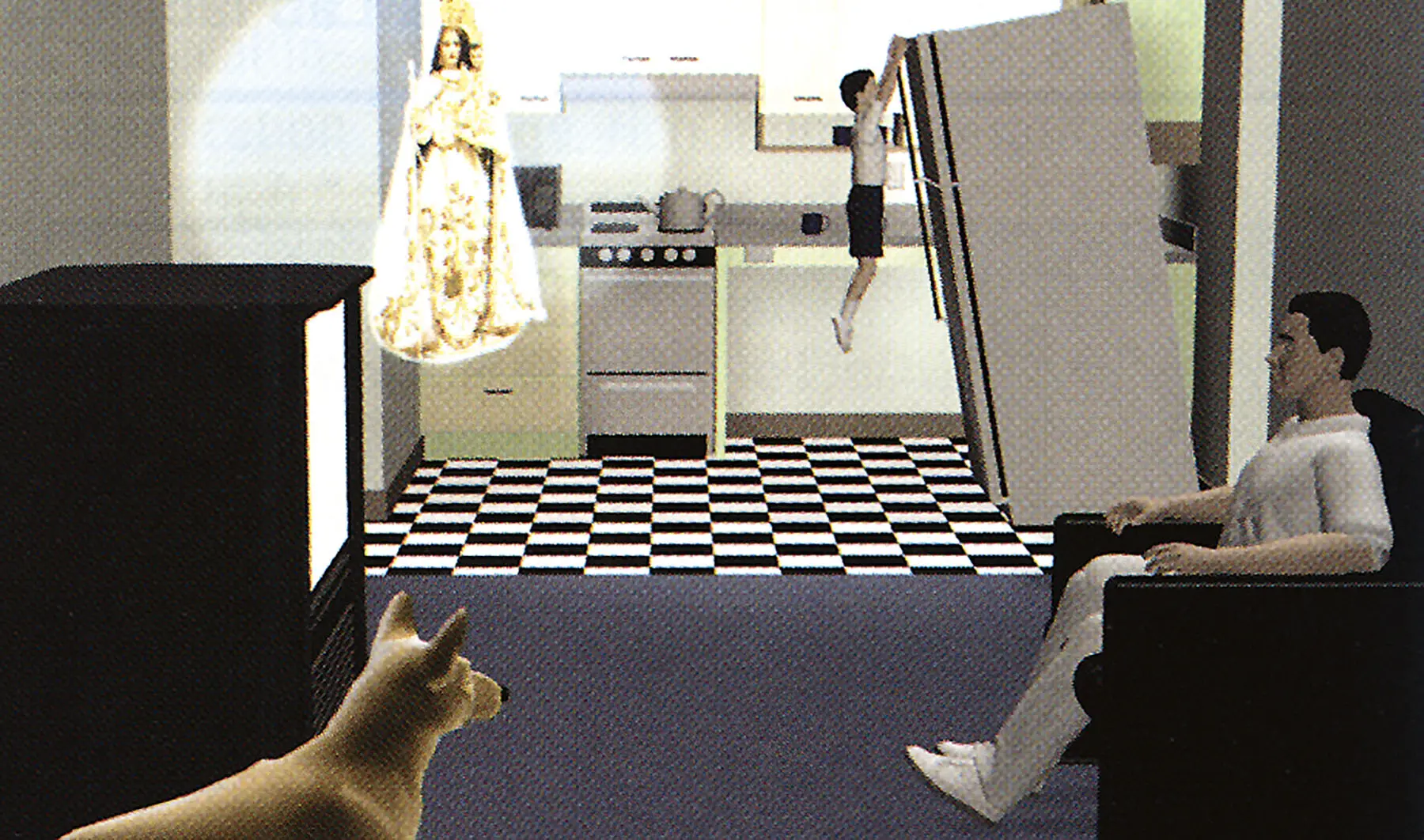
Francisco Larios' prize-winning work comprises 24 urban life images created with three-dimensional modeling software. The artist develops characters and environments, inserting figures of saints; he is a postmodern version of the ex-voto, those religious offerings (given in gratitude for intercessions received) that believers deposit in churches. Larios' pieces, however, are characterized by the banality of their tone "not by the intimacy one often finds in these offerings" and the plain language of the prayers included. Gratitude is given not only for the health of a son or one's survival after an accident, but also for things such as a connection to the Internet or the cancellation of a debt. Larios refers to contemporary socio-political realities, to bourgeois life, to contradictory social values, and to the role of religion in society. His work speaks in a pan-Latin American language and it combines tradition and modernity, humor, and social commentary.
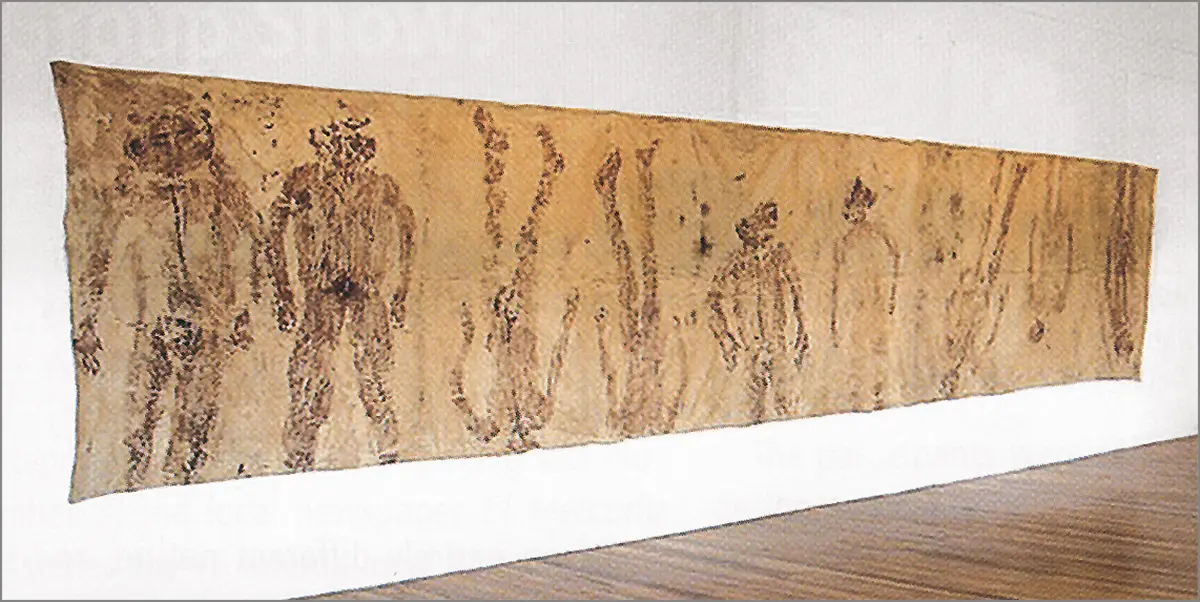
The collaborative shroud Olvidados (Forgotten Ones), presented by Mexican artist María Teresa Margolles "a founding member of SEMEFO (Forensic Medicine Services, in Spanish), the conceptual and performance art group" impresses by its size, the human body forms stamped on it, its dried-blood coloration, and even its disturbing aroma. The intensity grows as we read the explanatory text, something necessary in this case, where it is explained that Margolles worked in a morgue for a year, printing on this cloth with body fluids as if in a huge monotype. We are faced with a forceful critique of violence, where the anonymity of the represented figures, added to the real presence of death and the ethical questions arising from the work, forces viewers to think about the final passage, and about their own morbid impulses and their own mortality.
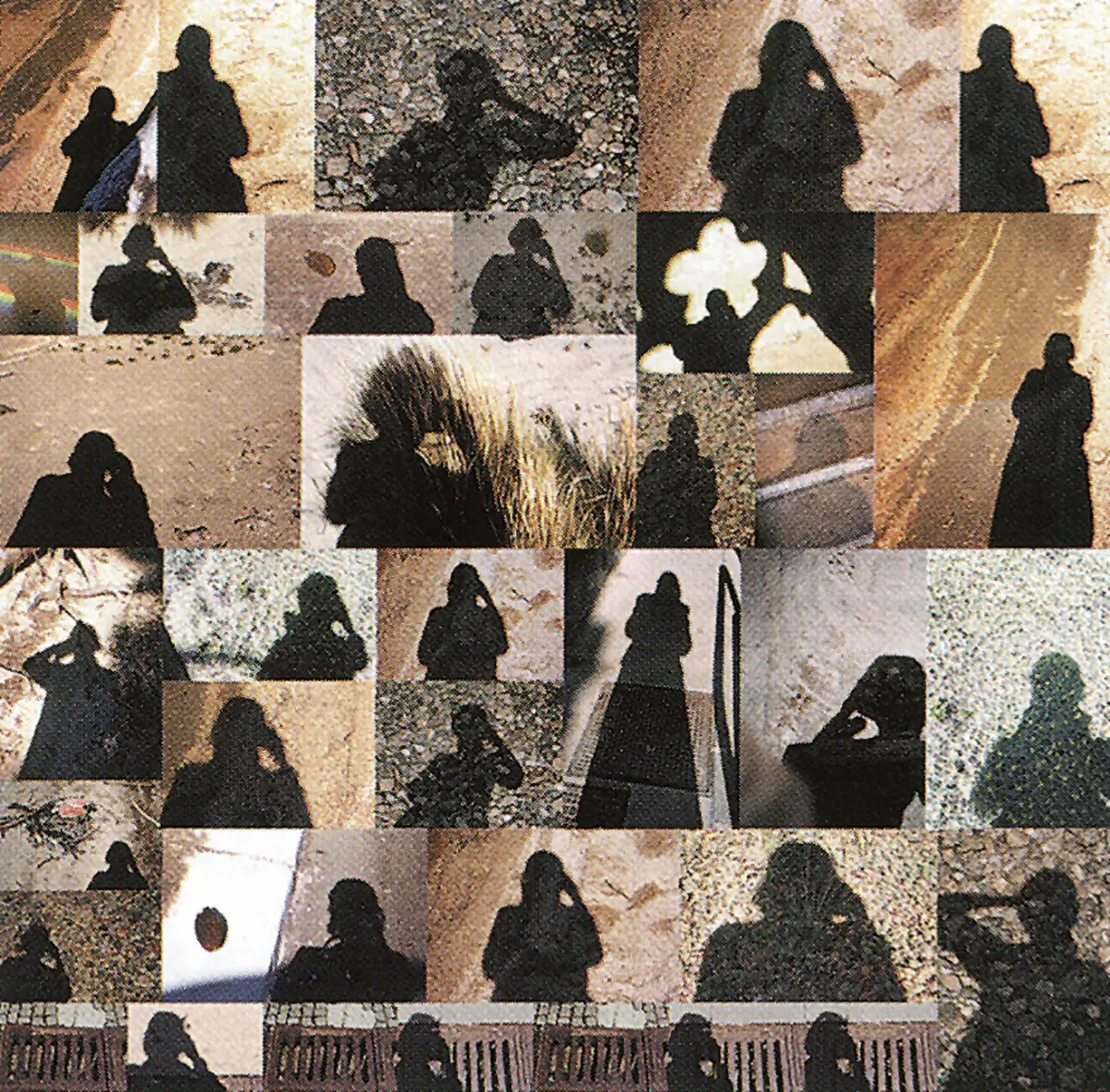
The presence of the viewer is also an essential element in Itinerarios (Itineraries), by Matilde Marín. It is an assemblage of photographs documenting the artist's shadow over the course of several years, beginning in 1993, in different locations throughout the world. Presented on a wall of approximately 10 feet long, the large format implies a sense of human proportion, transforming us in the artist's accomplices, as if we faced her shadow itself. The work speaks of a nomadic life, and the photographs constitute a travel journal that's both visual and personal. The artist's dark projections on the ground are private and anonymous, and they generate the dual feeling of being and not being there. In that sense, despite communicating in an almost painterly way, this is still a work of photography, a process incorporating place and time, congealing past instants.
Besides the three established prizes, the Jury opted to acknowledge a larger number of artists, conceding Honorary Mentions to four works that demonstrated the diversity of artistic propositions present at the Biennial. Gustavo Araújo, from Panama, was mentioned for his installation El sueño (The Dream), which explores the languages of video and advertising to create poetic, visually captivating works of art. In a darkened gallery, the sound of ocean waves emanating from the video piece titled Red Frog accompanies a couple walking toward the sea without ever reaching it; it also provides a soundtrack for Bocanadas (Breathfuls), a blue-light fence composed of multiple digital images of underwater bubbles. On the ground, a light box-turned-sculpture shows the seashore in transparency; two children play on the other side of this scene, only to disappear a second later.
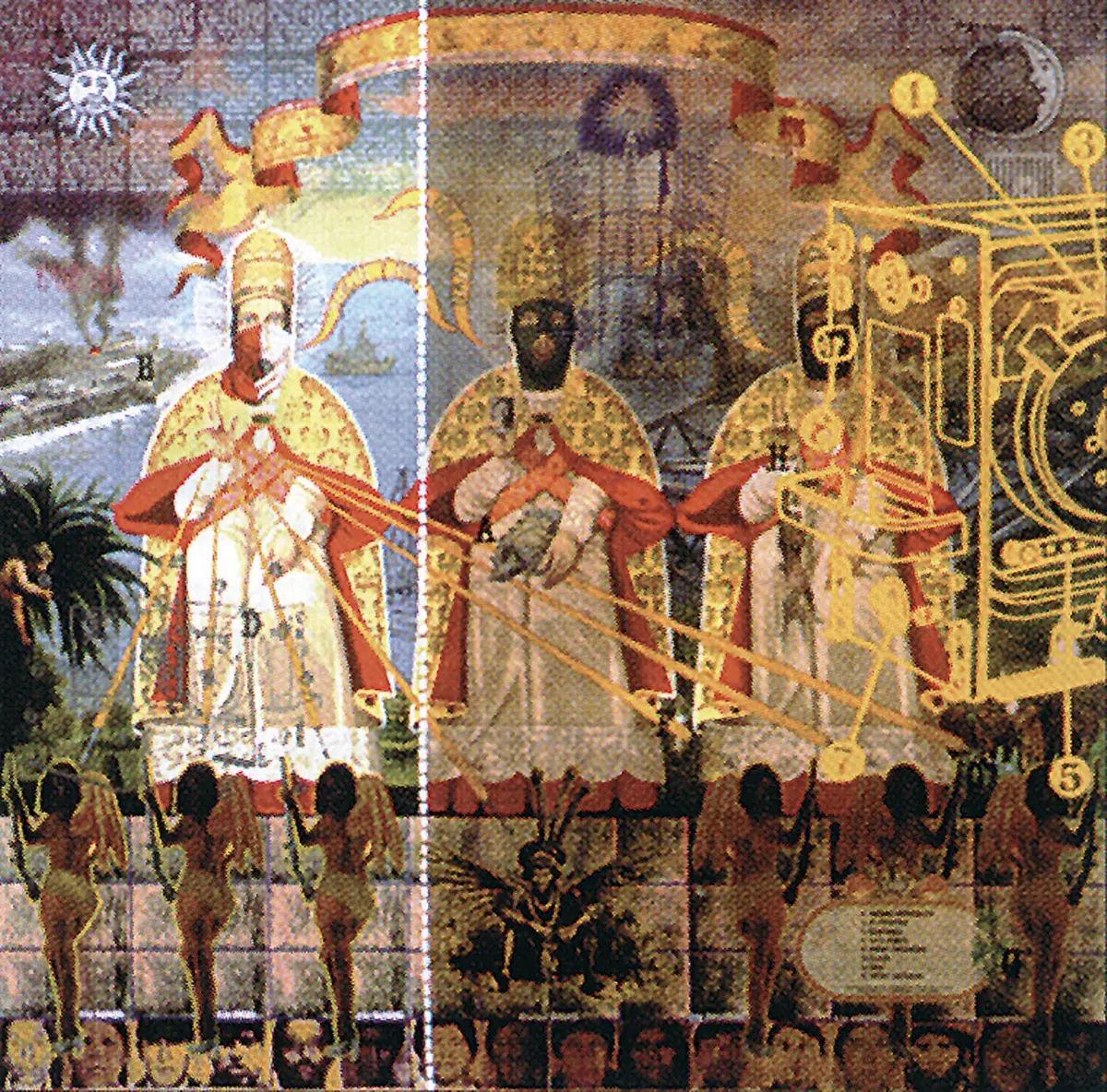
The notion of time's passage is also essential to Pablo Cardoso's Geodesia, an installation formed by a series of miniature paintings initially they seem black and white photographs in oval-shaped photographs suggesting an automobile's rearview mirror. Placed horizontally on a handrail that suggests an invitation to walk through this procession of obsessive forms, this work, according to the artist, provokes the eye, activates the gaze, and obliquely uses pictorial realism. It also evokes thoughts about traffic, highways, and the constant movement characteristic of today's world. Bernardo Krasniansky's Pintura holandesa (Dutch Painting) is another polyptych related to photography. Comprising 45 small canvasses created through acrylic-on-linen transfers, this work offers a new interpretation of portraiture, a classic genre in the history of art. Curator Ticio Escobar has called this an insidious meditation because it attempts to deal more with the conflict of reproduction than with the values of similarity. We see multiple versions, both positive and negative, of a 17th-century portrait of a female sitter, realized in a range of contrasting computerized tones. We are in the presence of a portrait and its duplicate, of trace and its shadow; we are confronted with the mystery of an image that reproduces an absence. Of an entirely different nature, and very unique, is the mixed-technique work presented by Alfredo Márquez and Ángel Valdez, Caja negra (Black Box). This large, baroque canvas is populated by images and open to interpretations. In close-up, it offers a trio (or trinity?) of human figures of different races, clad in luxurious ecclesiastic apparel. Around these figures, an overwhelming amount of appropriated elements enter the composition in several planes, referring to Peruvian history from colonial times to the present the nation's political troubles, its imposed christianization, its tragedies, traditions, and myths, both Andean and imported. All of this happens in a discourse of misencounters which the viewer may intuit, but not comprehend fully. The Exhibitors and Their Works The works exhibited at the VII Cuenca Biennial had various levels of creativity and quality, perhaps an inevitable situation given the lack of a general curator in charge of unifying the different national selections. The creation of such a position in future Biennials would certainly complement the laudable work of the event's general coordinator and his team in structuring the Biennial and distributing the works among many exhibition spaces. The placement of the works was an important element in those cases where the curators selected pieces sharing a conceptual proposition or those that worked together as an aesthetic group. Such was the case with the Argentinean selection, shown at the Modern Art Museum. The space was dominated by a silent harmony, to which no doubt the mysterious, almost white paintings by Juan Andrés Videla contributed significantly. In adjacent spaces within the museum, we found the abstract strength of Delcy Morelos's (Colombia) monochromatic paintings of towers, and a suggestive exploration in Jaime Landívar's (Ecuador) installation. Landívar covered a room's walls with repeated portraits of a crowd, an effect perhaps undermined by the insertion of three-dimensional figures painted on the photographs' backgrounds. In the Museum of Medicine, an installation was mounted with a series of export mini t-shirts, part of the Zip-504 project by Grupo Arteria, a collective of young Honduran artists. The installation did not reflect the true value of this work, which is found in the process of its realization: the artists joined the world of tolls as workers, "exporters and marketers of our culture's most representative industrial product: ourselves."The selection from Costa Rica was housed on the second floor of the same museum, with canvases by Emilia Villegas and Adrián Arguedas. Argueda's dynamic compositions were worth noting; his works are expressive large-format paintings showing old swimmers in reference to life's transitions. On the other side of the impressive, if somewhat abandoned, museum structure, Mexico's Margolles shared a space with Natalia Critchley, from Venezuela (she presented three urban-themed canvases), and Jorge Pineda, from the Dominican Republic. Pineda's work is also worth of notice, modest as it is in its resources. With small photocopied self-portraits, intervened in paper and acetate superimposed directly on the wall, Pineda accomplishes a composition dealing with live topics such as blackness, heritage, social roles, and sexuality. The second Dominican artist at the Biennial, photographer Domingo Batista, was disappointed with works too close to touristic poster art, which he didn't transcend. At the Central Bank could be seen the work of the three selected Uruguayan artists. Among them, most impressive was the collaborative work of Eduardo Cardozo and Fernando Peirano, related to the production of Bananas in Ecuador. Three letters C (in reference to the qualification of Ecuador as a risk country) formed with yellow, spotted bananas which already by inauguration day were on their way to rot, worked as a commentary on the state of Latin American economies. On an adjacent hall, we could see part of the Guatemalan delegation, and of particular interest, resulted in Mariadolores Castellanos' installation, a series or resin blocks suspended in the air. The blocks incorporated old maps, texts, and drawings, generating feelings of nostalgia and remembrance of unknown places. The Cuban selection, exhibited at the Museum of Metals, had a surprisingly conventional tone. Nonetheless, the dark, enigmatic canvasses presented by Carlos Montes de Oca had a surprising quality. The same old building hosted the Panamanian delegation, which, besides Araújo's installation, included sculptures by Lezlie Milson focused on issues of gender and otherness and paintings by Haydé Victoria Suescum, in which intense colors and original vinyl frames allow for a reinterpretation of pop culture's images and signs. The Bank of the Azuay was one of the visitors' favorite spaces. Among other works, young Chilean artist Andrés Vío's abstract moldings, made with twisted and woven newsprint, made a significant impression, and so did the conceptual work of Patricio Palomeque, from Ecuador, who took advantage of the bank's vaulted ceiling to create a work whose reality was only perceived through the reinforced door and the indication on the program. It is impossible to comment on each one of the many works of art seen at the Biennial, but it bears mentioning that there were also several parallel halls, among them an exhibition of Colombian painter Omar Rayo's works and the collective Art-Object, organized in Spain. However, of the parallel shows, the most impacting was the Digital Art Hall, with works from Argentina, organized by Graciela Taquini. This show included video, web art, and animation. Another visitor's favorite was the extraordinary video work presented by Argentine artist Liliana Porter, who, with simplicity, humor, and poetry, explores socio-cultural attitudes through the animation of mechanical toys, and small characters where perhaps more than one visitor to the Cuenca Biennial saw his or her own reflection.
MÓNICA KUPFER