
The New Museum in New York recently presented a retrospective exhibition of the American artist Tom Friedman.1 At first glance his work, with its subtle humor, simple and sometimes trivial ideas, obsessive finish, and flirtations with madness, easily fits into the post-conceptual stream. Friedman (b.1963) is relatively young and belongs to a generation that, if not shaped, is at least informed by the immediately preceding batch of conceptualist artists. His works are based on tautology and comment on the process that generates his art. Often there are connections with Fluxus whimsy. If this was all, Friedman's work would not be that interesting, and he probably wouldn't warrant this exhibition. It is also the case that Friedman, consciously or unconsciously, often quotes the work of older artists with the risk of falling for easy satire. For example, we find feces (Artist's Shit by Manzoni, 1961), an inverted map (South America by Torres-García, 1943), a photograph of the artist lying on the ceiling (echoes of Yves Klein jumping from a balcony in Le sauté dans le vide, 1960), and the organization of found objects in distributions (previously explored by Tony Cragg).
Still, though one is presented with a collection of works not always original and extremely diverse, one senses a nearly unchallengeable consistency. This coherence is based on the particular use Friedman makes of dialectical schemes. One encounters baroque minimalism, abstract works that are at the same time realist, pieces that are descriptive but devoid of content, and others spatially empty while inhabited by history.
Perhaps even more interesting is the unusual relation Friedman has with craftsmanship. His methodology expresses, but rather than intimidating us with the enormous amount of time invested, Friedman invites appreciation of his devotion to material perfection. This may be another dialectical polarity to add to the list: utilizing ideas that suggest the viewer's possibility of participation while favoring a pure physical completion that precludes it. In much of Friedman's work in this show, there is no ambiguity; there are no margins.
Under these conditions, one would normally assume that the viewer is reduced to being merely a consumer of the pieces and that the work is experienced as restricted and restricting, without echoes, without evocations. Friedman's art may share some of this risk, but his approach to craftsmanship rescues his work from a lack of dimension. It is, therefore, more rewarding to focus on Friedman's process than on the final products. We have lived through several decades of an ambivalent relation with, and distrust of works manifesting technical virtuosity. With the "Art of Ideas," higher value was attached to the ability to elicit audience interaction with work than a contemplation of the material finish. "Bad Painting," for example, directly confronted rules expressing traditional values. When there was "perfection," for example in works attempting spectacularity, it relied on technology. Pedagogical efforts negated technical schooling as an end in itself, challenging past academies and the canonical curriculum. In this context, Friedman's work seems to admonish us for our ambivalence about craftsmanship. Or perhaps he's found a way to conceptualize the action of the artisan.
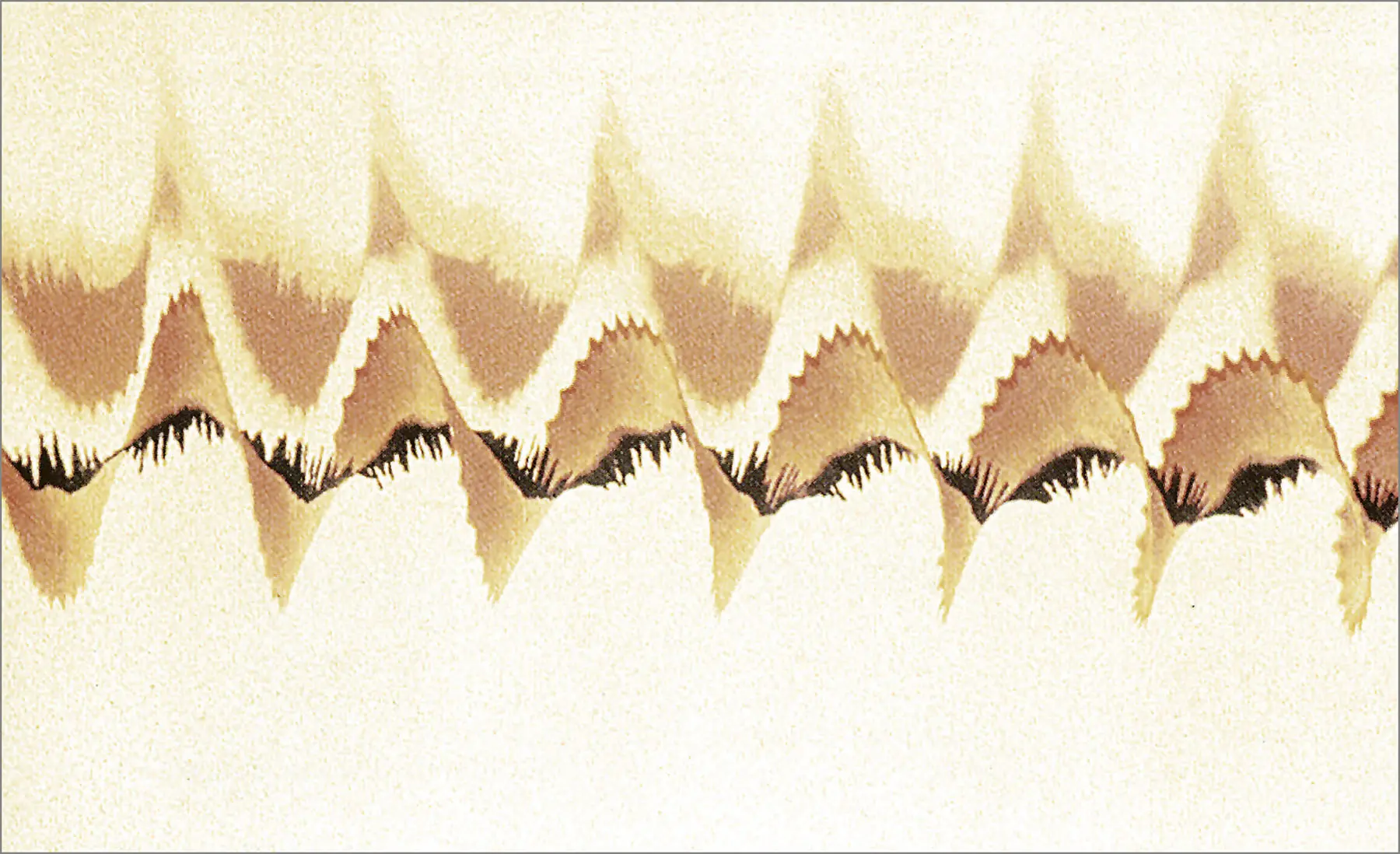
When a whole pencil is transformed into a seamless shaving produced by a sharpener (Untitled, 1992), it is apparent that several things are taking place. There is the obvious conceptual joke that nothing has been sharpened. There is the unexpected physical beauty of a coiled serpentine possessing an unbearably painful fragility. In this and other pieces not executed on-site, the exquisite fragility evokes awe; that they could somehow arrive for the exhibition unharmed. At the same time one marvels at the virtuosity of the producer. How did he manage that the shaving didn't break during the process of production (sharpening the pencil)? When viewing the piece, one isn't inclined to consider the possibility that the artist might have glued fragments to simulate continuity; somehow the sheer presence of the object inhibits doubt. Remarkably, then, Friedman achieves impeccability and accords this perfection a central position in the work without, apparently, seeking to startle us. (For peace of mind, I should note that minimal traces of glue could be spied in some areas).
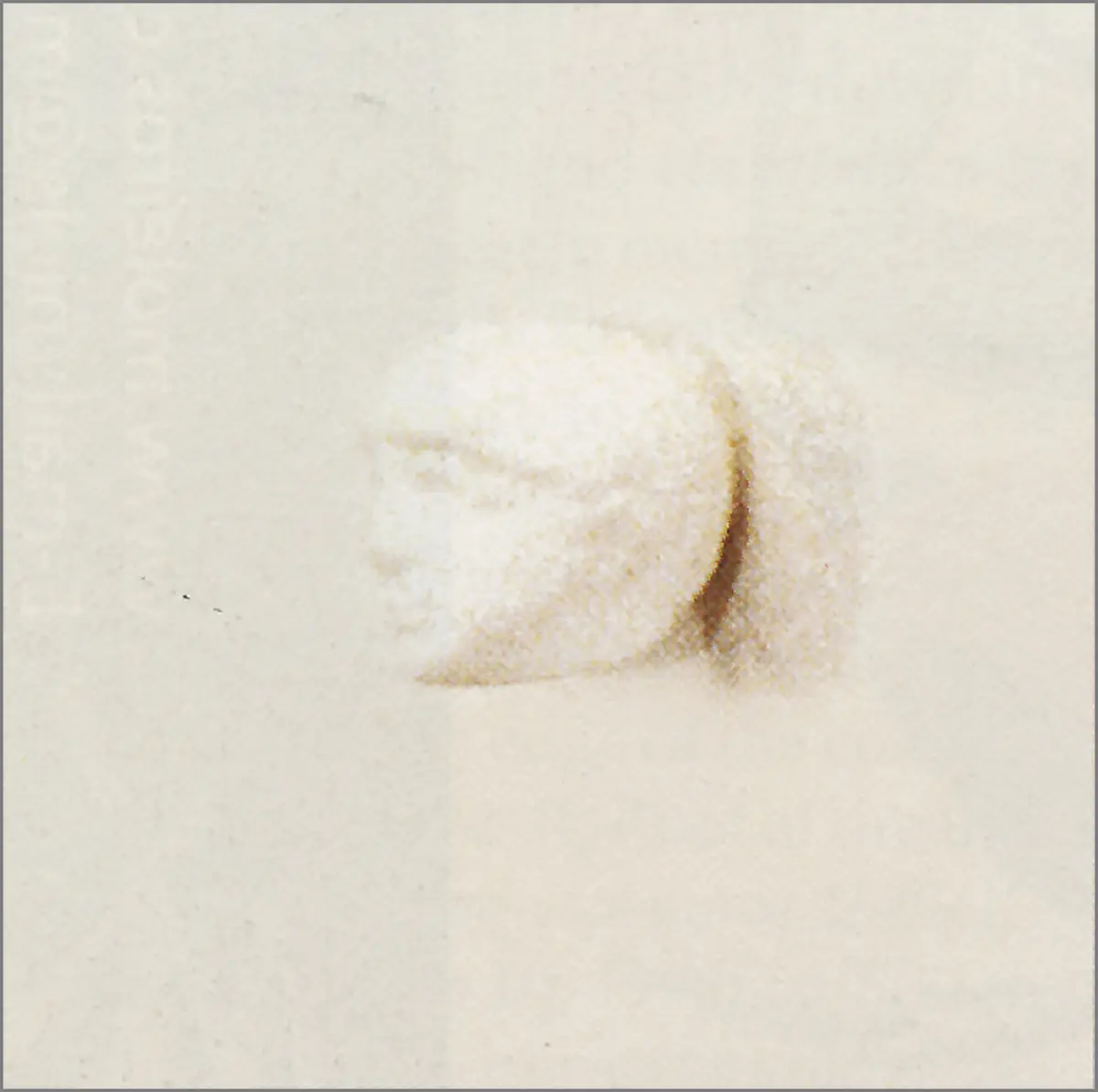
There is humor in Friedman's work, but it is very modest and lightly dispensed. This turns out to be essential to the success of the work, for strong humor would intersect badly with the technical virtuosity of the pieces. The way Friedman conceived and produced his work, the gentle humor softens the edges of virtuosity, while the virtuosity provides a depth the humor lacks. The overall effect of the humor is to delay the realization of how the piece was made, thereby avoiding a fireworks effect and allowing a subtler experience. In his self-portrait carved out of a single aspirin (Untitled, 1994), the whimsy of allusion to headache engages the viewer before a fascination with the detail work takes over (how many pills were broken during the attempt to achieve the desired result?). The typical question engendered by virtuosity: "How did the artist manage to do this?" does, inevitably, pop up. But this question arises quietly, in a moment of politeness, and is not shocked out of us by any imposing demand on the part of the artist, or as a sign of pride. Friedman works the way he does because he cannot do it any other way. His virtuosity is authentic; it is inseparable from his ideas. In this respect, Friedman takes a different path from his nearest contemporary colleague, the Argentinean artist Jorge Macchi, whose works there often are surprising intersections. While Macchi's work is based on ideas, and evolves and comes to closure by relying on sequences of ideas, Friedman's work starts with ideas but evolves and ends in their execution.2
This integration of idea and artisanship underlines the impact Friedman's work achieves in general; virtuosity is the product of a disciplinary specialization taken to the extreme of credibility. Virtuosity in this sense derives from a fragmentation of possibilities of viewing the world and tends not to allow for an integrated or global vision. In fact, though, in Friedman's case, virtuosity does not give voice to a fragmentary vision. While normally virtuosity is a perception tunneled through an act of juggling, Friedman doesn't see the world through a trick. Craft is the essence of his world and gives his work meaning.
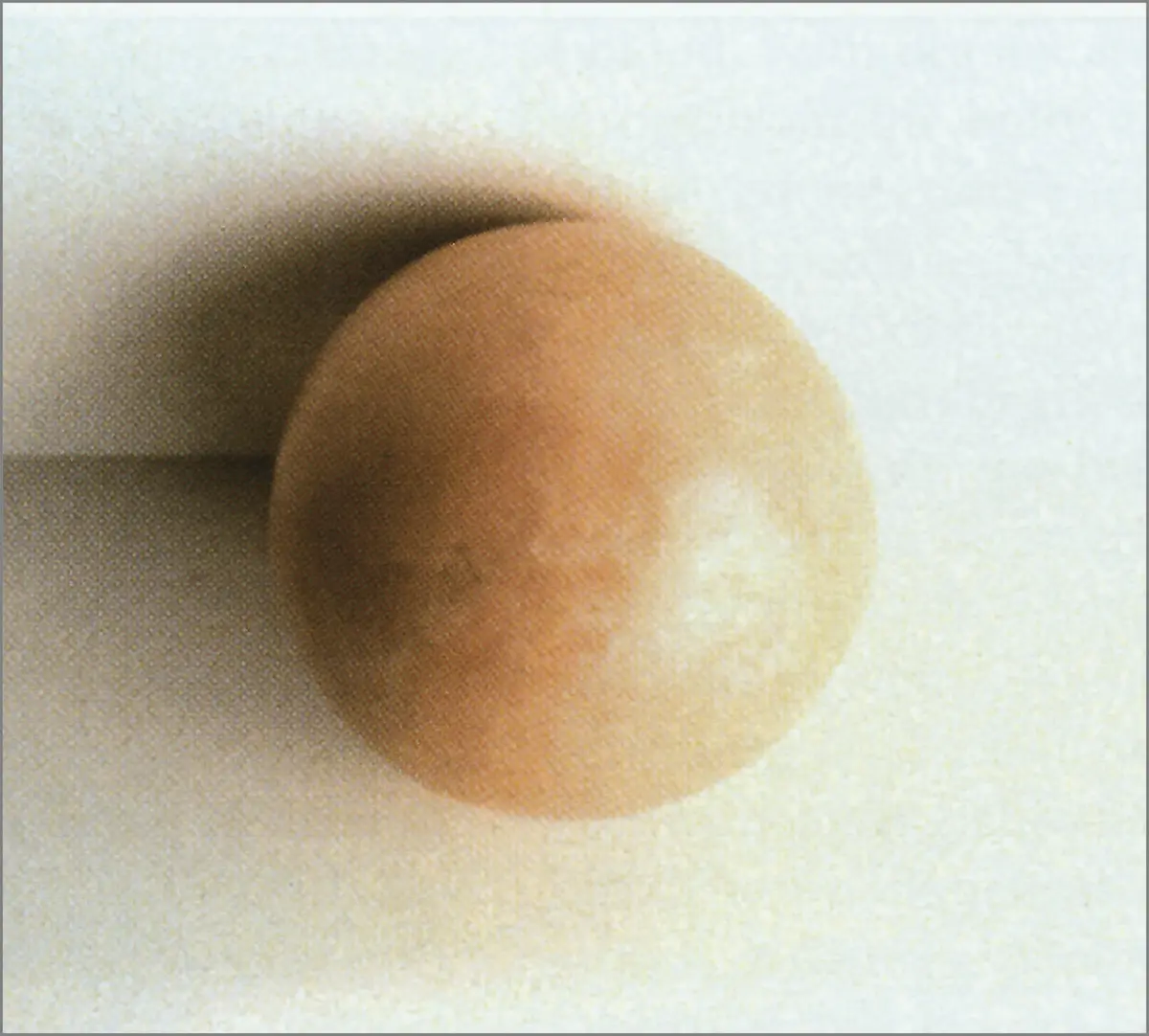
When Friedman chews 1,500 pieces of bubblegum to build a perfect sphere (Untitled, 1990) that ends up wedged into a corner of the room as if it were, precisely, a piece of chewing gum, it is the knowledge of his quasi-medieval investment of time that gives the piece its power. Without this knowledge we see nothing more than a pink ball; but with the knowledge we find the piece resonant with the idea of time passing, like the wrinkles in an aged face or the folds of the hand. Friedman's piece refers to infinite movements over long periods of time, in other words, history.
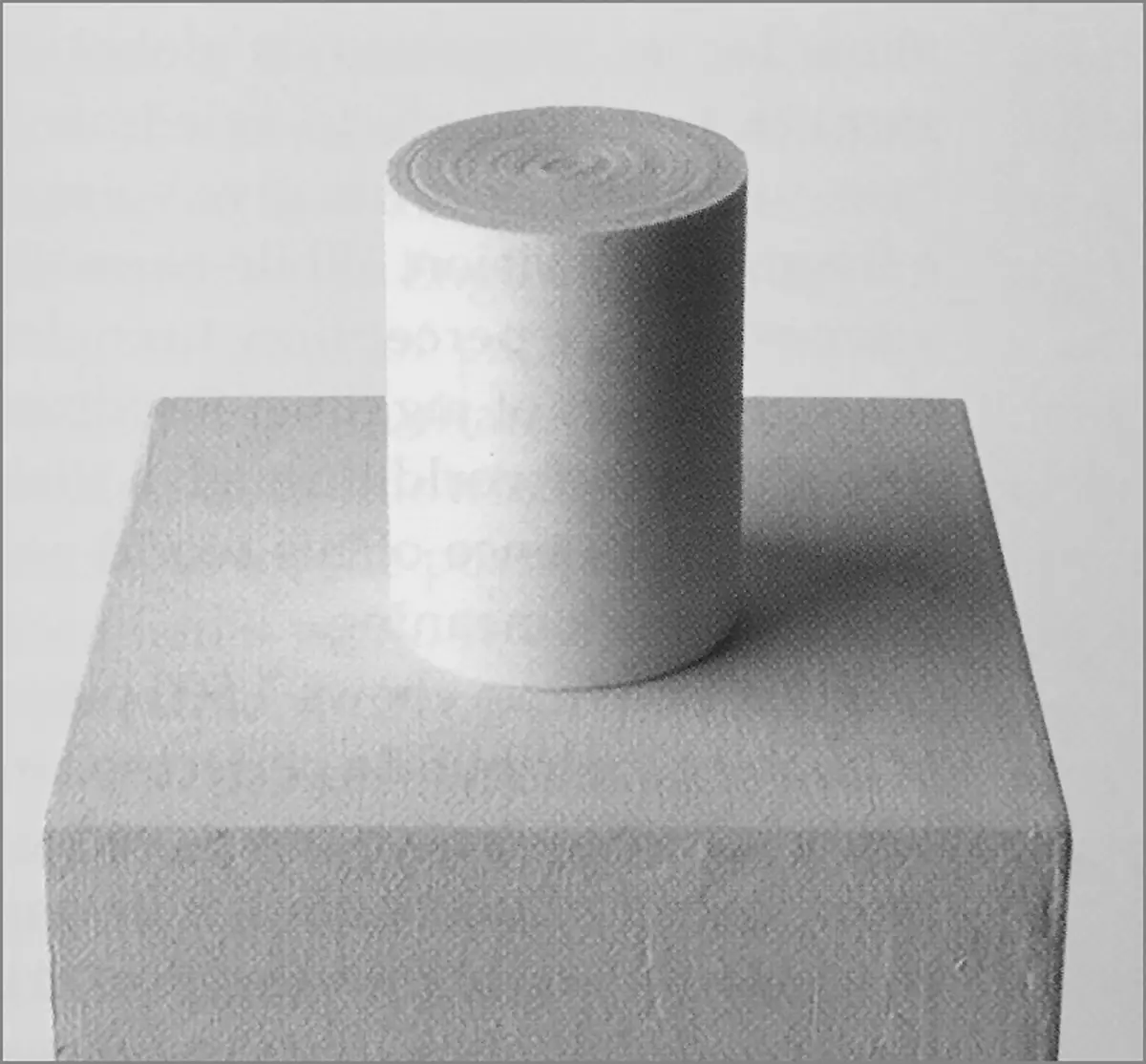
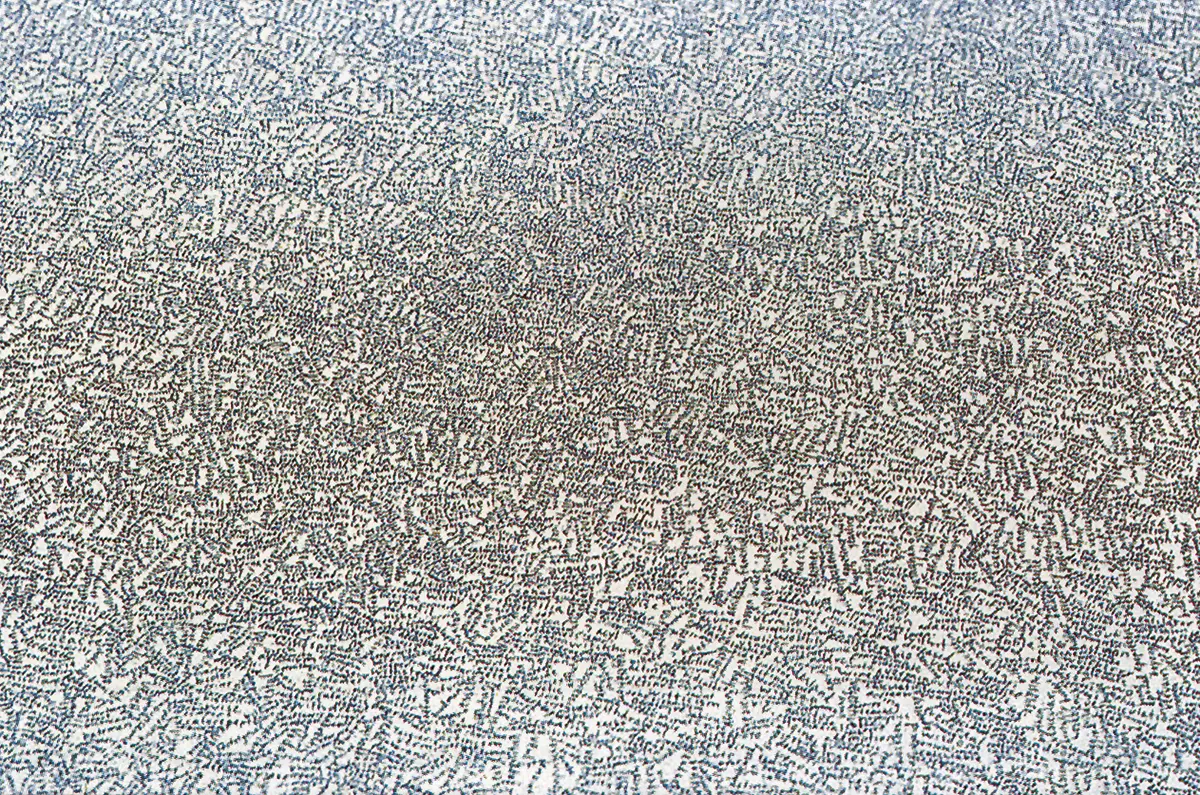
Friedman's obsession with meticulous repletion is manifested in a remarkable diversity of forms and suggests a dedication beyond ordinary human limits. In 1,000 Hours of Staring (1992-1997), a white sheet of paper declares "as its only merit" that it has been gazed at for the equivalent of an eternity. There is nothing spectacular about the perfection of this piece. On the contrary, there is a humbleness to it that is endearing. In effect, if an aesthetic should be associated here, it would be one of a new, true Arte Povera, one limited to the use of everyday materials without cost. The magic in Friedman's work lies in the precise placement of his virtuosity in relation to the reading of the work. It is not self-aggrandizing virtuosity, but a tool for transmutation. In Untitled (1990), a roll of toilet paper was carefully re-rolled without its central cardboard tube. The result is a solid cylinder that would never be associated with something as fragile as tissue paper. It looks as though it has been carved out of marble.
The obsessive character that informs Friedman's virtuosity could be suggestive of mysticism or madness. If there is any visionary aspect to his work, I suspect it is directed to an unknown God of irony. In one piece, Friedman has copied (in a disordered fashion) all the words of the English dictionary on a square yard of paper (Everything, 1992-1995), simultaneously demonstrating both knowledge and its absence. As for the possible madness in Friedman's work, it would inhere in such extraordinary precision; with intent so patently cerebral, one would be forced to redefine madness. There is some "outsider-ness" in his work, but it is too carefully administered and too intelligent to classify him with those whose repetitive motions testify to an imbalance and neurosis on which they cannot reflect.
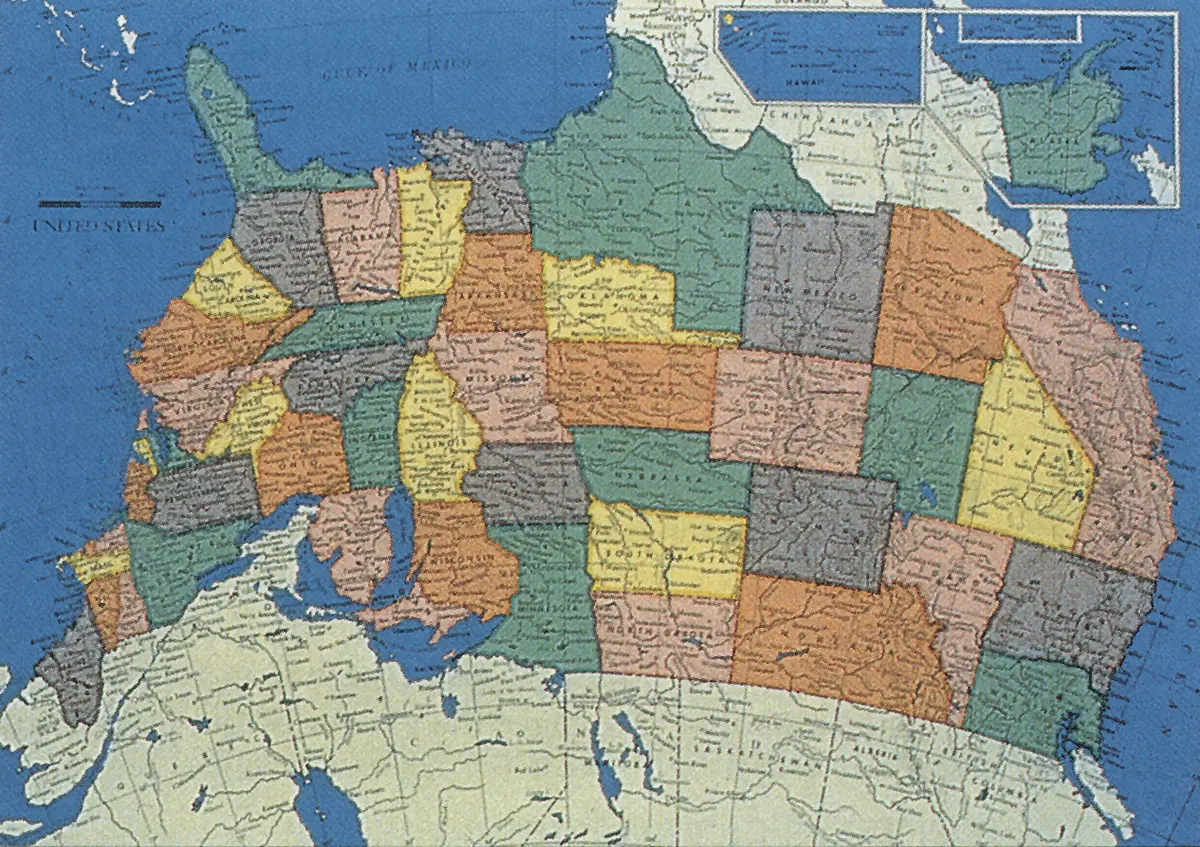
Friedman is too aware and has too much respect for the process. Many of his pieces would be produced more easily with the help of a computer or technological means. But often the idea does not have sufficient weight and it is his dedication to the process of making that saves it. In Untitled (1991-1994) he reproduces a map of the U.S. with South on top and North on the bottom with such precision that the viewer accepts it as printed. It is therefore easy to disregard the piece as cute, light, and lacking in originality. Friedman, however, carefully painted the map and put all the information with transfer lines and letters until he achieved an industrial finish. The work ceases to be a play on Torres-García (of whom he may not be aware) and becomes a reenactment, in effect, of Borges' tale about the rewriting of Don Quixote from scratch. Friedman seems to be an authentic Pierre Menard, thought up by somebody who, in turn, is recreating Borges from scratch.
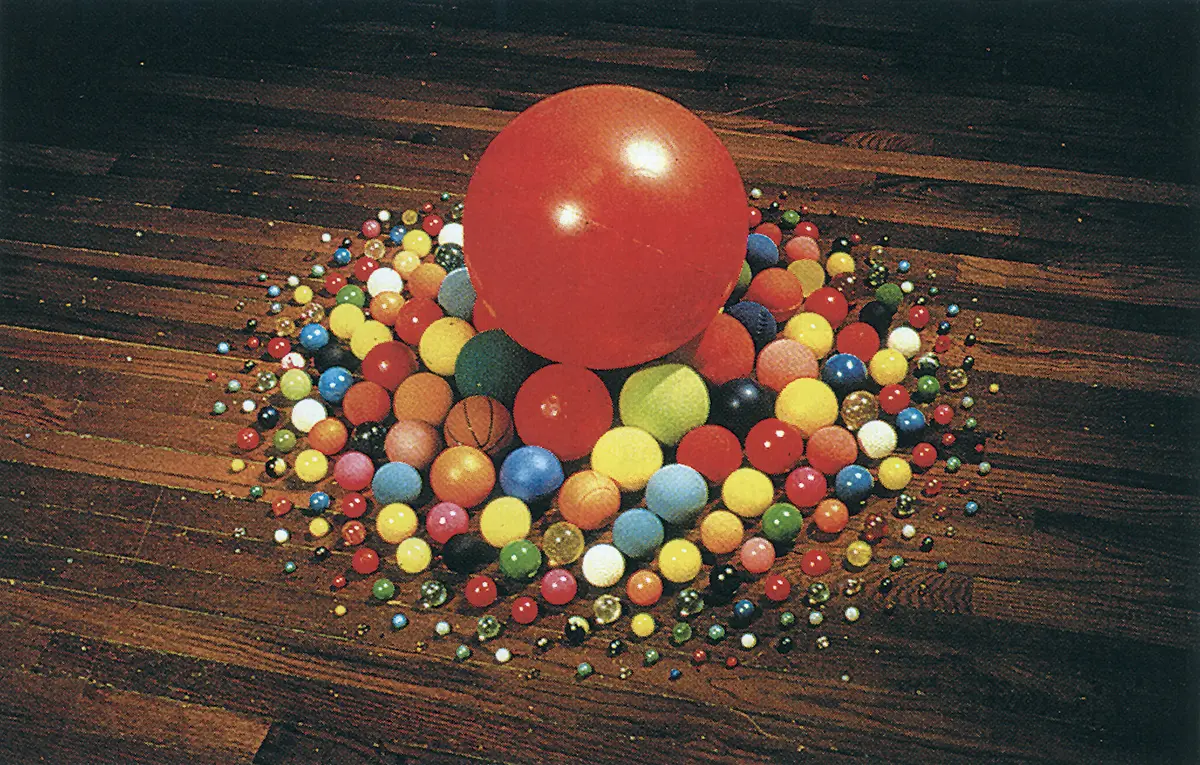
In another dialectical move, Friedman avoids titles. The great majority of his pieces are untitled, only to be approximately identified by the meager information of dates and materials. The strategy of maintaining the idea without any literary description doesn't dilute or obscure the concept but gives it more density instead. He rarely falls prey to cheap humor and double entendres. Hot Balls (1992) is one of the few exceptions. In it, he used 100 balls of different sizes and colors stolen from different shops over a period of six months.3 It is also a piece that describes best one of the artist's distinctive characteristics that may be also a weakness. One of the common denominators of the exhibition is the atmosphere of playfulness and winsome mischief. In an ambiance of divertimento, a mental wall is constantly being raised that inhibits the possibility of reaching the core of things, dispelling any reaction that might not refer to wit or play. But the way things are made comes to the rescue.
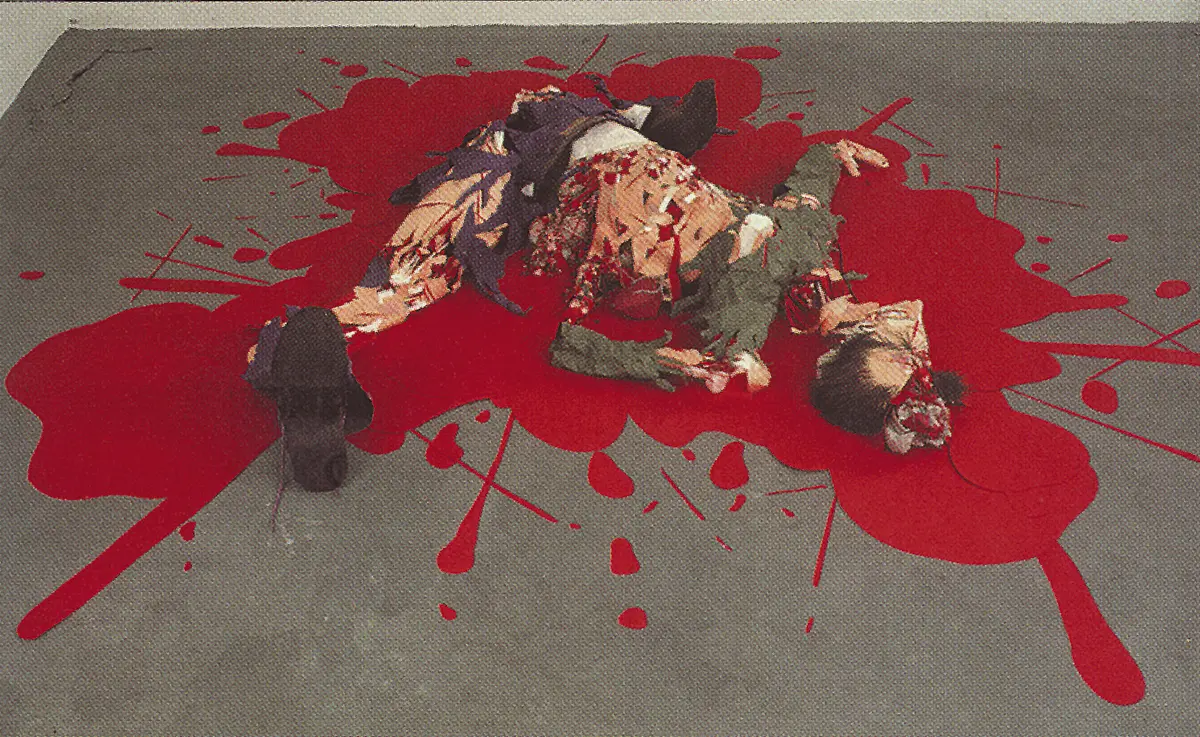
One of the more recent pieces, potentially the most dramatic and certainly the most ambitious in the exhibition, is Untitled (2000), a life-size self-portrait. One can't say that it is a full-bodied piece because the artist portrays himself in a state of fragmentation produced by a motorcycle accident. Body parts are scattered in a pool of blood, with organs and guts spilling out from the belly and the head splintered beyond recognition. It sounds horrible and, for a second or so, it also looks terrifying. But, the shock immediately dissolves into a prank. The sculpture on the floor is made from colored construction paper, and carefully cut with scissors. Hair by hair, vein by vein, detailed splatters, everything is reproduced; however, without negating the material being used. The preciousness of the work reminds me of Chinese paper filigree. The violence, if any, is in the wrinkling of some of the paper. A grand guignol installation befitting Halloween, the piece is impressive, again, for the way it was made.
In the context of what one has been seeing for the last several years, this exhibition is a welcome breeze of fresh air. This is so not only because it forces a revision of the role of "making" in the production of art. It is also because, as Dan Cameron (curator of the exhibition) suggests, "Friedman represents a philosophical approach to making sculpture that can best be described as 'anti-monumental."4 In societies with bankrupt economies (the U.S. doesn't yet qualify as one), this description wouldn't mean much. In an art market where the enormous expenses of installation involved in making a gallery fit the artwork (Richard Serra's rusty iron mastodons in Gagosian Gallery) are taken for granted and absorbed by the sale's price, this position can be seen as nearly revolutionary.
NOTES
1. Tom Friedman, an exhibition that started at Southeastern Center for Contemporary Art, Winston-Salem, NC. The New Museum, NY, 10/12/01 to 2/3/02.
2. Friedman probably doesn't know Macchi's work. Macchi saw Friedman's work for the first time on a trip to New York in 2001.
3. As far as I know, nobody has yet pointed out that, with this exhibition, the New Museum has become an accomplice in shoplifting.
4. Dan Cameron, flyer accompanying the exhibition.
LUIS CAMNITZER
Uruguayan artist, Professor Emeritus at the SUNY College at Old Westbury.