
An exhibition addressing Brazil's "discovery," colonial history, and its contemporary legacy is a formidable undertaking. The exhibition Virgin Territory addresses these issues from a feminist, post-colonial view that challenges master narratives and expands the parameters of the discourse to include the treatment and role of women, the construction of gender, the role of the Catholic church, the practice of mapping, relations between the races and cultures within Brazil, economic conditions, recent social, political and cultural history and Brazil's place in contemporary global society. Needless to say, the curators' project is rather ambitious.
The show is divided into four sections: the first vision and discovery of Brazil, thus marking the land as a virgin territory to be explored and colonized; mapping as a means of claiming, controlling, and ordering the land and establishing global position; gender relations in a culture associated with machismo and Catholicism; and the mixing of cultures and races, known as mestizo. Many of the pieces fall into several categories, yet rather than undermining the implied division and categorization, such overlaps attest to the interconnectivity of the issues and discourses.
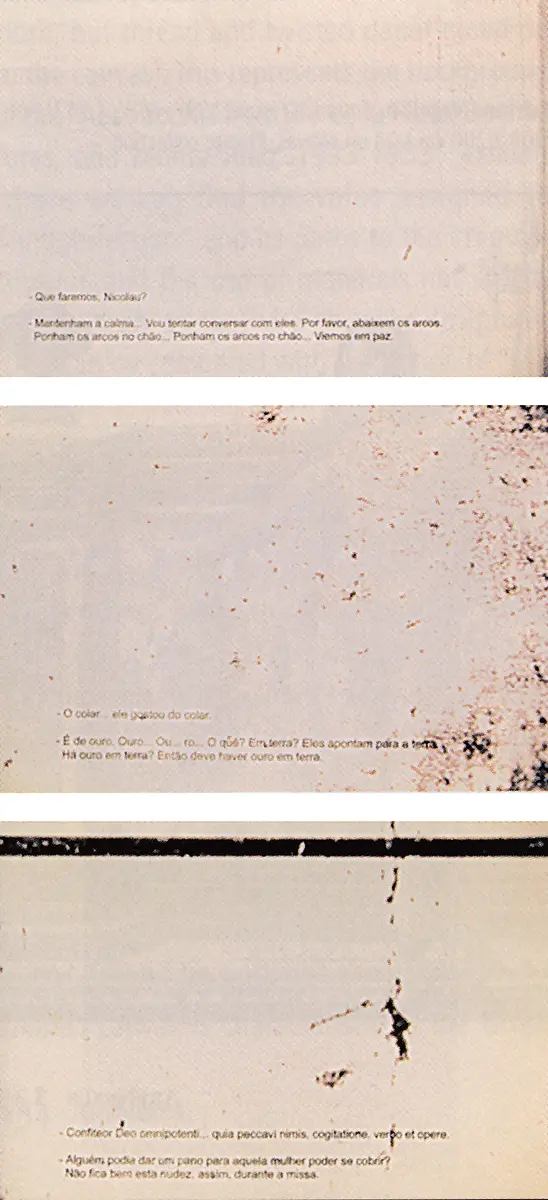
The first room of the exhibition establishes the connection between discovery and mapping, both methods of dominance with one laying claim to the land, and the other dividing and ordering it. In her video Vera Cruz, Rosângela Rennó addresses the "discovery" of Brazil in 1500, or the moment that Pedro Álvarez Cabral's ship first made contact with the new land. The primary account of this encounter has been through the letters of the ship's chronicler, Pero Vaz de Caminha to Dom Manuel I of Portugal in which he describes the pure land, a new "Eden," which Cabral names "Le Terra de Vera Cruz" or "the Land of the True Cross." Rennó takes this dominant and biased account of the encounter, featured so prominently in the recent Rediscovery Exhibition, an extremely popular commemorative exhibition marking the quincentenary of the discovery of Brazil that included Caminha's letters, and imagines it as a fictional documentary titled Vera Cruz (2000). The video is devoid of images and spoken words, utilizing only a blank screen marred by periodic scratches and the subtitled text of the explorer's account of the encounter, the only sound being that of the sea and the wind, reflecting both the lack of dialogue between the Portuguese and the Brazilians and the quality of the land, both as witness and contested terrain.
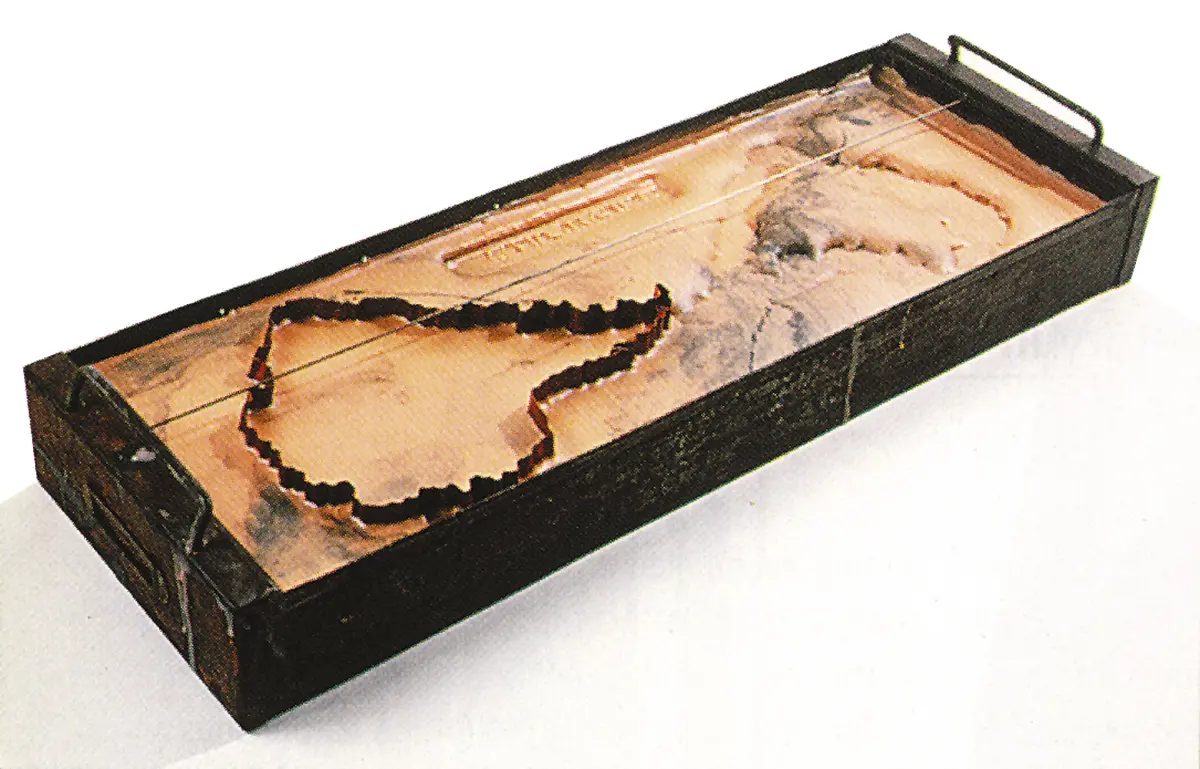
Several works by Anna Bella Geiger in a variety of media addressing the issues of mapping were included in the same section. Her Los fronteiricos (The borderlines) series are encaustic and metal assemblages of fragments of maps and territorial outlines displayed in rusted metal drawers. A linha imaginaria de Tordesilhas from the series Fronteiricos, (The Imaginary Line of Tordesillas from the Borderline Series) from 1993, refers to the European claim of the unseen New World, the division of the continent, and the plan to spread Catholicism and imperial power on the mapped representation of Brazil. Contemporary myths of Brazil as the other are addressed in Geiger's piece Am. Latina (1977), as four drawings of Brazil morph into forms illustrating clichés about religious mysticism, the mixture of the races, feminine sensuality, and dependence on northern countries.
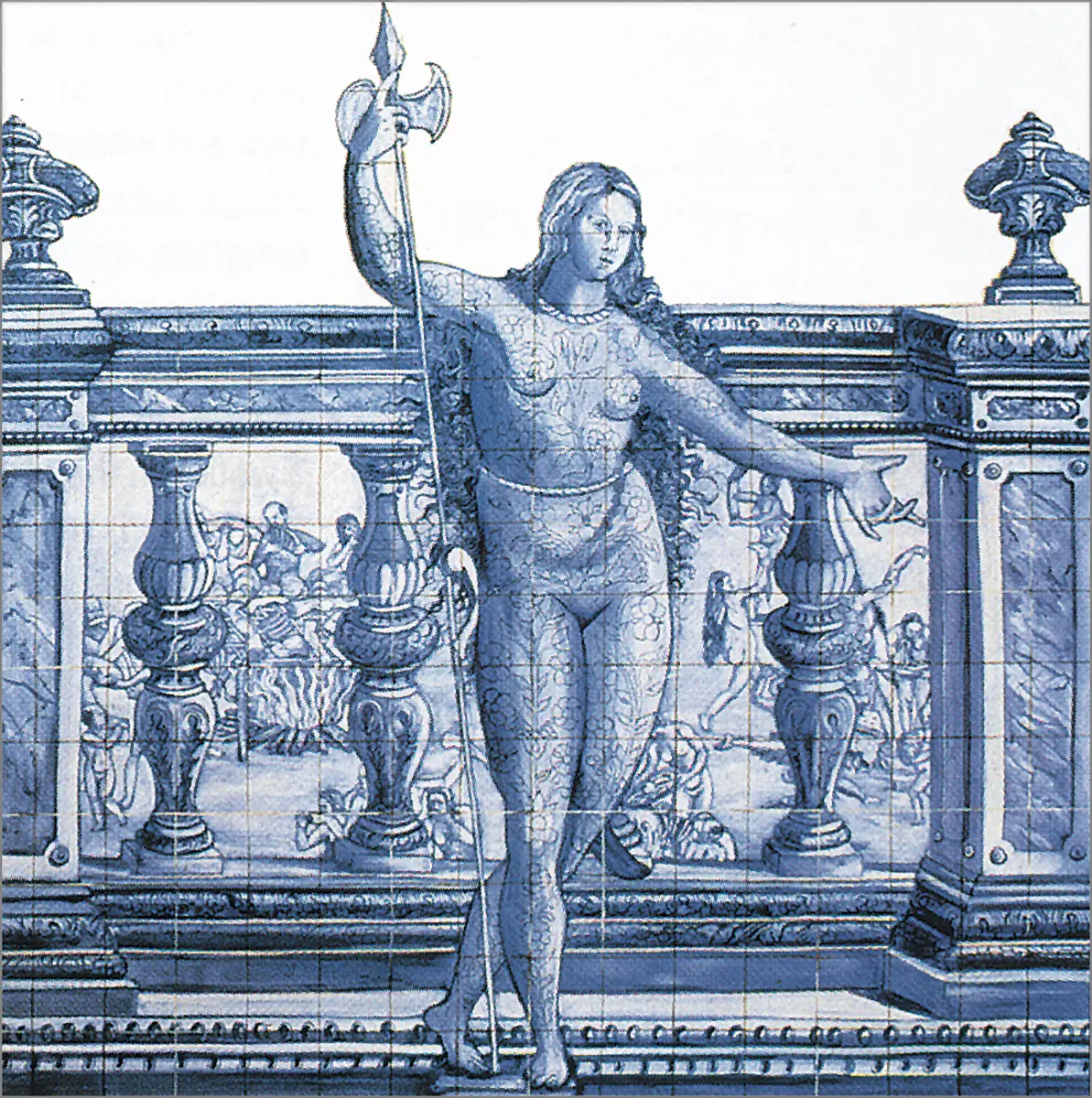
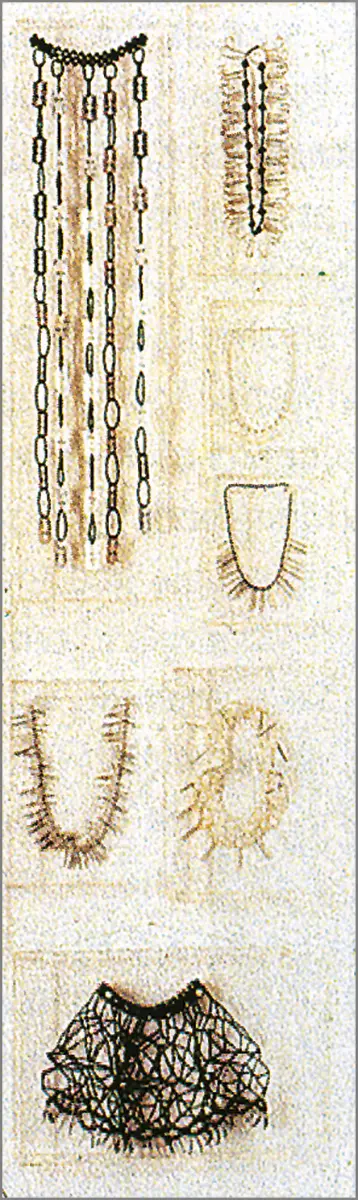
Adriana Varejão's works are Baroque-inspired meditations on Brazilian colonial history and the representation of this legacy through history painting. Employing subtle variations on both the images and the media of Portuguese baroque art, such as the reinterpretation of azulejos, Portugal's famous blue and white tiles as trompe l'oeil patterns, Varejão takes the forms so associated with colonialism, religion, and gender repression, repositioning them to tell an alternate narrative in the colonizer's own language. Deep red gashes rupture the uniformity of the tiles, a wound in the surface mirroring both the violent wounds inflicted on the people and the land and the practice of anthropophagy so central to Brazilian modern and contemporary art. Anthropophagy challenges the dominant narratives in a work such as Figura de Convite (Entrance Figure), where the beautiful, white female figure representing America is shown opening her arms, simultaneously gesturing a welcome to the Edenic new land and pointing to the cannibalism of Europeans by native inhabitants. Like Varejão, Nazareth Pacheco uses markers of femininity in her work Joias (Jewelry) to convey fetishistic beauty while implying a potential for violence and self-wounding. The glassy beads and intricate craftsmanship of her necklaces both mesmerize and repel, as the needles, razor blades, and metal hooks woven into the work signify both a threat and masochism.
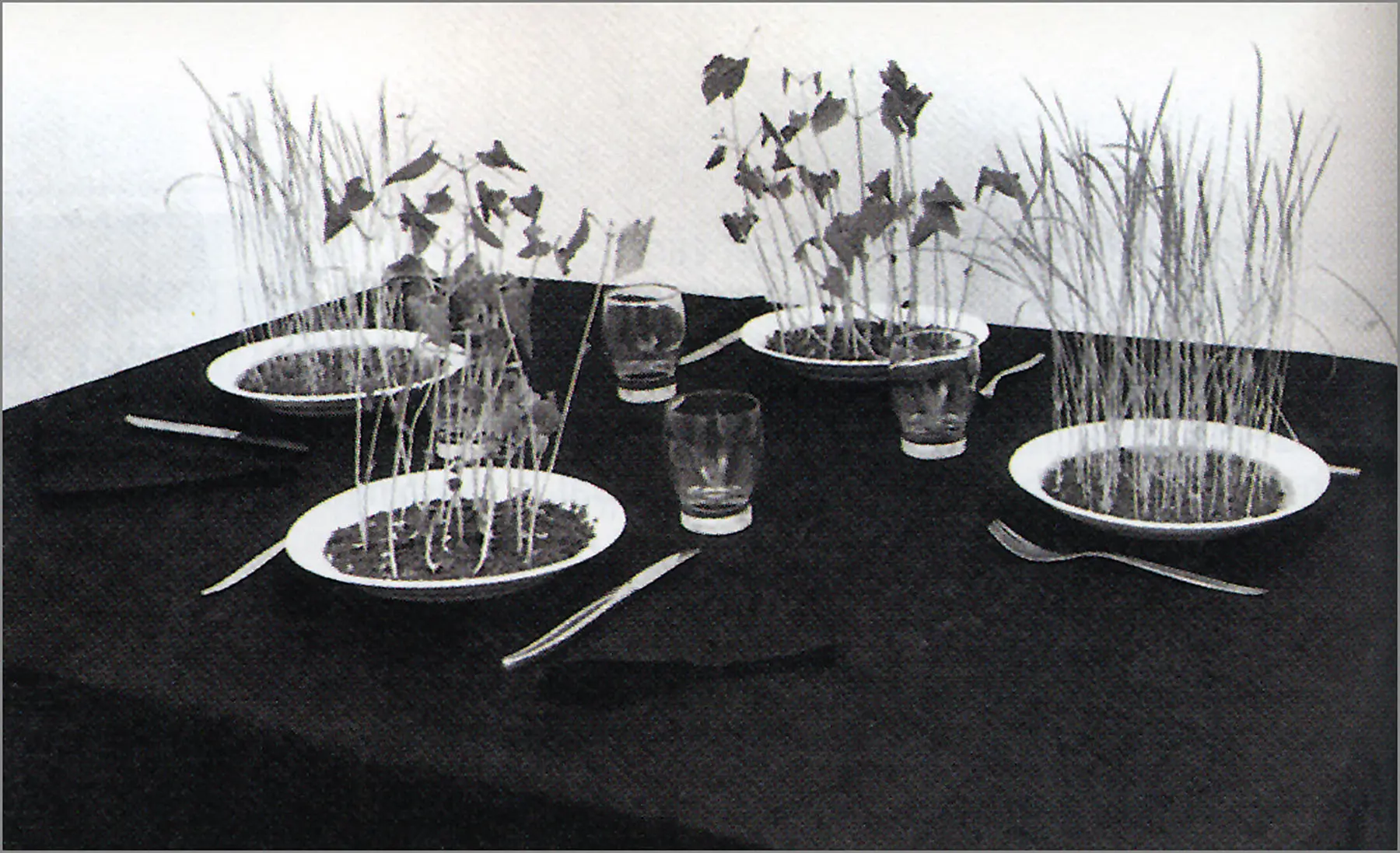
Brazil's recent socio-political history, specifically the military dictatorship that created a more isolated state and censorious attitude towards artistic activity is addressed through the poignant recreation of Anna Maria Maiolino's installation piece, Arroz Feijao (Rice and Beans) from 1980. While clearly illustrating a connection with the then-contemporary ideas of conceptual art and arte povera, the piece also addresses the political situation of the dictatorship and the resulting economic and intellectual poverty in addition to contemporary issues of hunger and poverty that exist despite the supposed "fruitfulness" of the Brazilian land. Presented as an offering, the work is comprised of several white-covered tables with empty place settings juxtaposed with the dishes on the central black-covered table where young green stalks of rice and beans sprout from the rich soil.
Through a variety of media and forms, the artists in this exhibition provide compelling counter-narratives to combat the mythology that forms the basis of the history of the discovery and colonization of Brazil and the myths and prejudice that structure gender, cultural, racial, and economic relations. While many issues are not addressed (but how could they all be?) and perhaps certain areas were better developed than others, the show offers a fascinating array of voices and ideas.
JENNIFER FARELL