
In the baroque imagination of Alejandro Aguilera, ornamentation signifies a dense stand of columnar carvings, some willowy and intricately volute, others as solid as railroad ties. With so much rough wood and mud, so many reddish-browns and blacks, a vegetal ripeness clings to this sculptural thicket, and the most noticeable pieces are reedy, fertile-looking shafts that stretch upward in totemic successions of quarter-moons, open mouths, and other gaping slits.
But here and there carvings stand like small stone sanctuaries on vaulting cliffs, and it's easy to read ornamentation as a model of an ideal city, where angular, painstakingly built monuments to the rational mind appear to spring from lush, primordial surroundings.
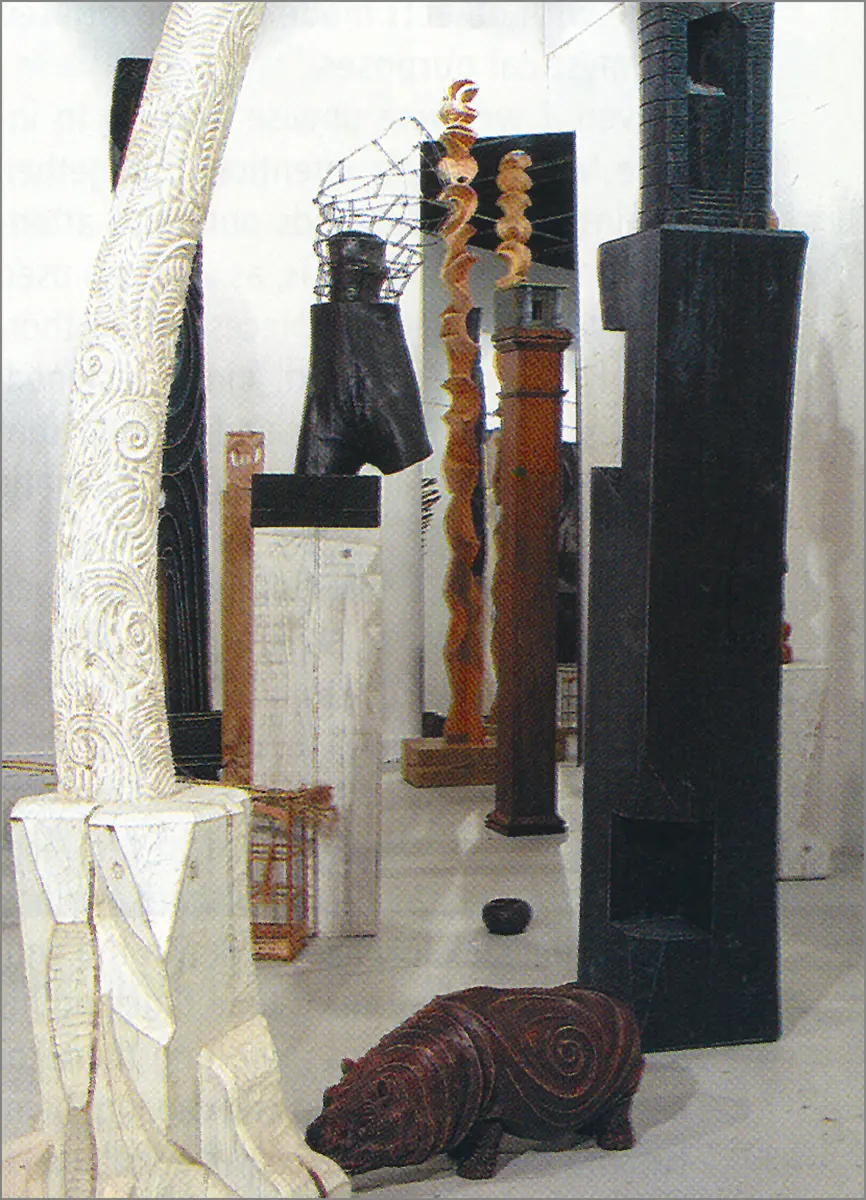
This could also be a story about twentieth-century art, of course; about Modernism and the primitive as is a piece titled Brancusi y los mameyes, the tallest, the most slender, and one of the most pre-industrial-looking of the lot, and Mr. Aguilera says as much.
Actually, he says quite a bit more: that his particular brand of ornamentation—call it "ornamentalism"—has to do with the intermingling of influences between European Modernism and so-called primitive cultures, and that he wants to demonstrate, among other things, how the latter came under the sway of what was taken from them in the first place and what new distortions this process has entailed. The trail of borrowings, thefts, and stealing back among cultures is almost impossibly obscure, however, and any discussion about it would likely end up being a dense, heated, clangorous noise. Although Mr. Aguilera's understanding of its predicaments is admirable, his claim is an enormous burden for one exhibition to bear.
Instead of trying to wrestle the hulk called twentieth-century art, it might be more restful to simply sit back and marvel at the virtuosity and acuity with which Mr. Aguilera himself, combines the sensual and mystical with reasoning and a ferocious tenacity. For a little intellectual exertion, we can pretend that he has staked out the somewhat more modest territory of devising a kind of inversion to the original theft of Picasso, say, palming African motifs or, if not an inversion, exactly, then a kind of re-balancing. His endeavor certainly has this kind of grandeur, however, contained it is by the artist's scrupulousness, his desire, and his ability to express himself hugely with small, disciplined gestures, and thus it is in no way as grandiose as it might sound.
He does occasionally slip into obviousness, and at times is just short of being goofy. He has carved lightly on the surface of a Danish modern nightstand, dropped niblets of dried corn into the wormy gouges, and placed one of his own small carvings atop it. It is a dual jest: an iconic, modernist knickknack all out of proportion to the modest object it holds, and invaded by the very seed of the primitive culture it looms beneath. Then there is the diminutive, sappy pair, pale and smooth as flesh, Ana y yo en Occidente, a penis and a vagina displayed side-by-side on a smooth-faced column.
But these seem like momentary, perhaps necessary, hesitations; throat-clearings amid the strenuous larger arguments that surround them. These range from Milano's Tale, arching overhead like a heavily tattooed ivory tusk, to the mixed-media contraption, Árbol-Sueño, wherein an architectonic, rectilinear wire framework stands in packed clay atop a carved and wispily polychromed tree stump, the way colonial churches have been portrayed as rising on the ruins of pre-Columbian civilizations.
Then there are the monuments, which come as close as possible to distilling the artist's bulky thesis: Templo-Iron and Templo-Analoga, one a rich and luminous obsidian inscribed with an intricate geometry of banding, the other the ashen white of a rustic Mexican church, its stand voluptuously niched and its entryway made of concentric arches. Each sculpture has a word: irony for one, and analogy for the other, literally carved into its respective face, as if the traditionally utilitarian constructs have been visited and disfigured by strangers who occupied them with an unaccustomed symbology.
Mr. Aguilera also scatters manufactured items about like ritual leavings in the forest of his own works: a finely polished deep ebony African headrest, a birdcage festooned with ceremonial straw bundles, a glass carafe filled with seashells, a toy-sized cedar shake barn similarly mixing the Western and mundane with objects made or appropriated for mystical purposes.
Even if we were unwise enough to ignore Mr. Aguilera's intentions altogether, the installation demands our close attention and admiration. It is, as we boys used to say, really built. Its pieces are so thoroughly engineered, fitted, joined, fastened, daubed, filled, stained, and sanded that carving seems like only a highly dramatic flourish.
He never uses a single chisel thrust when he can make several. No line of his objects, no surface, goes unattended. In the marvelous economy of his thinking, he fills the wood's natural cracks with the residues of his carving and colors them to look like stains, or, even more astonishing, to look more unmistakably like cracks. In the end, he must spend as much time finishing his sculptures as he does in bolting them together, gouging, scribing, and carving them. He smoothes and abrades with the persistence of weather, and his woodworks can gleam like polished stone, or look as faded as old adobe.
His intriguing and worthy arguments aside, he proceeds like a particularly dedicated anthropologist, but an anthropologist as much of form as of origins, trying to discover the shape of the thing at hand and of his history, and ours.
JOEL WEINSTEIN