
The exhibit Cruz-Diez. De lo participativo (Cruz-Diez. From Participation) to Interactivity was held at the Fundación Corp Group's showrooms from November 11, 2001, until February 3, 2002. Under the curatorship of Víctor Guédez, it brought together a series of works by the great master of kinetic art that corroborated his interest in promoting spectator participation and taking it to the last consequences by the use of technology.
As Guédez has observed, Cruz-Diez's creative work rests on the constant research on the existing relationships between creative fact and the act of perception. For the Venezuelan artist, it has always been important to free the spectator from what he has called the 'perceptive submission,' and create participative works in which the spectator 'finishes' the artistic experience (by different means such as the hand, by moving things, or, like now, by creatively intervening through technology.)
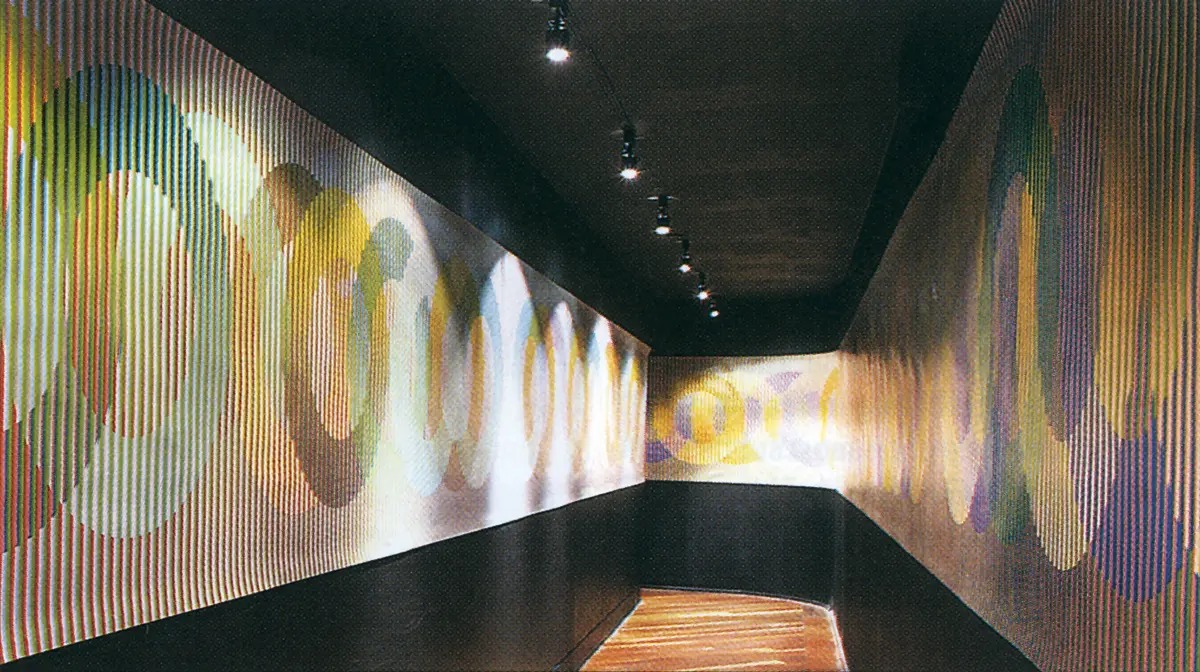
Cruz-Diez's conceptual trajectory begins by studying perception, in which color and its behavior as a space- and movement-making agent acquire great importance. Then it goes through his interest in the manipulation of the work of art, and finally, it reaches the digital experience. These stages are not surmountable; rather, they contain one another in what Guédez has called 'the expansive resonance of the same artistic preoccupation.'
The show contains some examples of manipulable works done between 1955 and 1965—abstract-organic moveable pieces made on painted wood.
One of the gallery's spaces shows a series of Inducciones (Inductions) and Adiciones Cromáticas (Chromatic Additions). These are the series that have become the axis where Cruz-Diez has based his research on the visual possibilities of color. 'The games on chromatic inductions,' points out Guédez, 'seek to change the static and two-dimensional realities into dynamic and multi-dimensional events.' Through digital technology, the artist can print out large, ink-jet copies, creating works whose sole scale accentuates the possibilities for color permutation, effect finalization, and the piece's overall visual transformation.
His fisicromías ('light traps')—another fundamental series in Cruz-Diez's research on color—are present in three huge digital proposals that have been produced by ink-jet printing. Here, the great planes are associated with geometrical shapes that put in evidence a series of transformations, dematerializations, and combinations. Espacio cromointerferente (Color-Interfering Space) (1974) is an environment on whose walls images of chromatic strips have been projected. A set of geometrical, three-dimensional shapes interferes with the projection. The spectator can place these shapes as he wishes, turning himself into a part of the game of visual interferences and relations allowed by the environment.
Espacio cromosaturado (Color-Saturated Space) (1960s) is a space divided into three rooms illuminated with blue, green, and red fluorescent lights. Color engulfs and saturates each space, provoking a retinal saturation that makes us perceive it as a total environment. At the same time, when we walk to the other colored room, the chromatic relationships relativize, producing a series of events whose source is visual but turns the experience into a corporal and sensorial unit.
By creating Espacio interactivo (Interactive Space), where the spectator becomes the co-creator, Cruz-Diez has used digital technology to take spectator participation to new heights. A hall is filled with computers that are running programs; from these, the spectator can choose multiple combinatory color, form, and relationship options and create his own work of art. Guédez says: 'This way, the spectator can resolve his own images from the registers and clues given by the artist's nomenclature. Through the incorporation of the digital, Cruz-Diez ratifies his permanent interest in taking art out of its traditional confines.'
In Cruz-Diez. De lo participativo a lo interactivo, we verify the great truth of an artist who knew how to interpret the circumstances of the times he has lived, integrate them, and recreate them in an extraordinarily contemporary body of work. A body of work that, in the artist's words, 'tries to expand knowledge and modify all existing notions and concepts.'
KATHERINE CHACÓN