
As it was seen at the Bronx Museum in 2000, Carlos Garaicoa's work has a special resonance in New York City, the place that has inspired and informed him in his creative activity. As again demonstrated in his latest show at Lombard Fried, Garaicoa is interested in confronting, perhaps reconciling, opposite poles of urban realities.
His exhibit, titled Porque cada ciudad tiene el derecho de llamarse Utopía (Because Each City Has the Right to Call Itself Utopia), summarizes, without targeting a particular city, a series of works representing various aspects of New Yorkers and their fetishism toward their city: on the one hand, to promote the myth of the ideal city, the utopic one, advocated by the tourist industry and mythically portrayed by the innumerable movies, novels, and works of art; and on the other hand, the urban violence, disorder, and chaos originated by the social, racial, and political tensions.
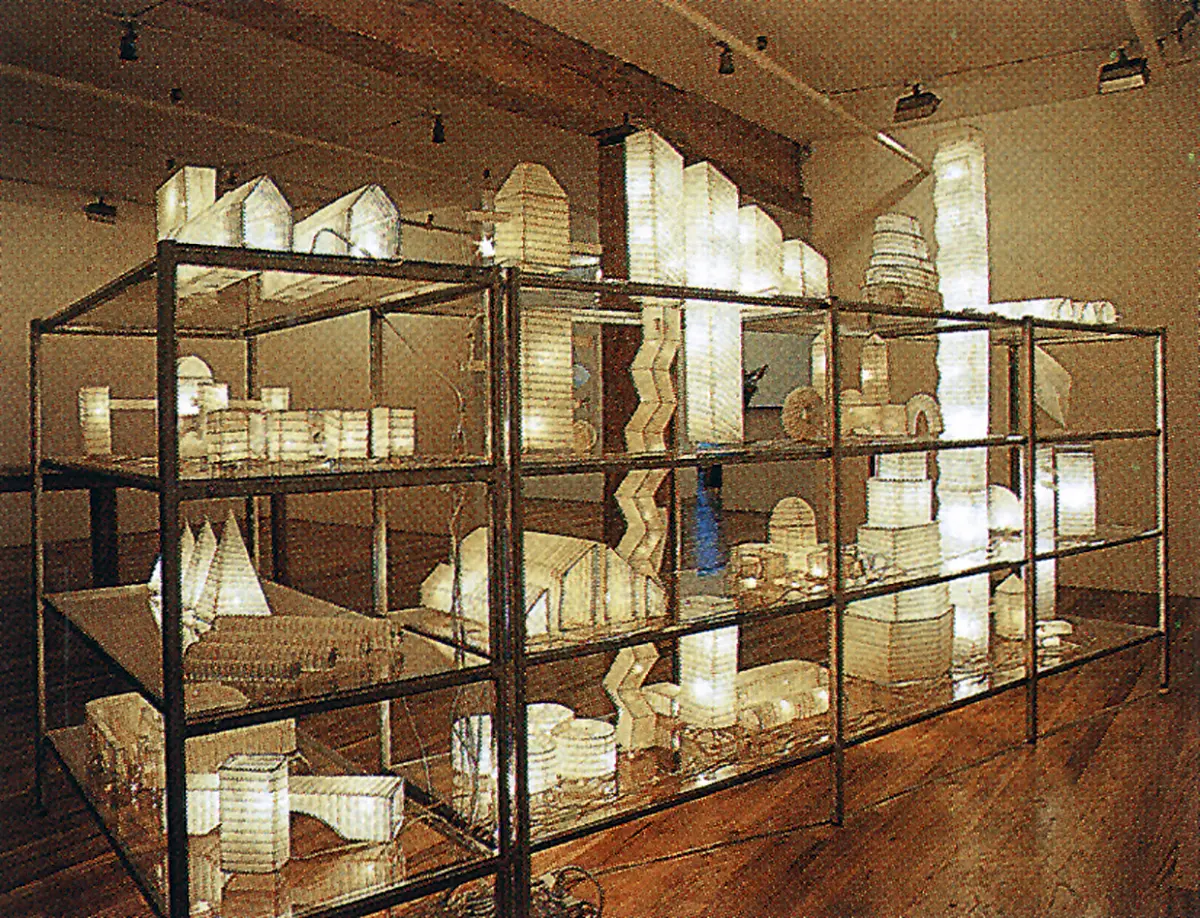
Garaicoa shows two installations. The first, originally made for the Yokohama Triennial, represents aerial views of this city [Yokohama], New York, and Havana projected on a DVD player. The second installation consists of shelves with images of paper lamps representing an urban landscape. Other works include a series of photos of Havana buildings with added images and a group of drawings made with threads suspended by needles directly onto the paper, representing architectural landscapes with dramatic perspectives in the Renaissance style.
After the September 11th events in Manhattan, it's inevitable not to interpret Garaicoa's work —particularly his photos of streets in Havana — as a reflection on the 'poetryfication' of city ruins as monumental wounds promoting collective nostalgia. As in Havana, where there is a romantic fascination and a maniac effort to idealize its crumbling houses and aged streets, in New York today the World Trade Center ruins are a site for tourist peregrination. In both cases, the landscape resulting from a certain social situation no longer promotes the reflection on the negative aspects that led to that degree of deterioration; instead, it becomes an instrument of commercial promotion. In other words, as these images remind us, even the images of greatest deterioration can be idealized.
It is possible, through this interest in portraying the idealistic escapism, that Garaicoa presents his installation Puedes construir tu ciudad bajo tu propio riesgo (You Can Build Your Own City at Your Own Risk). The installation, which resembles the showcase of a Japanese lamp store, is an imaginary scenario worthy of Italo Calvino's Invisible Cities. Being both sophisticated and attractive objects, they are also metaphors of society and its containers.
Architecture and utopia have gone hand in hand since the times of St. Augustine and Thomas More. Buildings are the ideal framework where the perfect society can exist. Unfortunately, this alliance has also given place to the marriage of art and dogmatism. In this installation, Garaico's reference to architecture is something more than an imaginary divertimento of God City. By juxtaposing ruins and utopia in the broadest sense of his work (as his retrospective show at the Bronx was called), he alludes to the two painful sides of Cuba's reality coin: On the one side, the argument of the steps taken to achieve a better world; and on the other, the powerful reality of shortage and deterioration.
It is in this sophisticated orchestration of works, and in his simple, refined architectural drawings, that Garaicoa opens a new chapter of his criticism of urban utopias.
PABLO HELGUERA