
The Chelpa Ferro group's strategy is to use the multidisciplinary backgrounds of its four members to do installations, objects, videos, performances, engravings, records, and shows. Integrated by two visual artists from the 1980's generation, Jorge Barrão and Luiz Zerbini, a videomaker (Sérgio Mekler), and a musical producer (Chico Neves), the group has existed for eight years now. Chelpa (a popular term for money) and Ferro, the name, make reference to a dull coin made out of heavy metal, inexpensive, creating a delicate irony on the value of a work of art and the marketplace.
The coherence of the group of works shown in this exhibit reveals Chelpa Ferro's interest in the possibilities of sound in the territory of images. In this sense, the works link contemporary music with, for example, "The Art of Noise" manifesto (1913), by the Italian Luigi Russolo. But they are also about the research on the physical aspect of the music by authors such as Stockhausen, Cage, Schaeffer, and, more recently, Aphex Twin. Their constructions like to pass themselves as polyphonic constructions, like in Sistema #1 (System #1), which has 7 fish tanks, 5 speakers, water, shells, and an mp3 player. But they also have humble structures, such as VU (2001), an analog tape recorder that's playing with no sound. We can see the treble and bass needles moving back and forth, but we only hear the hiss of the running tape. The group's repertoire goes from the digital to the analog.
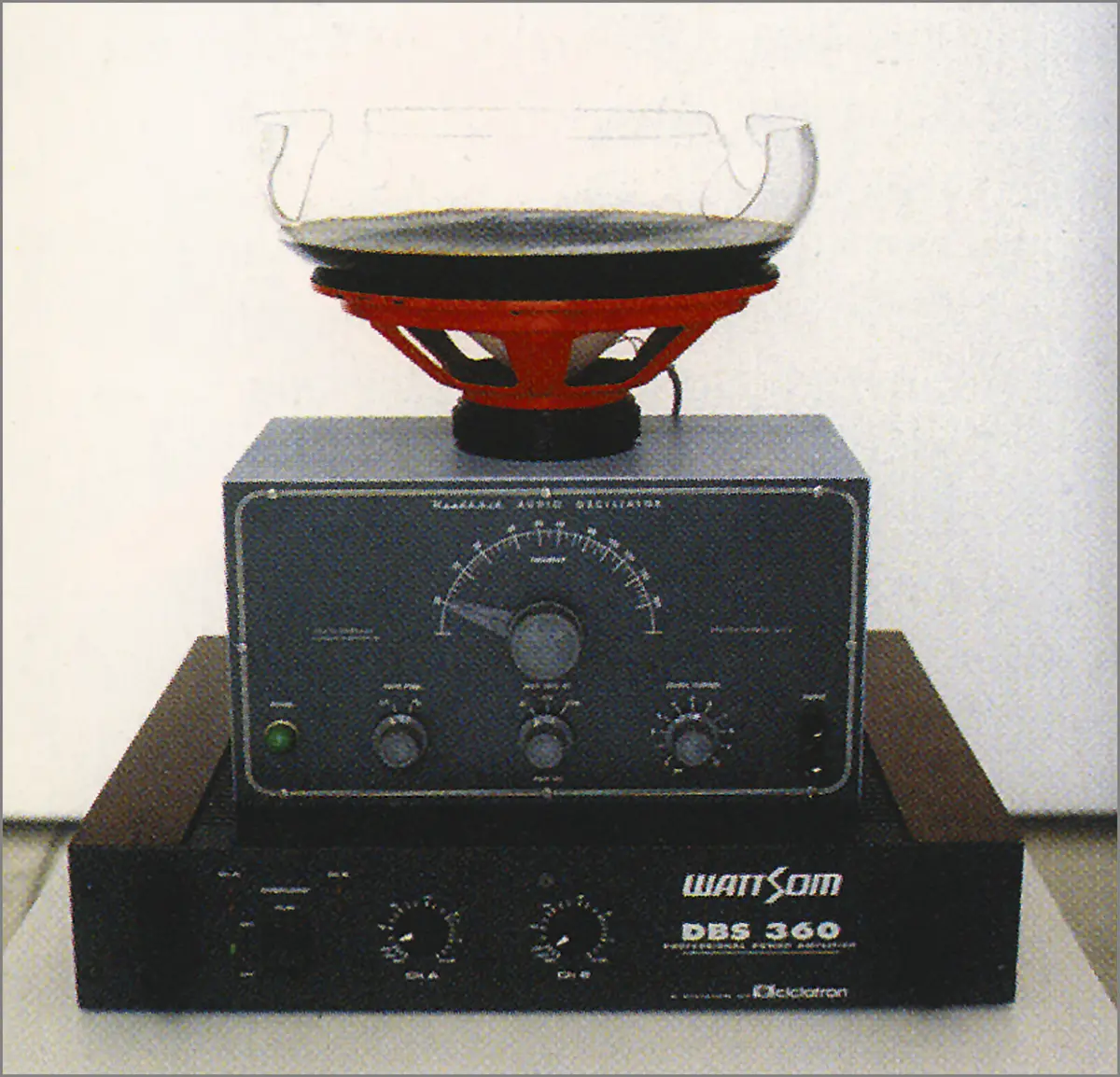
The theoretical universe with which Chelpa Ferro dialogues doesn't hide the informal and juvenile style proper of rock groups. The fact that none of them has an academic background in music should be taken as a relevant piece of information. In this regard, some works possess strong, playful, and comic content, like Copo d'Agua (Glass of Water, 2001), which consists of a glass of water atop a loudspeaker connected to an amplified frequency oscillator. The water surface shows different designs according to the sound wavelength chosen by the spectator (high or low). Chuva (Rain, 2001) is a tree branch with dry pods. The branch is connected to a motor that makes the pods vibrate slightly, creating a sound similar to that of rain, referring us to the indigenous musical instruments used especially for the evocation of nature. Moving from "no-fi" to "hi-fi," two wall installations, Paisagem Sem Montanha e Paisagem Sem Mar (Landscape Without Mountains and Landscape Without Sea, 2001), show in 15-inch monitors the group's software graphics being projected by DVD players. As suggested by the title, they are animated abstract and figurative paintings. We think of the transfer from the technological machine to the gallery, where it resurfaces as an object of consumer society.
The transferal and perversion of the image related to the sound come in even stronger in Manual abstrato (Abstract Manual, 2001), a series of five silk screens. The screens appropriate images from electrical and electronic appliances' instruction manuals. Maintaining the manuals' monotonous graphic patterns, the juxtaposition of several parts is taken away from their original function. What's at stake in this ironic operation with technology is the spectacularization of technical mechanisms and operations that here have been transformed into images filled with irony and seduction.
Within its artistic complexity, Chelpa Ferro's objects and installations use effects and shapes drawn from sound and audio imaginary to try to represent a new material and social world connected by networks operating on different technological realities and repertoires, who communicate electrically and electronically by means of cables, antennas, loudspeakers, and screens. Thus formal and conceptual elements are created from the following operations: ligation, conjunction, union, linkage, interaction, cooperation, integration, radiation, irradiation, overlapping, superposition, junction, branch, diffusion, connection, relation, concentration, dispersion, interlocution, transmission, and vibration. A world that can be understood like the corpus "where our nervous system can be found" (Cage), or like the automaton in whose machinery man's movements are repeated. There is also a reference to the gatos and gambiarras,1 Informal and illegal ways to connect and distribute electricity, lighting, and phone lines, frequently used in the outskirts of large Brazilian cities. The object consists of a post full of outlets and connecting points: a strong artistic image, rich in interpretations.
The appropriation of the structure and appearance of one of these chaotic and uncontrollable connections (gambiarras) also reveals the contradictions and inconsistencies of the emerging economies' technological development and access to it.
NOTE
1. From the original Portuguese. Translating the terms would make them lose their meaning, although they both can be understood as a form of piracy—two techniques to illegally connect to and draw energy from the main electrical lines.
RODRIGO MOURA