
Curated by Paulo Herkenhoff, Geografía do Brasil (Geography of Brazil) brings together around 40 works by Cildo Meireles that zero in on the notion of territory, both in its abstract and physical senses and the way it establishes relationships with the country's different regions.
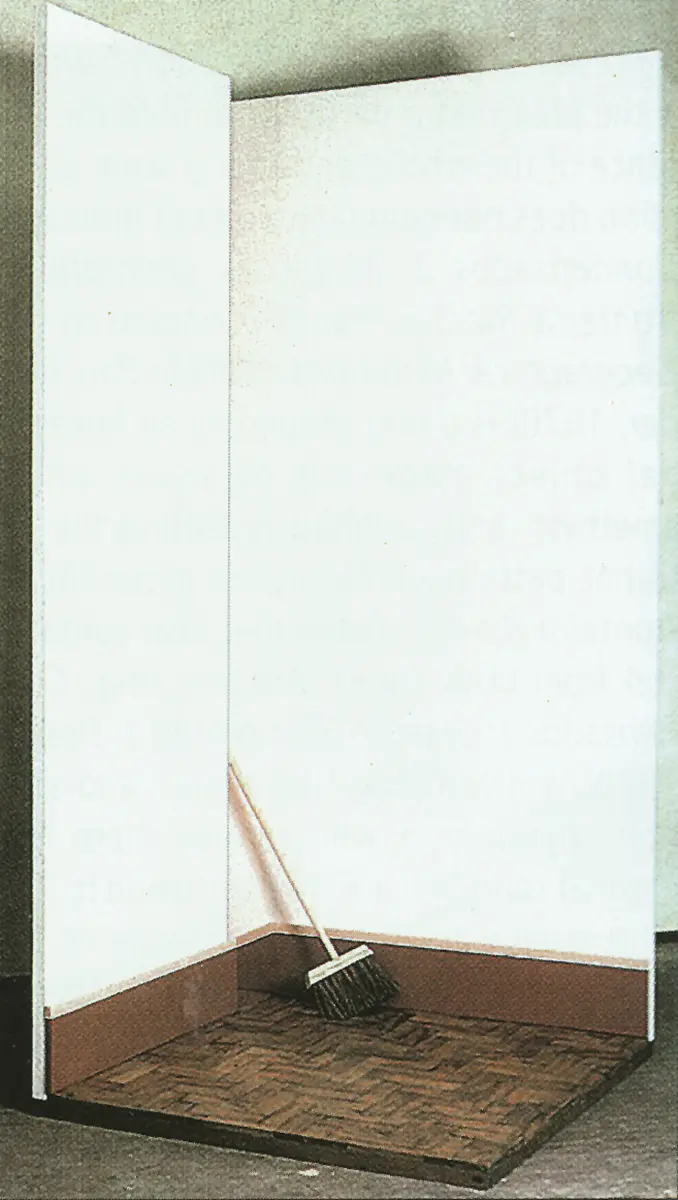
In one of the exhibit halls, the notions of geography and geometry are confronted by drawings, projects, and maps done on grid paper. For example, Arte física: caixas de Brasília/clareira (Physical Art: Brasilia Boxes/Clear) (1969) is related to an intervention where the artist determined an area on the shores of Paranoá Lake, in the country's capital, by burning materials he found on site. The piece is made of two wooden boxes containing local soil and the ashes resulting from the burning. On the wall, there's photo documentation of the intervention, alongside a map of Brasilia indicating where a third box "identical to the ones displayed" is buried. The boxes function as points delimiting the area that the spectator must construct mentally. The work's field of existence varies according to the place where the exhibit is being held, symbolically articulating archeology, museology, and rites. In the same hall, we find Espaços virtuais: cantos (Virtual Spaces: Corners) (1967-1968), an object reproducing, in real scale, a corner with floor, baseboard, and wall. Beside it are the projects for the Espaços virtuais: cantos (1967-1968) series, which are geometrical reproductions on paper with edges. The relationship between the virtual and the material, the physical and the represented, appears both in the lines crossing the territories and the straight crevices forming volumes and planes. Here, the boundaries and superpositions between geography and geometry, between straight lines and trajectories, and between drawing and cartography, are challenged. Here we also find Mutações geográficas: fronteira Rio-São Paulo (Geographic Mutations: Rio-São Paulo Border) (1969), associated with the intervention performed on the border between those two states. The artist dug a well on each side of the line and exchanged the soil. He saved some of the soil inside a suitcase whose interior, according to the catalog, "reproduces the frontier's topography." Once more the artist works with the problematics of the notion of "frontier" in real space, which is symbolized by the use of materials from the place of origin.
Present in many of this exhibit's works is the idea that a particle can hold the essence of the whole and that a scale alteration does not generate a loss of intensity. Condensados 2- Mutações geográficas: fronteira Rio/São Paulo (Condensed 2 - Geographical Mutations: Rio/São Paul Border, 1970) is a ring-shaped by a hexagonal object made out of silver, onyx, amethyst, and sapphire repeating the internal pattern of Mutações geográficas: fronteira Rio-São Paulo that also contains soil from both states. Another ring, Condensados 1: desierto (Condensed 1: Desert, 1970) is given shape by a gold-and-sapphire pyramid in whose apex there is a grain of sand. The artist's conclusion is: "He who is able to upset the essence of the smallest particle, will be able to upset the whole universe." Condensados 3: Bombanel (Condensed 3: Ring Bomb, 1970/1996) is a cylindrical ring made of gold, lens, glass, and gunpowder. The piece's potentially destructive force exists inherently in the title: It's just a matter of a ray of sunlight entering through the lens to ignite the gunpowder. It's not casual that Cruzeiro do Sul (Southern Cross) has been drawn on the same grid paper as the Condensados series, in 1970. Cruzeiro do Sul consists of a 9-mm3 cube made out of pine and oak; these are the woods that Tupis tribe members rub together to make fire. The piece stands alone in a darkened hall, with a beam of light directly over it. The vast, dark space alludes to infinite space, and the tiny piece of wood hides energy's potential, the possibility of fire. In Paulista 97 (1997), Meireles inserted gold screws along São Paulo's most important avenue, alluding to the small, valuable objects that are lost in the vastness of the rich Brazilian metropolis. Some of the bricks in which the screws were inserted were later extracted from the avenue and included in the show, pointing once more toward the shifting from the space outside to the exhibit space, and toward the archeological and precious character of a piece that's contemporary and is currently shown in the museum.
The circulation of objects defining invisible territories in the operation of society is the theme of a series of an object that is circulating on different systems: Coca-Cola bottles (Inserções em circuitos ideológicos: projeto Coca-Cola) (Insertions in Ideological Circuits: The Coca-Cola Project, 1970), currency bills (Inserções em circuitos ideológicos: projeto cédula [Insertions in Ideological Circuits: TheBill Project], 1970; Zero cruzeiro, 1974-1978; Zero Dollar, 1978/1984; Árvore do dinheiro [Tree of Money], 1969), coins (Zero Centavo [Zero Cent] 1974/1978; Zero cents, 1984), and bones and wafers (Missão/missões (como construir catedrai) [Mission/Missions (How to Build Cathedrals)], 1987). In another section of the exhibit, we find some works whose relationship with geography is less evident. Some of these are related to language ("Semantic Objects" such as Dados [Dice] 1970-1996, Porta-bandeira [Door Flag], 1981, and Pecevejo/cerveja/serpente [Bedbug/Beer/Serpent], 1980); and some others raise political issues, such as the photographic register of the Tiradentes-Totem-monumento ao preso político (Tiradentes-Tótem-Monument to the Political Prisoner) (1970) intervention.
Geografía do Brasil concisely and originally presents the complexity of a good part of Cildo Meireles' works, without encasing the production of one of Brazil's most important contemporary artists into the classic retrospective show. The exhibits widen the number of possible readings, allowing a deeper understanding by presenting other angles of the artist's works. The show's itinerary can also be taken as a statement: Recife, Salvador, and Brasilia —cities outside the traditional axis of Brazil's great exhibits. Those who live in São Paulo will have to travel to see this enriching work by Cildo Meireles.
ANA PAULA COHEN