
This article will explore a small but important body of work within the artistic production of David Alfaro Siqueiros. These works represent the image of Christ and most of them were executed in the early 1960s. David Alfaro Siqueiros (1896-1974) was the youngest of Mexico's Tres Grandes. He was an easel and mural painter, graphic artist, theoretician, and polemicist, as well as a lifelong committed communist, who paid dearly for his political convictions by being incarcerated several times throughout his life. Ironically, unlike Rivera or Orozco, whose politics were less orthodox and more libertarian, Siqueiros was not anti-clerical or staunchly anti-Catholic1. As a matter of fact, after the death of his mother, his paternal grandmother, a devout woman, raised Siqueiros in the Catholic religion. Siqueiros' father, Cipriano Alfaro Palomino, was himself a practicing Catholic, something rare for men in the Mexico of his day. Don Cipriano was a lawyer by profession and a Francophile who read late 19th and early 20th-century French Catholic literature.2
This indicates that Siqueiros was raised in the traditional Roman Catholicism of his time. In 1911 Siqueiros started attending the Academia de Bellas Artes San Carlos, and there he was exposed not only to the basics of the education of an artist but also to atheism, anarchism, socialism, and other free-thinking ideas. Shortly thereafter he left home and broke up with his father. Due to the San Carlos student strike in July of 1911, the school closed its doors. Siqueiros continued his art education at the Escuela al aire libre Santa Anita under the directorship of Alfredo Ramos Martinez, and in 1914 at the age of 18, he joined the Constitutionalist Army under General Dieguez. The Mexican Revolution had been in full swing since 1910 and Siqueiros was a willing participant as a Constitutionalist soldier, fighting during the conflict's last five years and achieving the rank of Second Captain. In 1919 Siqueiros married for the first time and traveled to Europe as a military attache. By the time he returned to Mexico in September of 1922, he had encountered Modern Art in Europe, befriended Diego Rivera in Paris, and published his first article "Tres llamamientos de orientation actual a los pintores y escultores de la nueva generation de America" (Three calls of current orientation for painters and sculptors of the new generation of America). That very year Siqueiros started his murals at the colegio chico at the Escuela National Preparatoria San Ildefonso. Although these murals were left unfinished, there is a section titled Los mitos (encaustic, 1922-1923), where Siqueiros painted an Indian Christ floating above a hammer and sickle, and next to the burial of a worker. From the beginning we see that Siqueiros identifies the figure of Christ not with the traditional bourgeois religion in which he was raised; but rather with the marginal and exploited elements in Mexican society: the Indians, and the workers. In 1923 Siqueiros joined the Mexican Communist Party (he would be expelled in 1930 and not allowed to rejoin until 1946), and founded with Rivera, Orozco, and others the Sindicato de obreros, técnicos, pintores y escultores (the artist's labor union). Siqueiros would be the principal author of the union's manifesto and of the editorial direction of the union's newspaper, El Machete.
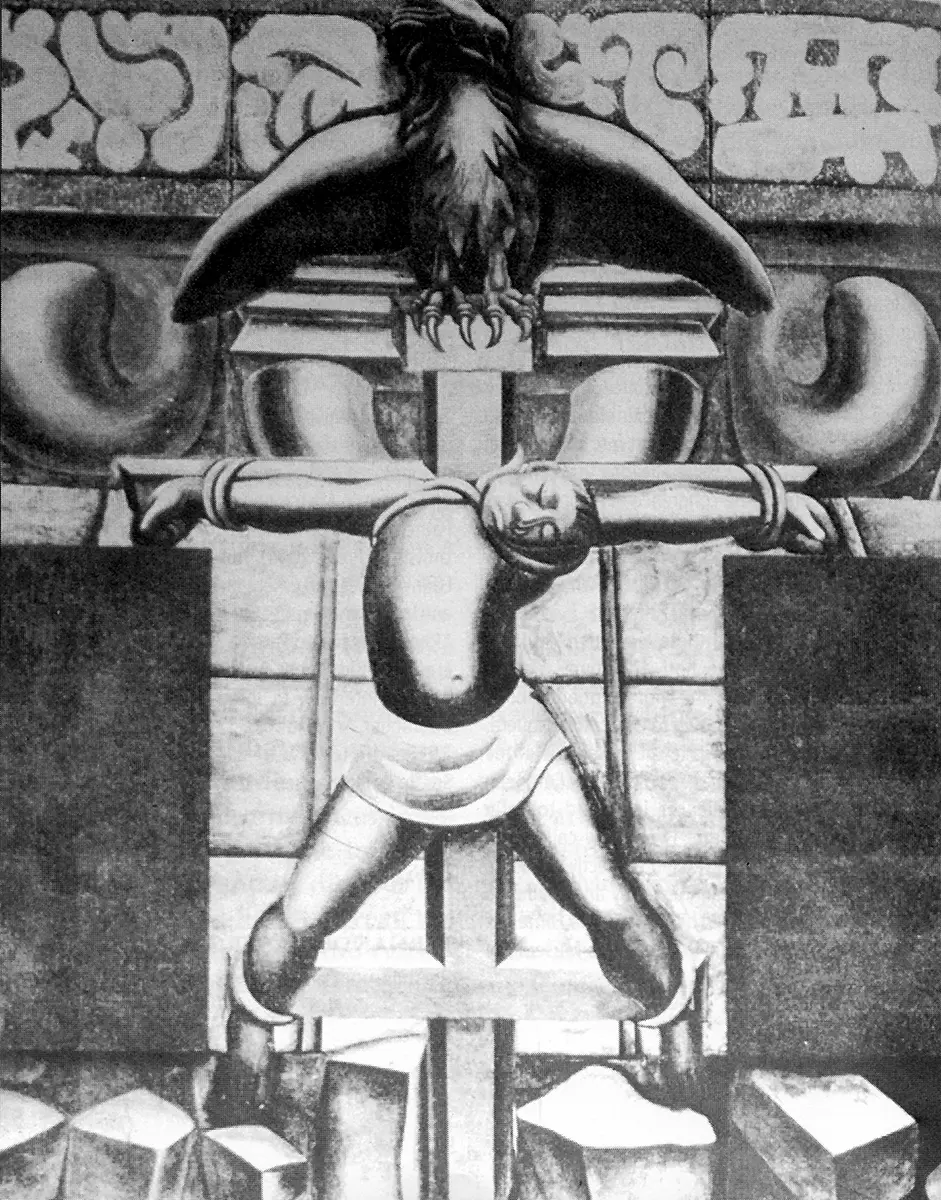
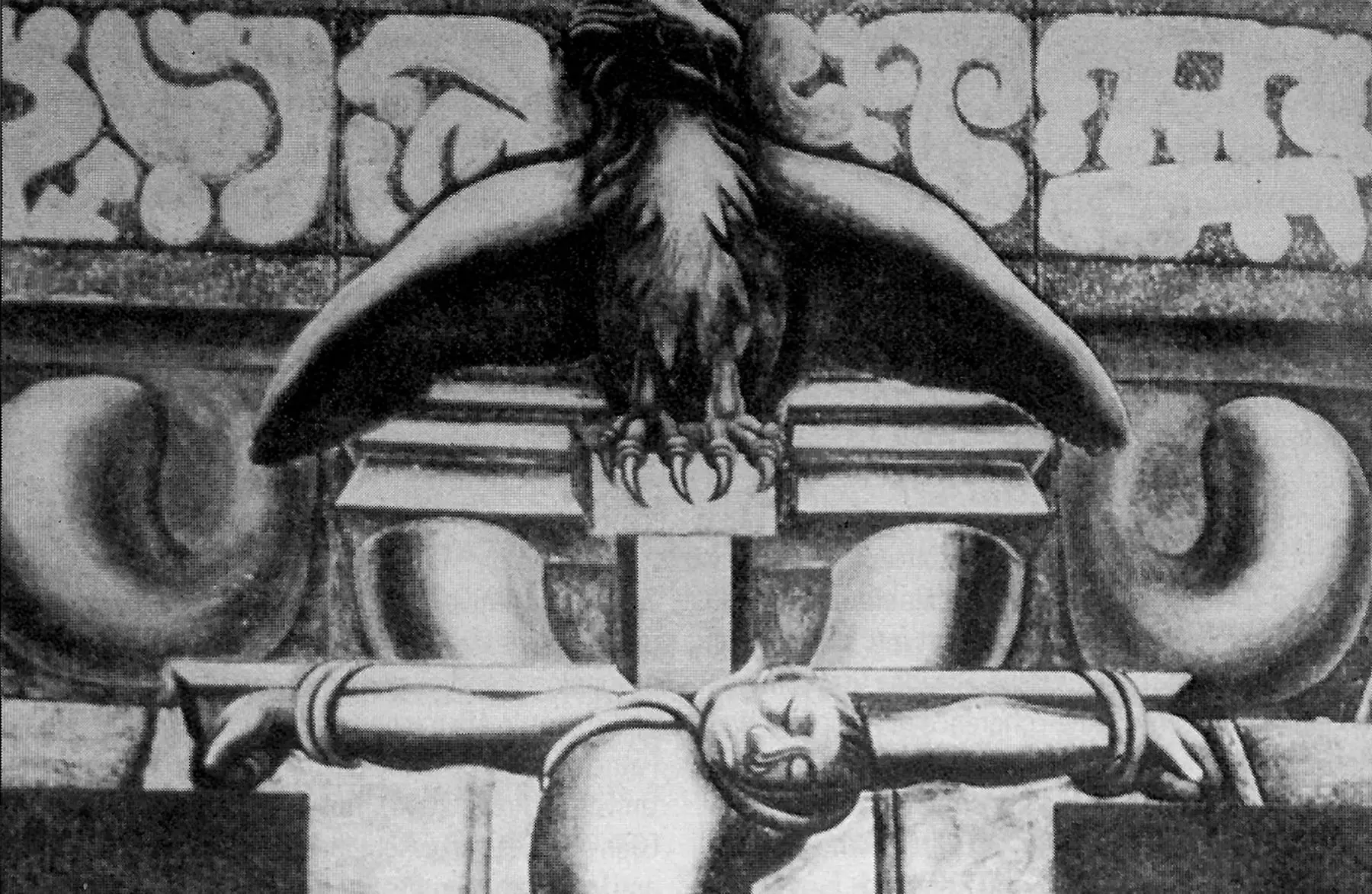
The 1930s would be a very active decade for Siqueiros, perhaps his most experimental and significant decade as an artist. In 1931 he was under house arrest in Taxco, where he produced an extraordinary body of work in printmaking and easel painting. The following year, Siqueiros visited Los Angeles, and there he painted Mitin obrero (Chouinard School of Art, destroyed), América tropical (Plaza Art Center, partially destroyed), and Retrato actual de México (private residence of film director Dudley Murphy, sold at auction a number of years ago). All of these murals employed experimental fresco techniques, such as blowtorch, airbrush, etc. The Mural Block Painters, a team put together by Siqueiros to work in a collaborative manner, helped to execute them. Of this group of murals, the one that concerns us here is América Tropical. The central motif of this mural is a crucified figure. Siqueiros returned for a second time to a Christie theme, this time as a thoroughly secularized version of the crucifixion. In this work, he transformed the Christ figure into an Indian. He stated that instead of painting "a continent of happy men, surrounded by palms and parrots where the fruit voluntarily detached itself to fall into the mouths of the happy mortals, I painted a man ... crucified on a double cross, which had, proudly perched on top, the eagle of North American coins. "3 This Christ is an Indian peasant, perhaps even a migrant worker. Siqueiros painted the figure tied, not nailed to the cross. Seven clean and volumetric forms make up the body: two arms, a head, a torso, a loincloth, and two legs. With a great economy of formal means, Siqueiros painted an emotionally charged figure, that speaks of exploitation, suffering, and grief. Above it a rapacious bird, the eagle (symbol of the U.S.A.) watches over its prey. After this mural, the use of a Christie image would disappear from Siqueiros' art until the 1960s.
Throughout the rest of the 1930s, Siqueiros would be very active: he traveled, lectured, and painted in South America, opened the Experimental Workshop and Laboratory of Modern Techniques in Art in New York City, married Angelica Arenal, and fought in the Spanish Civil War, etc.
In 1939-1940, Siqueiros executed the mural that most scholars consider his masterpiece, Retrato de la burguesía, in the Mexican Electrician's Union building. This work synthesized all of the formal and technical experimentation that Siqueiros was involved with during the 1930s. The following year, 1940, Siqueiros participated in an assassination attempt against Leon Trotsky, after which he departed for Chile (under the auspices of his friend Pablo Neruda), where he painted a mural in Chilian. All throughout 1943 Siqueiros traveled and lectured in Peru, Ecuador, Colombia, Panama, and Cuba.
In Cuba, he painted two murals and several easel works. In 1944 Siqueiros returned to Mexico, where with the exception of brief trips to Europe, India, and the Soviet Union, he would remain for the rest of his life.
Between the late 1940s and early 1950s, Siqueiros's pictorial production entered what we might term a mannered and repetitive phase which, with few exceptions, continues until the artist's death. His forms lose their previous sculptural structure; the colors become acidic, even flat. The convulsive, dramatic quality of his best "critical" realism gives way to a false monumentality and simplistic heroism. The culmination of this pictorial decadence is his last mural cycle at the Polyforum, critically analyzed by the late critic Luis Cardoza y Aragon as a work of hollow rhetoric and big, never monumental, sloppy forms.4 Yet occasionally Siqueiros could still produce a powerful, if very uneven body of work in the easel medium. Such is the case with the series of Christ images he painted while incarcerated from the 9th of August, 1960 through the 13th of July, 1964. Siqueiros was arrested in 1960 and accused of "social dissolution." He was sentenced two years later to eight years in prison.5 At this time the Second Vatican Council was taking place in Rome. Convened by Pope John XXIII in October of 1962 and continued by his successor Pope Paul VI through December 1965, the Second Vatican Council's purpose was to preserve and energize the inherited faith of the past but also to adapt the Church to the present-day needs of humanity, believers, and unbelievers alike. According to Pope John XXIII, the church was opening its windows for the light and fresh air of the 20th century to come in. Journalists and clerics alike called this the aggiornamiento. One of the important components of the Second Vatican Council was the call to dialogue with non-Catholics, non-Christians, and nonbelievers alike, to search for common ground and work for the common good. Integral to this, in both Europe and Latin America, was the dialogue with Marxists. During this period of incarceration, Siqueiros followed the news on the international scene with curiosity, in particular the goings-on of the Second Vatican Council, the new openness of the church, and its call for social justice for the poorest and marginal elements in society.6 While in prison Siqueiros befriended two practicing Roman Catholics; the Archbishop of Cuernavaca, Sergio Méndez Arceo, and the journalist Julio Scherer García. Siqueiros had a home and workshop in Cuernavaca and Méndez Arceo was a strong advocate of the reforms of the Second Vatican Council not just in his native Mexico but also throughout Latin America. He was particularly committed to the issue of social justice and the dialogue with Marxists. So, between him and Siqueiros there existed a common geography and concerns for social justice.
Julio Scherer García was at this time an important journalist at the leading daily Excelsior. Scherer García would become the paper's editor until July 8, 1976, when he walked out in protest at the government basically taking over the paper.7 In time Scherer García and his colleagues would begin up the weekly magazine Proceso, which to this day continues to be the most significant independent weekly within Mexican journalism. Both Méndez Arceo and Scherer García visited Siqueiros at the penitentiary on a regular basis. The end product of Scherer García's visits was the book of conversations with Siqueiros, La piel y la entrafia (Mexico, D.F.: Ediciones ERA, S.A., 1965). It is very possible that both Méndez Arceo and Scherer García conversed with Siqueiros not only about his incarceration, and the political situation of Mexico, but also about their own positions as left-wing, or progressive Roman Catholics.8 At this time Siqueiros was given either a photograph or an actual statue of a Neo-Colonial Man of Sorrows. Who gave this sculpture to Siqueiros? It is possible that Méndez Arceo gave this sculpture to the artist.9 Ultimately what is important here is that this photograph or sculpture (whose location is not known) was the source of inspiration for Siqueiros' own images of Christ.
Between August and September 1963, Siqueiros painted four easel paintings with Christ as the subject. The first, Cristo del pueblo, followed by Viacrucis de Cristo, El redentor vencido, and Cristo Negro. All four works are acrylic on wood and measure approximately 80 x 61 centimeters.
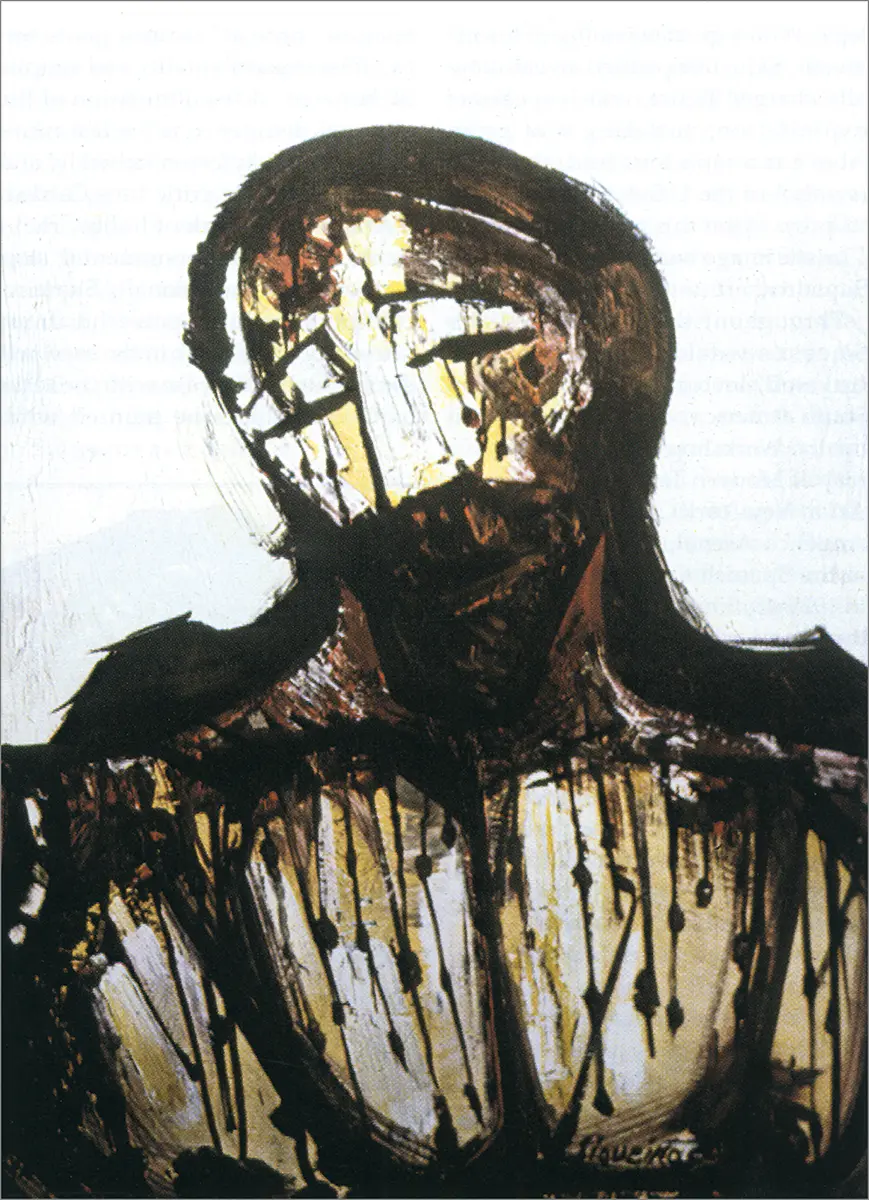
Cristo del pueblo consists of a bust-length depiction of the figure. The background is a stark white, which presses the figure to the foreground. The skin color of this Christ is a combination of white, yellow, and yellow ochre. The head, face, neck, shoulders, pectorals, and arms are forcefully drawn with a mixture of black, brown, and red. Throughout these forms are drips and splatters of alizarin crimson: the blood of the crown of thorns and of the lashes. The expression on the face of Christ is one of dignified suffering, of stoic resistance. On the back of the panel, Siqueiros wrote: "Only he who believes in Christ should paint Christ, wrote Fra Angelico; this is why I have painted him, thinking —no doubt— in those terrible Mexican Christs of the people that I believed in as a child."10 The inscription recalls the impact that the physical suffering depicted through these popular Christs had on Siqueiros as a child.
This image is a part of popular Catholicism, not just in Mexico, but also in most of Latin America. The religion of the people is one of deep and raw emotion, in which the poor see their daily suffering reflected in a bleeding Christ. The title Siqueiros gives this work makes direct reference to this being an image of the people.
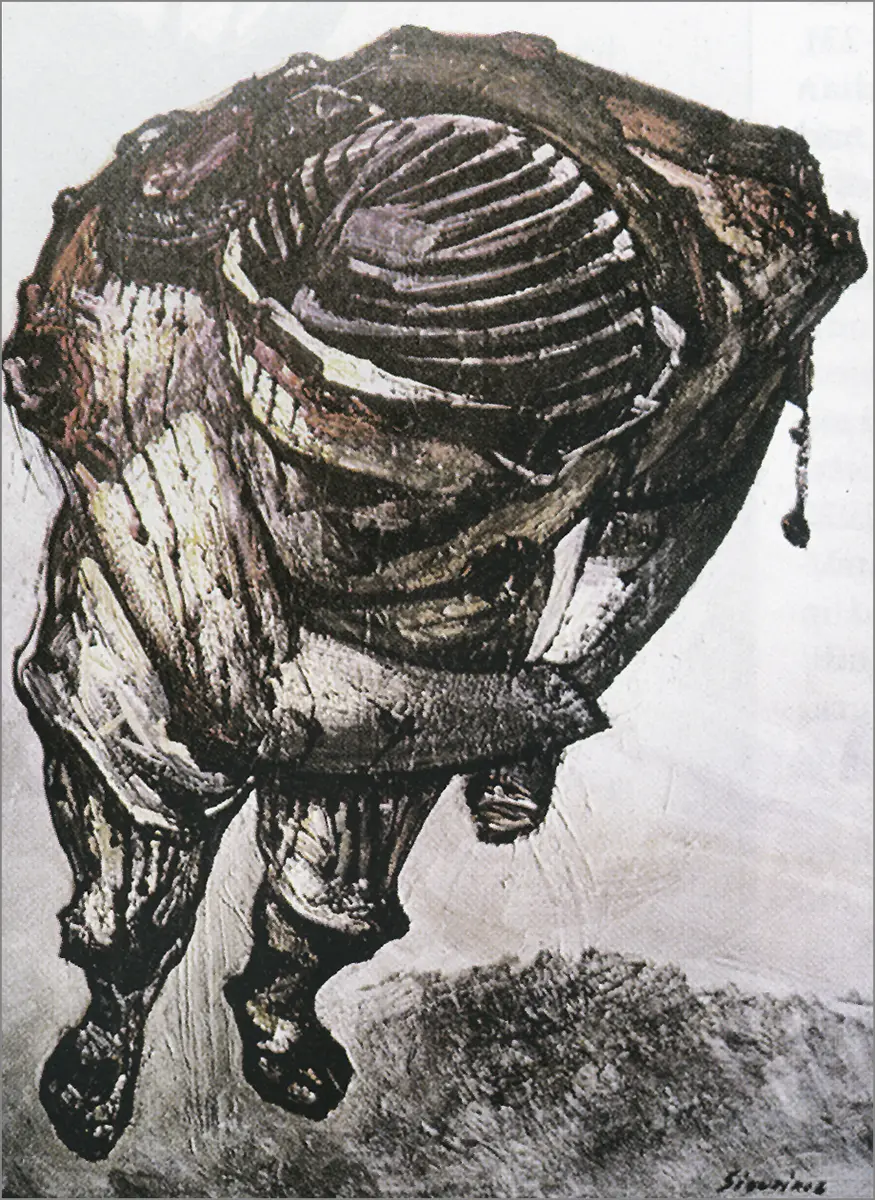
El redentor vencido depicts the figure from a bird's eye view starting at the top of the head and dramatically foreshortening the rest of the body down to the feet. The figure stands on a ground of dirty white mixed with pink and gray. The face is twisted, looking down and sideways, so we barely see an eyebrow, the nose, and the tip of the beard. The coloration of the body consists of a sickly pale yellow with touches of green. The hands are missing; they have been cut off and the stumps are bleeding. Black and purple lines outline most of the body, and as in the previous work, alizarin crimson drips and slashes all over the surface of the body, defining wounds in the shoulder, head, elbow, torso, knees, and feet. The dramatic foreshortening gives the body a powerful, monumental quality. Yet it is an image of defeat. On the back of this panel, Siqueiros also inscribed a message: "His doctrine of 'Peace on Earth' was buried under the blood and ashes of 2000 years of evermore devastating wars."11 For Siqueiros, those who in his name waged wars caused the defeat of this redeemer.
The inscription on the back of Viacrucis de Cristo, not illustrated here, also tells of the meaning of this group of works: "First his enemies crucified him (2000 years ago), later his friends mutilated him (starting in the Middle Ages), and today his new and true friends restore him under the political pressure of communism (post Ecumenical Council). I dedicate this small work to the last."12
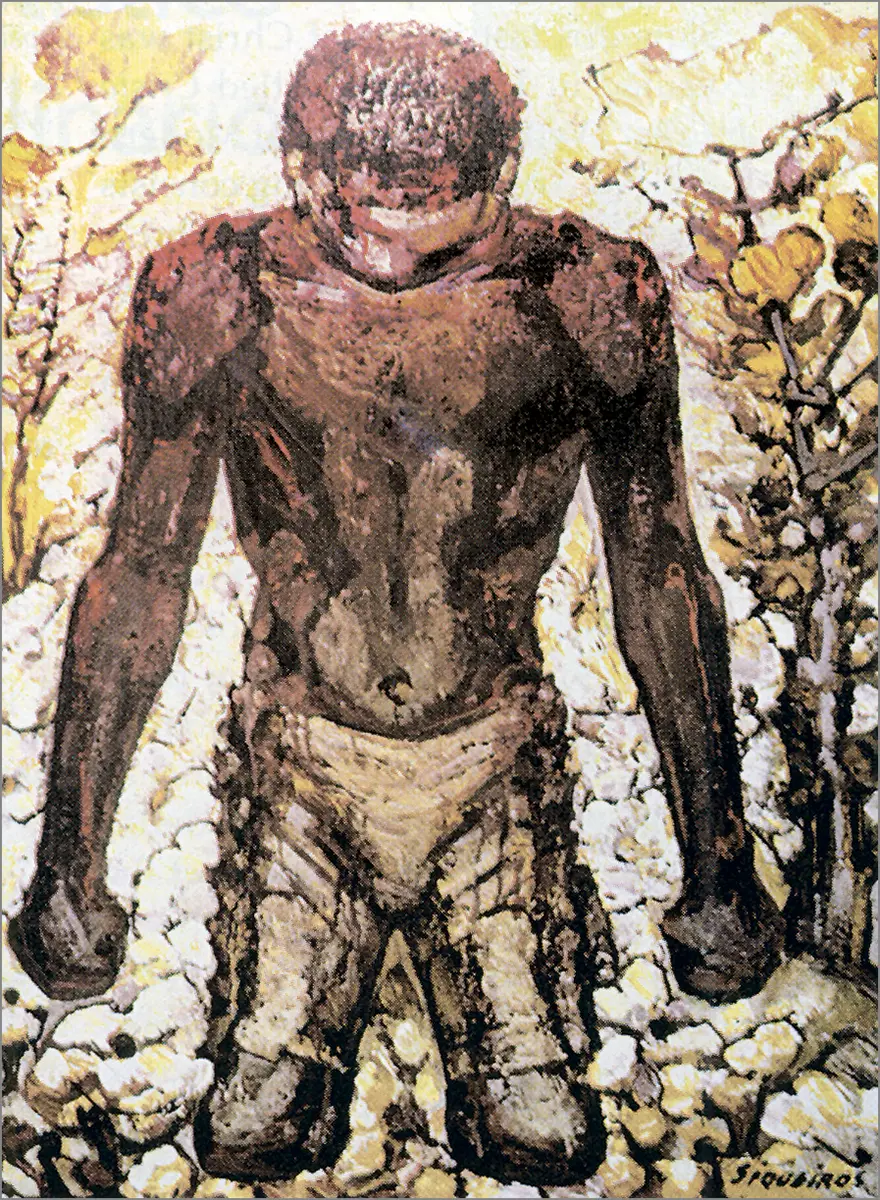
The last of these Christie images painted in 1963 is Cristo Negro. This painting depicts a black man, shirtless and on his knees, arms to the side with clenched fists, and head inclined towards the ground. Blood drips down his forehead, arms, torso, and legs. He is surrounded by an arid landscape of rocks and yellowish plants. The figure is most probably waiting to be lynched. Siqueiros had portrayed a lynched African American in his Retrato de la burguesía mural of 1940. The fact that this dark-skinned Christ is being painted in the early 1960s can also be a reflection of Siqueiros' knowledge of the civil rights struggles of African Americans in the United States, and also of the struggles of Africans for their independence from colonialism throughout the African continent. In light of these historical events, it is significant that Siqueiros adapts the figure of Christ to that historical moment: since African Americans and Africans were among the oppressed and struggling peoples in the 1960s, then Christ is one of them.
I propose that these paintings are Siqueiros's visual equivalent to a Christian-Marxist dialogue. They are in part the fruits of his discussions with both Mons. Méndez Arceo and Julio Scherer García. They are his meditations, and his responses to the events of the Second Vatican Council. As an orthodox communist, who was an ally of Stalinism, Siqueiros could have had two possible reasons or angles for the creation of this body of work. First, Stalinism defunct since the early 1950s, no longer offered Siqueiros an "orthodox" safety net of thought, and perhaps he felt attracted to the orthodoxy of Roman Catholicism. Second, he could have been authentically moved by the possibility of a Christian-Marxist dialogue, a dialogue that could dismantle the rigidity of both positions in favor of understanding and common ground.
In 1965, Siqueiros produced the lithograph Calvario. This print depicts very literally the mutilated figure of a Neo-Colonial Christ floating above a hill with three crosses. The figure with its torn flesh, chopped hands, and legs cut off under the knees is entirely covered in blood. The dark reds contrast with the pale gray sky and green hill of the rest of the composition. In the distance, the three crosses seem empty, as if martyrdom had been in vain, there is no resurrection, no supernatural act to redeem humanity. It is an image of emptiness, despair, and a kind of visual "dark night of the soul."
All of these Christ images painted by Siqueiros in the 1960s, recapture the sculptural sense of form that the artist so richly explored in his best easel work of the 1930s. These works possess a limited use of color and simple composition, where the substantial forms, depicted from dramatic perspectival angles, create an intense emotional impact.
Siqueiros's last image of Christ was executed in 1970 and titled Cristo de la paz (Vatican Museum of Modern Religious Art). The painting consists of the tied and bloody hands of Christ, dramatically projected into the foreground, followed by the foreshortened torso and head in profile, which take up the middle ground and background of the picture. Siqueiros applied the paint on this work as if he were sculpting a relief; the textures accentuating the volumes. Coloristically, the figure consists of a pale, grayish-white with touches of yellow. Behind the figure, there are touches of green and red, which both delineate and bring forth the shape of the body. This is a majestic, rebellious Christ, one who will only bring peace through justice. On the back of this panel, Siqueiros has once again written a commentary: "Christian: what have you done with Christ in more than two thousand years of his doctrine?"13 The inscription supports the rebellious image of the painting.
The images of Christ that Siqueiros produced in 1963,1965 and 1970 are earthly images of a suffering God. Through these works the artist meditated on the Christian-Marxist dialogue that was a result of the Second Vatican Council. He was also paying homage to a "God among us:" the bleeding Christ of the poor and the marginal of Latin America. This very Christ would reappear as a liberator in the Liberation Theology of the 1970s.
NOTES
1. Raquel Tibol in her prologue to Palabras de Siqueiros (Mexico, D. F.: Fondo de Cultura Economica, 1996) assures us that Siqueiros was never anti-clerical or anti-Catholic, even for a Communist Party member. In a lengthy conversation I had with Tibol in June of 1995, she repeated the same to me.
2. David Alfaro Siqueiros, Me llamaban el coronelazo, 3rd ed. (Mexico, D. F.: Editorial Grijalbo, S.A., 1977), pp. 11-32.
3. David Alfaro Siqueiros, La historia de una insidia (Mexico, D.F.: Ediciones de "Arte Publico," 1960),p.32. "un continente de hombres felices, rodeados de palmas y loros, donde las frutas caen voluntariamente en las bocas de los felicez mortales, yo pinté un hombre... crucificado en una cruz doble, la cual Neva orgullosamente posado encima el aguila de las monedas de Norte America." This and all other translations from the Spanish are by the author.
4. Luis Cardoza y Aragon, "Polyforum" in Antología (Mexico, D.F.: Lecturas Mexicanas, Secretaria de Educación Pública, 1987), pp. 113-136.
5. Edgardo López y Luis Alamillo, David Alfaro Siqueiros, Cronología mínima (Mexico, D.F.: Museo-Sala de Arte Publico Siqueiros, 1991), p. 22.
6. Raquel Tibol, Conversation with the author, 23 June 1995.
7. Excélsior had been consistently critical of the corruption and abuses of the Luis Echevarría administration under Scherer García's editorship. The government orchestrated a "coup" of sorts among the shareholders, and Schere García and his supporters walked out in protest. For further information see Vicente Leñero, Los periodistas (Mexico, D.F.: Joaquín Mortiz, 1978).
8. Tibol, 23 June 1995. Although I tried twice to communicate with Scherer García by mail, I have not been successful in contacting him. Monsignor Méndez Arceo, who was born in 1907, had already passed away when I started researching this article in 1995.
9. Ibid. Maria Balderrama, who worked briefly on the Siqueiros catalogue raisonné, also confirmed the existence of a photograph of a Neo-Colonial Man of Sorrows among the artist's papers.
10. Back of panel, Cristo del pueblo: "Que solo aquel que crea en Cristo pinte a Cristo, escribio Fra Angelico; por eso yo lo he pintado pensando —sin duda— en aquellos terribles Cristos mexicanos de pueblo en que creí cuando niño."
11. Back of panel, El redentor vencido: "Su doctrina de 'Paz en la Tierra' fue sepultada en la sangre y cenizas de 2000 anos de guerras cada vez mas desvastadoras."
12. Back of panel, Viacrucis de Cristo: "Primero sus enemigos lo crucificaron (hace 2000 años), despues sus amigos lo mutilaron (a partir de la Edad Media), y hoy sus nuevos y verdaderos amigos lo restauran bajo la presion politica del comunismo (post Concilio Ecuménico). Esta pequeña obra esta dedicada a los últimos."
13. Back of panel, Cristo de la paz. "¿Cristiano?¿qué has hecho de Cristo en mas de dos mil años de su doctrina?"
ALEJANDRO ANREUS
Art historian and Associate Professor of the History of Art at William Patterson University.