
The city of Le Mans' cultural center (L'ESPAL, 250 kilometers outside of Paris) presented Argentine artist Eduardo Hoffmann's first retrospective in France, with around 50 recent works (1998-2001), most of which had never been seen before. These works made evident Hoffmann's expressive exactitude—physical as well as mental—, confirm him as a painter for whom painting is an absolutely vital act. It is through this internal energy that we can decipher or untangle the threads of weaving rich chromatic textures and transparencies, as well as in suggestions of things that are not said out loud, but are inscribed in the background, in the memory of feelings and sensations. Entering the depths of Hoffmann's paintings, we encounter the (unconfessed) proposition of existential philosophy, one where nature and its raw representations materialize the concepts of an almost unimaginable pairing: pictorial poetry and formal philosophy.
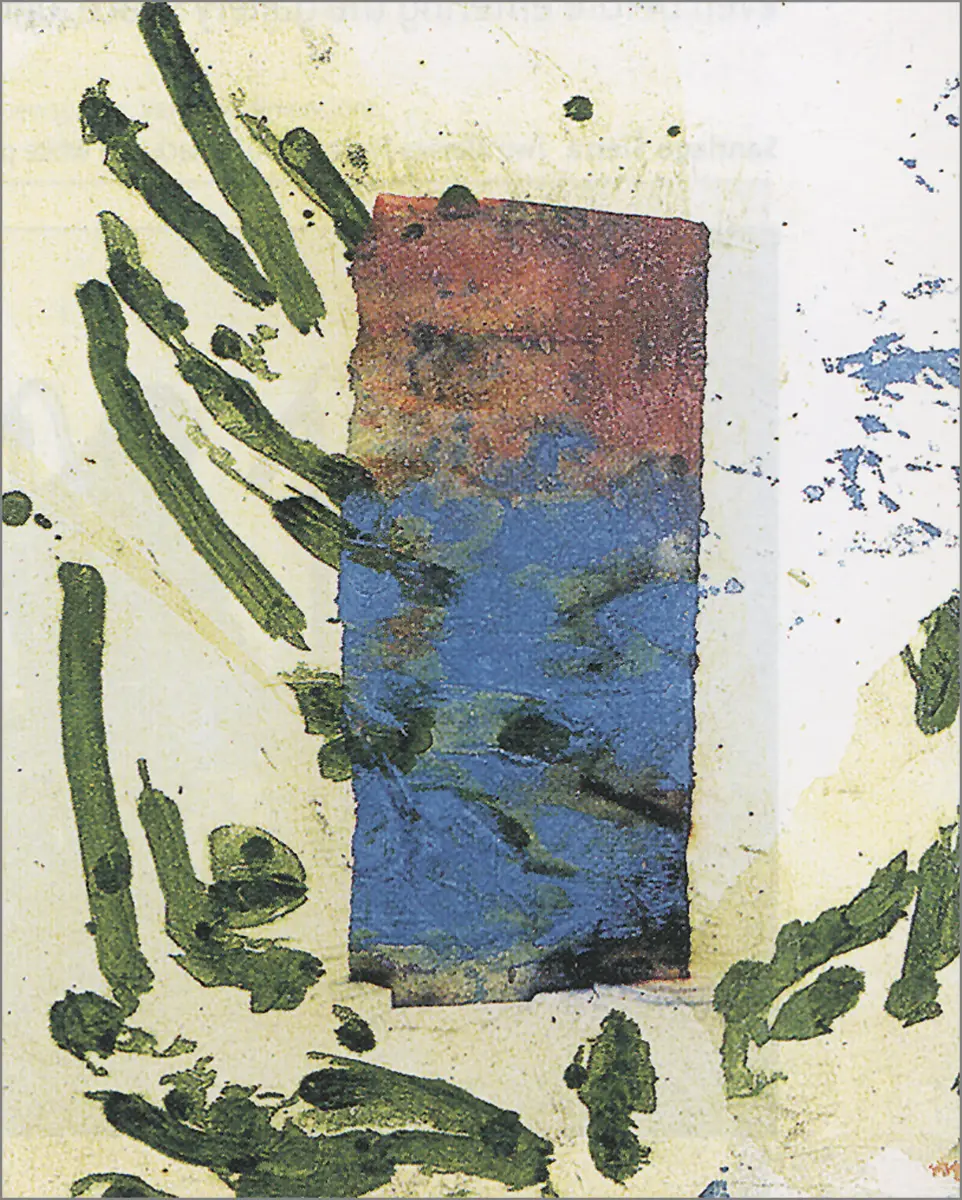
Hoffmann's retrospective followed exhibitions at L'ESPAL by Markus Lupertz, Jean-Michel Basquiat, Jacques Villeglé, and Valérie Favre. This multidisciplinary space (it houses theatre and music as well as the visual arts) devotes three or four shows a year to contemporary art, and it has accommodated well the spirit of Hoffmann's work—a spirit that expresses itself in an intense sensibility, with large scenic constructions designed to serve the works and articulate them in several "families." The show's large format allows us to enter an oeuvre built around the topic of time, its fragmentations, and its fleetingness, but also around the permanence of its own elements. Hoffmann's sensibility is physical and experimental when it comes to nature: earth, water, fire, or sky. His work regarding matter as trace, seal, or scratching, is not a nostalgic evocation but a way to allow our gaze to reach, in the silence of the evocation (or disappearance) of forms, for the space of an infinite wisdom.
Hoffmann is the first Latin American artist to show his works at L'ESPAL. The curators of his show have helped dispel a well-established cliché, since Hoffmann's work does not respond to preconceived ideas, common among French observers, of what contemporary Latin American art is; it doesn't refer to the local nor does it belong in the category of identity-art. On the contrary, this is an artist who speaks of his most profound individuality, his affinities, his hopes and dreams. And, as such, he speaks of the most universal I.
In his philosophy of the empty and the full, Hoffmann opens up a dimension that is more oriental than it is Latin, more sacred than ritualistic, in the sense that some of his works include forms of organic or anthropomorphic calligraphy while others evoke the force of the tidal waves in Japan's Hokusai. There are also works that practice the spatial games played by traditional Chinese artists for centuries. What does French historian Auguste Bercque say in his book The Reasons for Landscape?: "There is an essential difference between the two meanings of the word 'landscape.' In the first meaning, landscape at a natural scale, we face a first-degree reality, reality as it appears to our senses. But in the second meaning, landscapes are images, representations of absent things."
This definition applies to the sensorial and conceptual density in Eduardo Hoffmann's "landscapes" or cosmographies, where lines of force are reached through schematization and not through the banal profile of surrounding objects. We can thus understand his art as a weaving of relationships and correspondences established between the artist and the world he sees, the world of perception and dreams. In the spirit where stroke and form are united—because the world that surrounds us rhymes and resonates, and the representations of the landscape can multiply their own correspondences.
CHRISTINE FRÉROT