
Mexican artist, Flor Garduño's recent photographs concentrate on the female nude as a still life and portrait subject. The seventeen black and white prints exhibited compose part of a selection of photographs to be published this spring in a book titled, Donna. Similar to Garduño's famous photographs depicting indigenous peoples, her latest prints recall the evocative nudes of her teacher, the renowned Mexican photographer Manuel Álvarez Bravo. Los Limones 1999, for example, is reminiscent of Bravo's nude beside spiny cactuses, The Good Reputation Sleeping, 1938-1939, although Garduño's print emphasizes the lemons and their textured, luminescent rinds rather than the figure. Softly shadowed behind the fruit is the sensual form of a reclining woman's bare torso, the delicate tip of her nipple mimicking the protruding ends of the lemons before her. It is a still life borne of evocative contrasts, the figure's shadow-smeared flesh softly framing the voluptuous assemblage of fruit.
A classic example of Garduño's photography is Medusa (1998). A nude stands with her back to the camera, her hips swayed provocatively, her arms bent with hands upon her head, while cascading down her back in lieu of thick locks of hair are the long, shiny bodies of five, dead fish. The sea creatures' sightless eyes, pointed chins, and gaping mouths unnerve, suspended over her vulnerable bare shoulders and spine. The dramatic effect created by the woman's incongruous mane is amplified by the dark surroundings and dramatic lighting that casts her flesh in a glow.
Abrazo de Luz (2000) exemplifies the deliberateness of the Mexican photographer's project. A nude stands before a black wall clutching an enormous bouquet of pearly white calla lilies, the stalks pressed awkwardly between her breasts, her face barely visible behind the large blossoms. Garduño allows but a minute glimpse of the figure's pubis to appear between the stems, enhancing the provocative dialogue of curving, fleshy stems and nude torso. The exactness with which the artist sets up the composition, strategically placing the flowers against the figure, results in an effect, although initially seductive, that ultimately appears contrived.
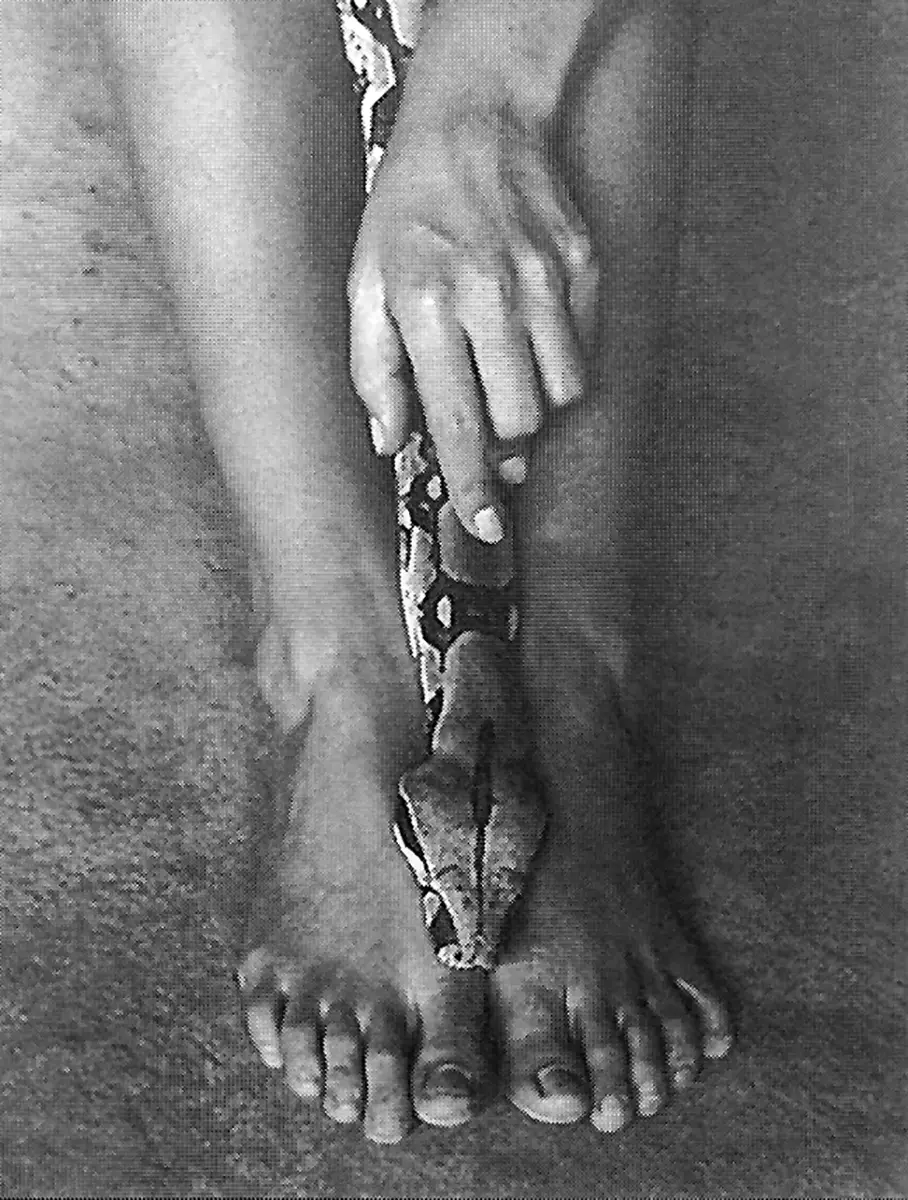
In the end, the seemingly calculated manner in which Garduño constructs her photographs weakens her project. In Boa Mexico, 1999, a person's bare calves and feet are portrayed with a beautiful, black and brown patterned boa constrictor hand-held where the two limbs touch. Although at first, one's eye is drawn to the dangerous snake, whose head rests menacingly atop the model's bare feet, and to the subtle differences in texture and tone between legs and background, the image fails to endure beyond one's initial attraction. Ultimately the photograph appears overly studied and static. The edgy, the uncanny, or the unexpected visual and thematic qualities that pervaded some of Garduño's earlier photographs are traits absent in this body of work. Instead, a disappointing predictability informs many of these photographs.
MARY SCHNEIDER ENRÍQUEZ