
When asked in 1997 if she had any interest in working on large-scale glass pieces, Isabel De Obaldía replied, "I like the type of work I am doing now because the pieces are more intimate. Maybe in the future, I'd like to work in a larger format."1 In the same interview, the artist said that she found the male form more interesting than the female. In her latest exhibition, Torsos, both of these statements appear to have been self-fulfilling.
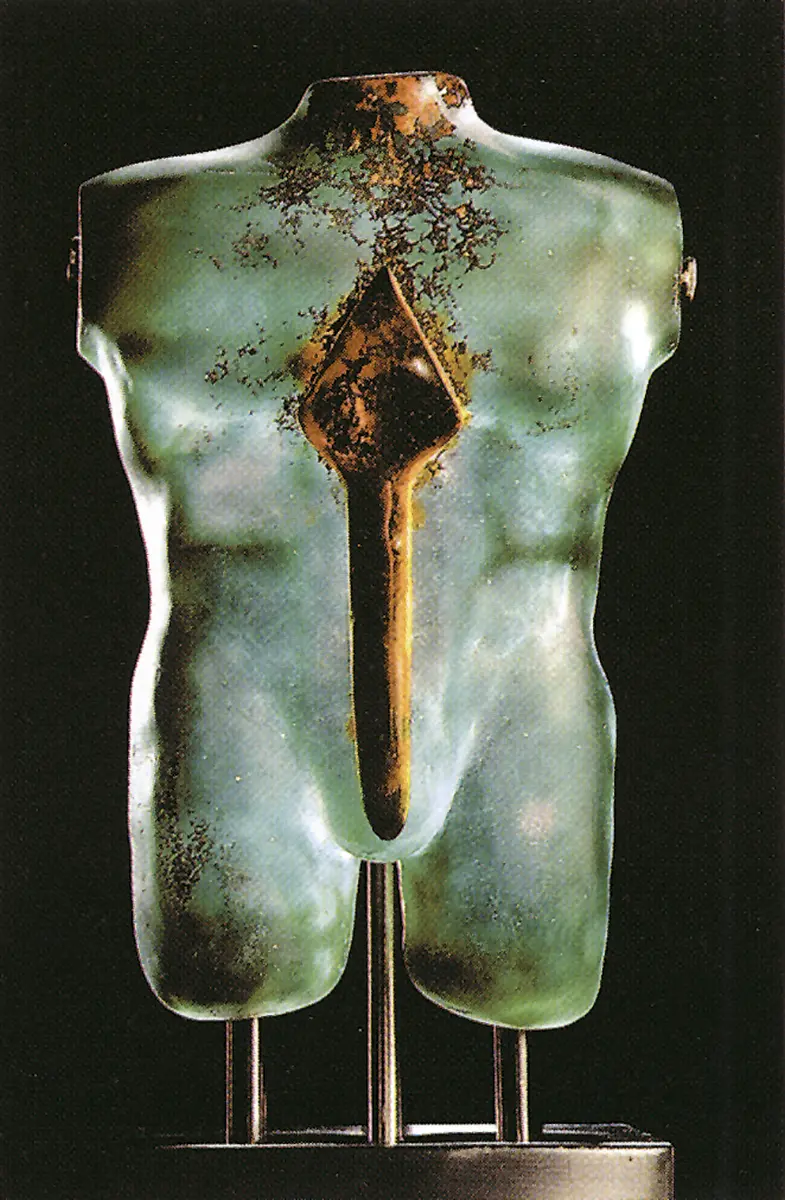
The main exhibition space at Mary-Anne Martin Fine Art was filled out with ten large male torsos. The most massive of these measures 20 x 23 x 5 inches, well beyond the scale of her earlier works. Mounted against the walls, and well-lit from behind with reflected light, the room glowed with a filtered illumination that gave the glass much of its mystical allure. At first glance, it became evident that these larger pieces retain the sophisticated draftsmanship and highly developed sense of color that mark De Obaldía's earlier work. But here, the overall impression was that these sculptures exhibited a more aggressive use of glass as a medium allied with magnified technical skills. To some extent, the work also retains a persistent reference to pre-Columbian sculpture, although in a more understated manner.
When the weight and density of the glass become more explicit, it is inevitable that comparisons will be made to other glass artists who work on a larger scale. The tactile qualities and the evocation of mass manifested in the work of Howard Ben Tré can be seen—or felt—in De Obaldía's most recent work. This clearly sets her apart from artists working with glass in more traditional and abstract modes, such as Dale Chihuly and Harvey Littleton, but she also deviates from Ben Tré's architectural style. A great deal of the distinction of her total body of work lies in the fact that it is figurative. It is difficult to list more than a handful of glass artists, particularly in Latin America who work in a figurative style. Given the malleability of glass and its innate resistance to geometric forms, Obaldía has deftly taken advantage of the fundamentally organic nature of the glass itself.
Torsos further demonstrates the artist's sensitivity to the natural qualities of glass as she evokes its sculptural potential. The works take full advantage of the medium's reflective and luminescent qualities. All of these factors indicate that De Obaldía is becoming even more masterful than before in her handling of the glass, the models and molds she creates, as well as the colors embedded in the individual works. This more confident and self-assured grasp has enhanced the physical properties of the glass, allowing it to take on some of the characteristics of natural crystal. Light is concentrated deep within each work and is transmitted through the surfaces, producing the illusion that these dismembered and disembodied torsos are pliant and alive.
Although the quality of the works in this show is very even, several pieces stood out. Both Torso with Wings and Arrow center the viewer's attention on the heart, and perhaps soul, of the torso. While the latter brings to mind pre-Columbian iconography and contemplation of mortality, Torso with Wings is more meditative, summoning conjectures about the essence of humanity and life after death. Red Armor, the most unabashed reference to Mayan sculpture, stands as a glowing metaphor for man's creation myths and earthbound origins. The least complicated and most iconic sculpture in the exhibition is Saint Sebastian. Suggestive of a fragment of classical sculpture carved from quartz, this representation lacks the more common attributes associated with the saint. While there are no arrows piercing the body, the attitude of the pose suggests a willingness, or resolution to accept martyrdom. Perhaps more than other pieces in the exhibit, Saint Sebastian embodies the subtle properties of glass as an artistic medium when it is handled with great skill and intent.
The objects seen in Torsos seem to be both the result of a logical progression of the concepts seen in De Obaldía's 1997 New York show as well as the stepping-off point for the next period of her production. The control that the artist has achieved over the medium has given her the ability to stretch her imagination and work in dimensions that would not have been possible even in the recent past. Based upon the development of her work from her very successful first exhibition with Mary-Anne Martin to now, the future is very bright for De Obaldía. Collectors of both glass and Latin American art should look forward to De Obaldía's future work with eager anticipation.
NOTE
1. Sullivan, Edward J.. Isabel De Obaldía: Beasts and Men, New York, Mary-Anne Martin Fine Art, 1997, p.10.
CLAYTON KIRKING